CHICAGO — The word revival is often tied to faith, prayer, and spiritual renewal. However, on Chicago’s Far South Side, some residents see a similar effect and describe what’s happening in their neighborhoods as transformational.
Much of the growth is centered in the historic community of Pullman. In its prime, the area produced the Pullman sleeping train car. Today, after decades of deindustrialization and decay, the community is booming again with fresh investment, construction projects, and new businesses moving in.
The orbital effects of progress also extend to nearby neighborhoods like Roseland, where long-vacant lots are being replaced by new homes.
For first-time homeowner Keshanna Pope, the transformation became personal when she purchased her home in early 2026.
“I moved in January 19th at 2 p.m.,” she said with a laugh, recalling the precise moment she received the keys to her new house in Roseland.
With the average first-time homebuyer now over 40 years old, Pope — who’s under 30 — is ahead of the curve. She told CBN News she immediately fell in love while touring the house.
“I was like, ‘Oh my God! It has an island. It comes with everything,'” Pope noted after hunting for homes in her price range for more than a year.
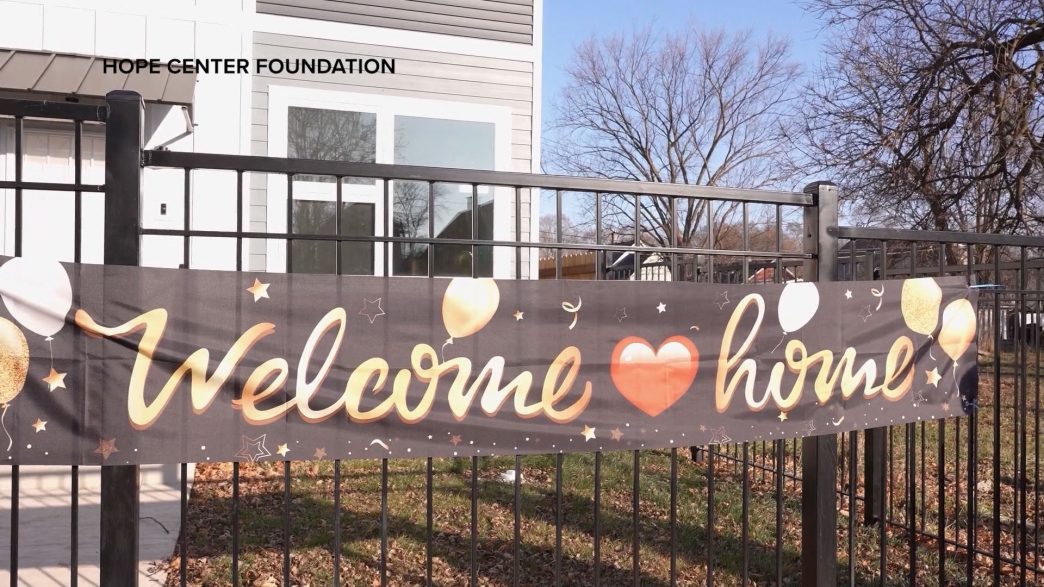
The purchase was made possible, in part, through a program offered by the Hope Center Foundation, a nonprofit organization helping residents access homeownership opportunities, find careers, and build wealth.
The foundation provides qualifying buyers with up to $50,000 in down payment assistance, reducing one of the largest barriers to purchasing a home. That assistance also puts monthly mortgage payments in the same range as rent payments.
Since constructing the first modular home in 2024, the Hope Center Foundation has built multiple houses in Roseland and aims to construct a total of 1,000 single-family affordable homes for low-to-moderate income families.
The Church Behind the Effort
At the center of much of the effort is Salem Baptist Church and its founding pastor, the Reverend James Meeks.
“Our ministry, largely, has been out of the four walls of the church,” Meeks told CBN News. “It’s about a commandment in the commission of Jesus when he said, ‘Let your light so shine before men that they may see your good works and glorify God.'”
After nearly four decades in the pulpit, Meeks stepped down to devote his focus to improving conditions in Chicago’s South Side through the church’s philanthropic arm — the Hope Center Foundation, which Meeks also created.
Beyond his pastoral work, Meeks also served for a decade in the Illinois Senate, after winning as an independent in 2002.
“I’m grateful to God that I never lost that mantle,” he said, recalling how fellow lawmakers addressed him as “pastor” rather than by the courtesy title of senator. “People never saw me as a politician. People only saw me as a pastor.”
“Reaching lost people and souls is where my natural bent and inclination is,” Meeks added, describing his calling whether serving in the Senate or among his South Side neighbors.
Now fully dedicated to the foundation, Meeks is meeting people’s spiritual and practical needs in powerful ways.
The foundation has become a key player in community revitalization efforts, combining faith-based ministry with public-private partnerships.
One of his collaborators is David Doig, president of Chicago Neighborhood Initiatives, a nonprofit development organization that has helped attract more than $1 billion in investments to the area.
“He and I have such a heartbeat and a desire for this community,” the pastor said, describing his professional partnership with David.
“We all have callings. God calls us to do different things,” Doig told CBN News. “You’ve got those people out there shaking the trees. That’s Reverend Meeks. He’s a tree shaker. I’m an applesauce maker. You’ve got to have both.”
Doig, a graduate of Wheaton College, has extensive experience in community development. He oversaw the creation of Chicago’s Millennium Park and the renovation of Soldier Field as the head of the Chicago Park District.
Winds of Change
Together, the duo and others have worked to bring employers, retailers, and investors into neighborhoods that previously struggled to attract major investment.
The redevelopment effort has drawn nationally known businesses to Chicago’s South Side, like Wal-Mart, Amazon, Whole Foods, and the maker of the homecare product line Method.
Among the newest additions to Pullman Gateway, an 8-acre commercial center, is a Chick-fil-A. When it opened in April 2025, it became the company’s first franchise in the South Side.
Owner-operator Elise Mills said the restaurant has created more than 100 jobs and provides educational opportunities for employees.
“All of my team members receive free college that they can go to,” Mills said. “I now have at least six team members who weren’t previously going to go to college, who are now in the middle of their studies.”
These types of investments do more than create jobs. They help create pathways to long-term financial stability and growth, which includes homeownership — still viewed as a powerful tool for building wealth.
Muse said the foundation’s housing efforts help to address longstanding wealth disparities affecting African Americans in Chicago, where white households have a median net worth of $210,000 compared to $0 for Black Chicagoans.
Jessica Caffrey of the Cook County Land Bank Authority told CBN News that affordable housing remains a crucial community need.
“We know the best way to create generational wealth is through property ownership,” she said.
The partnership gives the Hope Center Foundation access to the land bank’s inventory of vacant or tax-delinquent residential property to construct new homes in neighborhoods like Roseland.
“So what this means is 46 vacant lots now have 46 times two or three families in it,” Caffrey added.
More Than a Housing Development
Pastor Meeks, a 40-year South Side resident, believes his decision to plant Salem Baptist Church in Pullman in 2005 helped to kick off the transformation seen today.
“I like to think that none of the change that’s happened here would have happened without our church,” Meeks said, referencing the 10,000-seat building. “Our church was the first group of people to build in this community in about 60 or 70 years.”
But he also recognized the church’s limitations, which is why he started the Hope Center Foundation.
“He knew that the large vision that he had for his people — for this community — was not going to be able to be accomplished through tithes and offerings in his lifetime,” Muse explained. “The goal was to expand the work that the church had done for over 40 years.”
For those involved, the transformation is about something larger than economics.
Doig believes working alongside a church brings deeper meaning and impact. “Working with a church, the starting point is completely different,” he said. “It’s about mission.”
Meeks agrees. “I want people to see what Salem (Baptist Church) is doing outside of the four walls,” the pastor explained. “It is not so people can speak well of Salem. It’s so people can speak well of God.”
“Our motive for doing what we do is so that people can honor God,” Meeks continued.
On the community level or for individuals like Keshanna, this restorative work builds hope and brings new life where others saw blight.