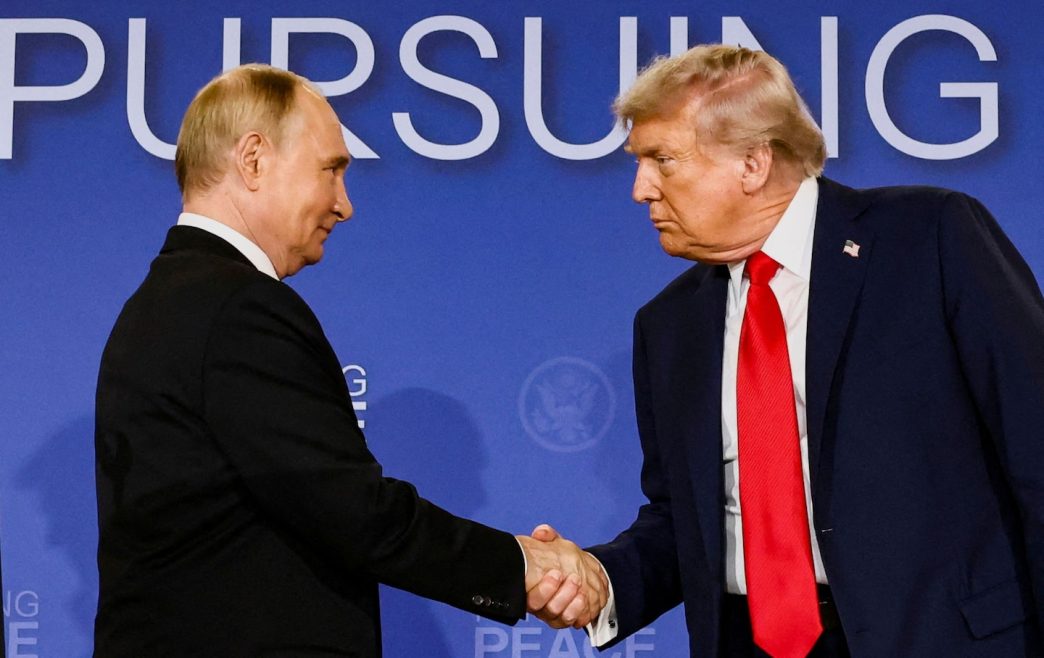
The Kremlin is counting the Trump administration’s latest turn against Ukrainian President Volodymyr Zelensky as a major triumph and, coupled with political upheaval in Europe, a sign that Western support for Ukraine is finally crumbling.
In the 10 days since Vladimir Putin last spoke by telephone with the American president, Donald Trump has announced a sanctions waiver for Russian diesel supplies to the global market, throttled Ukraine’s access to vital battlefield satellite systems, put sweeping new sanctions against Russian on hold, as well as moved even more firmly to Russia’s side by calling for Zelensky’s ouster and holding up supplies of critical interceptor missiles.
Subscribe to The Post Most newsletter for the most important and interesting stories from The Washington Post.
On Monday, Trump blasted the Ukrainian president again, saying it was “time for somebody else to negotiate on behalf of Ukraine.”
The stakes seem higher than ever. Trump’s special envoy Steve Witkoff is set to travel to Oslo on Tuesday to meet Zelensky, Finnish President Alexander Stubb and Norwegian Prime Minister Jonas Gahr Store. Trump’s son-in-law, Jared Kushner, is expected to participate via video link.
“The aim is to put diplomatic efforts on a more constructive path,” Store said.
Zelensky said on Sunday that if Washington aligned with Russia, Ukraine would not survive.
“If the United States will support Putin – it’s unbelievable, it’s a tragedy,” he told NBC News’ “Meet the Press” on Sunday. “If these two countries will be together, of course we will not prevail. And we will not be able to stand.”
While the European leaders and Zelensky might hope to use the Oslo meeting to steer the Trump administration to a tougher stance against Moscow, Kremlin officials have been crowing that victory over Ukraine is on the horizon, and that Trump’s recent moves are steps toward an ever-closer alignment between Washington and Moscow.
Trump’s recent ratcheting-up of pressure on Zelensky could mean the U.S. president is again seeking to strong-arm the Ukrainian leader into a deal on terms favorable to Moscow.
Kremlin spokesman Dmitry Peskov said Tuesday that Witkoff is expected to brief Putin following the Oslo talks.
Earlier, Peskov said Ukraine’s recent resumption of strikes on Russian oil refineries – in defiance of Trump’s demands – showed Zelensky’s administration in its death throes.
“Some final signs of agony are being observed,” Peskov said. “The Kyiv regime is resisting. But this cannot change the course of events.”
“Checkmate,” Kremlin special envoy Kirill Dmitriev posted triumphantly.
In Moscow, members of the Russian elite said that Putin, a former KGB officer, once again managed to turn the U.S. president.
Putin has decades of experience charming and manipulating foreign leaders, and has demonstrated a consistent ability to flatter Trump and pull him on side, analysts and officials said.
This time, they said, the Russian leader preyed on Trump’s fears over low approval ratings and sky-high energy prices ahead of the U.S. midterm elections, offering a deal on Russian diesel fuel that will supply just a fraction of America’s daily consumption and have no impact on prices.
On Friday, the average U.S. diesel price continued to climb to $6.33 per gallon, an increase of about 5 cents per gallon from the previous week.
“Russia’s leaders have achieved a certain political victory,” said a Russian academic close to senior Russian diplomats, who spoke on the condition of anonymity to discuss sensitive diplomacy. “All this happened after their telephone call. Probably Putin was able to convince Trump.”
Putin, the academic added, “probably conducted this conversation very professionally and prepared his arguments well.”
Mikhail Khodorkovsky, once Russia’s richest man and now an opposition leader in exile, said recent events followed a pattern in Putin’s relations with Trump.
“I am absolutely convinced that they believe that they managed to take advantage, as they always do; they are opportunists,” Khodorkovsky said. “In this case, they believe they have waited for the moment of Trump’s additional weakness and [taken] advantage of it.”
“For Putin, everything that is happening today are signs of the West’s weakness,” he said.
Dmitriev, the special envoy, and other Russian officials hailed the diesel deal and Trump’s waiving of tough sanctions that were to be imposed under a bill adopted in honor of the late Sen. Lindsey Graham, a firm GOP supporter of Ukraine, as steps toward broader Russia-U.S. economic cooperation.
Historically, Russia and the U.S. have never been big economic partners, with Russia exporting little of interest to the U.S. market.
“There is a whole range of economic and investment projects being discussed with the American side that will be implemented,” Dmitriev told a Russian energy forum last week. “Our list of projects being discussed with the American side also includes various projects in the Arctic, energy projects, LNG [liquefied natural gas] projects and other areas.”
“More and more Americans, including within the administration, understand that sanctions harm the United States itself,” he added.
In July – after years of Putin refusing to drop his maximalist demands in Ukraine – Trump finally seemed to side with Zelensky, telling reporters he was doing “an amazing job” and even backing Ukraine’s deep strikes on Russian oil refineries.
“It’s an escalation, but it’s also an escalation that can help lead to an end” of the war, Trump said.
But as the U.S. conflict with Iran dragged on, keeping upward pressure on global oil prices, and as the midterm elections drew ever nearer, the Trump administration suddenly turned again.
After an Aug. 31 meeting with Russian Finance Minister Anton Siluanov at a Group of 20 event in Asheville, North Carolina, Treasury Secretary Scott Bessent blamed Ukraine’s strikes on Russian oil refineries as the reason for surging fuel prices – rather than the war in Iran.
It was then easy for Putin to recruit Trump into sharing that viewpoint, some observers said.
“The simplest explanation is that Trump was simply interested in having a talking point for the midterms on diesel, that he has a deal to lower it, said Daniel Fried, a former assistant secretary of state for Europe during George W. Bush’s administration.
“I think it is just Trump lashing out because he’s feeling cornered and unhappy with the midterms, and Zelensky stood in his way,” Fried said, especially after Zelensky publicly derided Trump as “weak” after he announced the diesel deal.
“Trump then extended his frustration to add pressure and try to force a settlement based on a great power deal with Putin, who is skilled at playing his more gullible interlocutors,” he said.
That Trump and Putin share a view that strongmen should dominate a world divided into spheres of influence made it even easier for Putin, Fried added. “Trump appears to have been attracted to this view for decades,” he said. “And therefore, Ukraine is expendable on strategic grounds, in Trump’s view, and it was standing in the way of a perfectly good campaign talking point.”
Trump’s latest swing toward Putin was hardly surprising, said a former senior U.S. intelligence official.
“It almost doesn’t matter what he says, because Trump just seems like he’s very eager. He’s a very receptive audience,” the former intelligence official said, speaking on the condition of anonymity to discuss sensitive matters.
“If you look at the longer-term trends, he has clearly a preference for Putin over Zelensky, and that transcends any kind of temporary relaxation of the tensions that he has with Zelensky.”
“He likes strong authoritarian leaders,” the official said. “And deep down, there is this underlying belief on his part that Ukraine cannot win this war, that Russia is bigger, Russia is stronger, Russia is going to crush Ukraine if that’s what it takes.”
Signs point to Trump seeking to strong-arm Ukraine into a deal by December, when Trump has invited Putin to join him at the G-20 leaders’ summit in Miami, said Andrew Weiss, a Russian expert at the Carnegie Endowment for International Peace in Washington.
“The only way I can explain it is that it’s connected to the milestones leading up to the meeting of the G-20 in December,” Weiss said. “I feel like what’s going on here is not really about diesel or refinery long-range strikes. It’s really about Trump thinking that he can push the Ukrainians into some sort of political settlement.”
The Russians have “tried to use the administration as a battering ram to get the Ukrainians to surrender Donbas,” Weiss said, referring to the swath of eastern Ukraine coveted by Putin.
“But then that only opens up a subsequent conversation about constraints on Ukrainian military capabilities,” he added, or other underlying Russian demands. “The administration has repeatedly misdiagnosed what the Russians want, and the Russians don’t make that easy because they don’t say exactly what they want.”
Related Content
This article originally appeared on Washington Post at