
Heads, hands and other human remains are advertised on Facebook and Instagram at competitive prices. These are mummified pieces from centuries ago that are offered as second-hand objects. However, what appears to be a horrifying extravagance hides an international business that investigators have been following for years. And they’ve found something more disturbing than an Egyptian curse: potentially dangerous mushrooms, toxins, and human remains that travel through the mail to their buyers’ homes.
Mummy at the click of a button. A study titled The Real Mummy’s Curse, published in the International Journal of Cultural Property and led by bioarchaeologist Kirsty Squire of Staffordshire University, documented 128 advertisements for mummified remains between 2015 and 2025. Limbs and spine to complete the human head.
In the United States, for example, a head advertised as belonging to an ancient Egyptian mummy fetched $115,000 about a decade ago. The work describes an international marketplace that takes advantage of anonymity, control gaps, and deliberately ambiguous expressions to avoid platform restrictions.

The curse was biological. The New York Times reported over the weekend that the most alarming discovery has nothing to do with the pharaohs, but with what may have grown on their remains. According to Squires, many of the advertisements contained visible mold stains and bacterial colonies, including cotton structures that the sellers apparently did not consider dangerous.
Researchers warn that certain fungi, including Aspergillus species, can produce resistant spores that are able to remain viable for long periods of time. Changes in humidity during storage or transportation can encourage their spread, exposing sellers, postal workers and buyers to possible respiratory problems and other complications.
A package with centennial toxicity. Fungus isn’t the only concern. Some mummified remains, funerary objects, and pieces of ancient taxidermy may contain residues of hazardous substances such as arsenic, mercury, or lead, which are used in some historic preservation treatments. Direct contact, dust or unprotected handling can become exposure routes, especially when the origin and storage conditions of the material are unknown.
Squires notes that some vendors even post pictures of them holding the remains with their bare hands and without masks. The investigation thus raises a problem that transcends collection: potentially contaminated pieces are transported via conventional courier services without warning that they will require special evaluation.
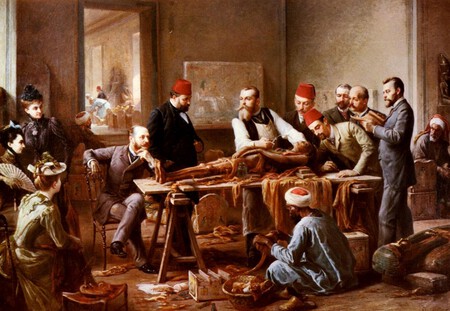
Egypt was already selling mummies on the Internet. Yes, the ancient corpse trade has a much longer history than social media. In the 19th century, European fascination with Egypt fueled a market where mummies were sold as travel souvenirs and collectibles. In cities such as Cairo and Luxor, traders offered whole corpses, sarcophagi, and human fragments, while heads and hands were particularly practical for travelers who needed transportation to Europe.
In 1830, the French theologian Ferdinand de Garombe even joked about the custom of returning from Egypt carrying a mummy and a crocodile. The obsession reached the salons of Victorian high society, where meetings were held to open mummies for guests, turning human remains into personal spectacles.
Tutankhamun’s curse had another explanation. The idea that Egyptian tombs punished those who desecrated them became popular after the death of Lord Carnarvon in 1923, just five months after attending the unveiling of Tutankhamun’s tomb. The British aristocrat died after contracting an infection from a mosquito bite, but the press turned his death into an alleged revenge by the pharaoh.
In 2003, two doctors suggested in The Lancet that he had breathed in Aspergillus flavus spores present in the tomb, although this hypothesis has never been proven. Another episode fueled the myth in Poland: after opening the tomb of King Casimir IV in 1973, several participants died in the following years and the same fungus was detected in the tomb. However, it was not proven that these deaths were caused by the spores.
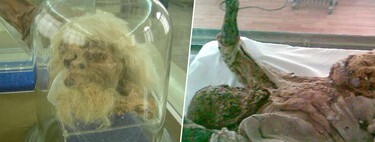
Danger travels. The original study, published on August 5, 2026, provided particularly revealing statistics: of the 128 records analyzed, 122 corresponded to human remains and six to animals, 66 contained heads in various states of preservation, and only one showed a complete human body. The researchers identified 13 Facebook posts with potentially visible fungal colonies, although they did not conduct microbiological tests to confirm the danger of each piece.
However, they also found that some sellers offered international shipping despite postal restrictions on human remains. The problem, therefore, is not a supernatural curse or a proven epidemic, but a poorly regulated trade that combines health risks, damage to archaeological heritage and the commodification of people who died centuries ago.
Picture | PS, Paul Dominique Philippoteaux
In Xataka | The oldest mummy on the planet was where no one was looking. A 12,000-year-old find in Southeast Asia has rewritten its own origins
In Xataka | The fact that Christian Friedrich von Kahlbutt died in 1702 is not exceptional. That his corpse did not rot, yes