
There’s been a lot of talk about neoclouds these days, but in recent hours, the conversation has grown with the slap that AI-related companies have received. The reason is that, on the same day that the Nasdaq closed with alarming numbers, Bloomberg reported that Microsoft, one of NeoCloud’s main clients, is beginning to lose confidence and is reviewing several projects with a magnifying glass.
And the market, which was already nervous, responded with terror.
In short. First, Microsoft hasn’t opened up about this in recent hours. It all comes from a Bloomberg report that basically demonstrates how the stock market works. Following media reports, it was seen that Neoclouds closed on November 5 with a drop between 10% and 17%.
According to the media, and citing people familiar with the matter, it seems that Microsoft is taking precautions and moving away from projects that some consider risky from neoclouds such as Nebius, IREN and Nscale. It will debate internally to sign contracts with new neoclouds as they prefer to focus on expanding their own data centers.

policy. The reason is unclear, but the hit came on a day of massive selling. The Nasdaq was down 5.52%, the S&P500 was down 4.3% and the Dow Jones was down 3.44%. The biggest shock was taken by some important companies in the AI and chip sectors besides Neocloud, but big tech companies that are hyperscalers like Microsoft, Alphabet or Amazon also fell far short of those Neoclouds.
He was quick to point out a political motive. With Democrats winning both chambers of Congress in the Nov. 3 election, investors fear more oversight and local restrictions on data centers. Estimates suggest that about 30% of the excess capacity planned for 2028 on US soil will be at risk, and ultimately, we already know how this market works and how investors panic about certain movements.
Neoclouds. But hey, we’ve talked about hyperscaler and neocloud and, even though it’s a topic we’ve already covered, let’s get back to it. Hyperscalers are those who control huge clouds through their own data centers. Amazon, Google or Microsoft are three examples. Neoclouds, on the other hand, emerged to deploy data centers at speeds that these hyperscalers could not afford, then rent their computing power to large companies for artificial intelligence.
They bought equipment like Nvidia cards at full speed, and Microsoft was one of the clients that promoted the sector the most, signing billion-dollar deals. It rents power to these companies to fill a curious computing gap that they have in one of the largest clouds on the planet, resulting in a lot of growth in a very short time.
CoreWeave or Nscale are two such examples, but the other side of the coin is that there are voices within the business that see this as temporary. Now, big clients outsource because of the lack of speed, but when they have it, they will leave NeoCloud. Gartner predicts that, by the end of the decade, 80% of these companies may merge or close, and Elon Musk is in somewhat of a similar situation. A stark contrast to Jensen Huang who has so far been keen to keep the wheel turning.
the slap make noise. The NeoCloud segment has grown 82% annually over the past four years, very quickly and very little organically, and last night we saw the results. The November 5 coup centered on four:
- CoreWave – It fell 57.6% between May 8 and November 4, with debt of more than $51.6 billion, more than triple from a year ago. At yesterday’s close, it was down 9.83%.
- Nebius – By the end of November 5, the drop was 14% and, according to Bloomberg, Microsoft is watching it closely because it has already been fined a million dollars for operating generators without a permit at a project in New Jersey.
- IREN – Before mining cryptocurrency, but turned to AI in 2023 and delayed some deliveries for Microsoft for a while. It decreased by 17%.
- Nscale – Microsoft had an option to double its contract on a Texas data center, but withdrew weeks ago due to grid connection delays.
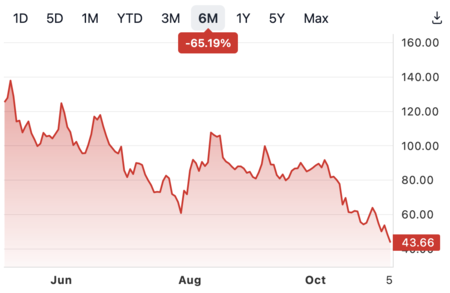
Last six months of Corewave
“flexibility”. Corewave doesn’t have the most notable decline, but it’s a case that’s heavily exposed to debt. In the second quarter they earned 112.5% more than a year ago, but another reading is that they have negative cash flow of $13.66 billion which they cover by going forward: including debt and new shares.
And, as I said earlier, Microsoft has not confirmed a recall, but a spokesperson told Reuters they will manage the infrastructure with flexibility. Its vision will focus on consolidating its own data centers, leasing facilities and partnering with third parties to reliably bring capacity to the table. Also, as they point out in Briefs Finance, they comment on the fact that plans change and adapt to circumstances, something common in such massive projects.
Now, in the background is the “threat” of Amy Hood, the company’s finance director. In its last earnings presentation, it said third-party capacity has arrived late, disrupting its spending plans. As Bloomberg points out, this is the third time he’s warned that in one of those calls, and Hood chairs a weekly power meeting that reviews whether the neocloud timeline is credible.

Paniquito. Now, as I mentioned, the market is still responding as it usually does because Microsoft added more than $200 billion in new data center lease commitments this past year and more than $80 billion in new cloud commitments. In fact, he will deviate from a small part of his commitment to Nscale.
But hey, it’s undeniable that something has changed in the sector and the caveat is clear: what happens in the US will affect everyone. In China we have already said that there was a lot of volatility recently, but this was still the case of a very specific “puncture” in a very young market. However, what happened last night has a contagion effect on the European and South Korean markets because we remember that in Europe there is ASML, which is in charge of building the most modern machines for manufacturing semiconductors, and in South Korea we find SK Hynix and Samsung, which do not need any role at this moment of the material crisis.
We’ll have to wait and see how this develops, but the obvious thing is that no more than one and two are going to have a good weekend when nearly $2.5 trillion has evaporated at once.
Picture | Screenshot of ‘The Big Short’
In Xataka | If you’re hoping for the AI bubble to burst, Jensen Huang has something to say: “This time it’s different.”