Russia and China, two of Iran’s strongest diplomatic allies, have called the war imposed on Tehran by the United States and Israel a gross violation of international law. More than 1,000 people have been killed in the ongoing conflict.
Russian President Vladimir Putin has described the assassination of Iran’s Supreme Leader Ayatollah Ali Khamenei on Saturday as a “cruel violation of all norms of human morality.”
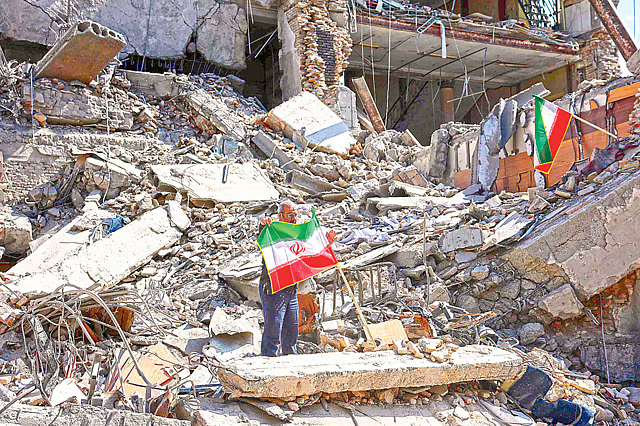
The US and Israeli airstrikes left only ruins all around. In the meantime, a man holds the Iranian national flag. Yesterday in central TehranPhoto: AFP
Chinese Foreign Minister Wang Yi, speaking with Israeli Foreign Minister Gideon Sarer, said that force can never truly resolve problems, and urged all parties to avoid tension.
Russia and China have also jointly requested an emergency meeting of the UN Security Council.
Russia-Iran: Strategic partners, not military allies
In January 2025, Russia and Iran signed a comprehensive ‘Strategic Partnership Agreement’. It covered a range of issues, from trade and military cooperation to science, culture and education.
The agreement deepens defense and intelligence exchanges between the two countries, as well as projects such as the construction of a transport corridor connecting Russia to the Gulf region through Iran.
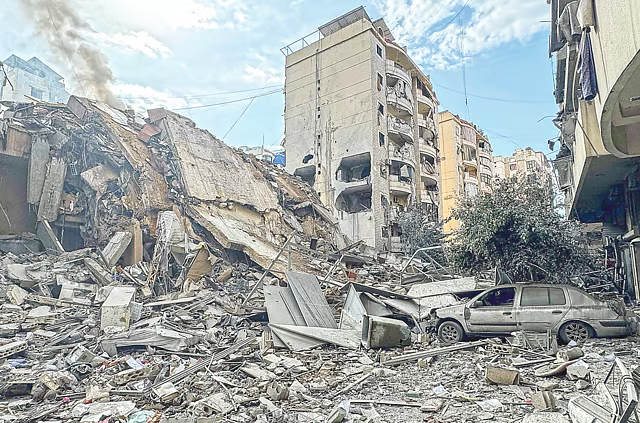
Buildings destroyed by Israeli airstrikes in Beirut, Lebanon yesterday. AFPBuildings destroyed by Israeli airstrikes in Beirut, Lebanon yesterday.AFP
These reactions are largely a reflection of the close ties between Iran, Russia and China. Moscow and Beijing have already signed bilateral agreements and increased coordination through joint naval exercises, essentially sending a message of unity against the US-dominated world order, which has long sought to isolate these countries.
However, despite strong condemnation from Russia and China, neither country has so far indicated any direct military intervention on Iran’s behalf.
Even in late February, just a week before the United States and Israel attacked Iran, the two countries held joint military exercises in the Indian Ocean.
However, Moscow was not legally obligated to take direct military action after the US and Israeli aggression against Iran began, because the agreement did not include any ‘mutual defense clause’ or provision for standing by each other in time of war, meaning it was not a formal military alliance.
Andrei Kortunov, a member of the Russian think tank Valdai Discussion Club, told Al Jazeera in a video call from Moscow that the defense agreement Russia signed with North Korea in 2024 was much stronger.
Kortunov said that under the agreement, Russia is obligated to assist North Korea if it engages in war. But in the case of Iran, the agreement only states that if one side engages in war, the other side will refrain from any hostile actions.
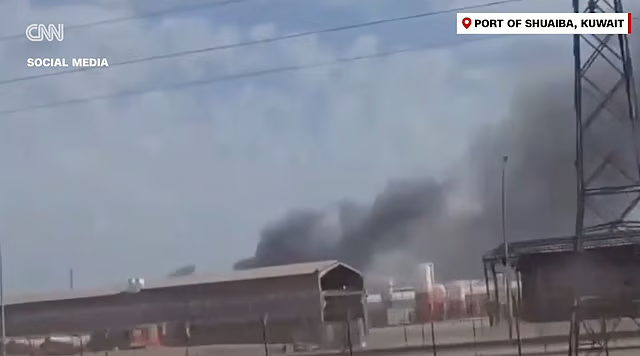
Black smoke rises after Iran attacks a temporary US operations center in the port of Shuaiba, Kuwait, killing six US service members.Photo: Taken from CNN video
Kortunov believes that Russia will not risk going to war directly on behalf of Iran. The reason, he said, is that Moscow is now placing more importance on US mediation in resolving the Ukraine crisis. Earlier, after the US attack on Venezuela in January, Russia only condemned it, but did not take any direct action.
Although the agreement does not oblige Russia to intervene, there has been some frustration among policymakers in Tehran.
Kortunov said Tehran hoped that Russia might do something more effective beyond diplomatic action at the UN Security Council.
Restrictions on China-Iran
In 2021, China and Iran signed a 25-year cooperation agreement. Its aim was to increase ties in the energy sector and include Iran in China’s ‘Belt and Road’ project.
Jody Wen, a fellow at the Center for International Security and Strategy (CISS) at Tsinghua University in China, told Al Jazeera that Beijing sees this relationship as very pragmatic and stable.
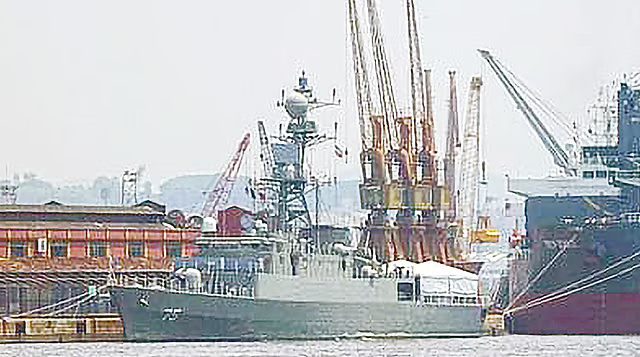
Iranian warship IRIS DenaFile photo: Reuters
“Politically, we have regular contacts and economically, the cooperation is very deep. Many Chinese companies have invested in Iran,” Wen said by phone from Beijing.
However, Wen stressed that Beijing has drawn clear boundaries in this partnership, especially regarding military intervention.
“The Chinese government has always adhered to the policy of non-interference in the internal affairs of others. I don’t think China will send any weapons to Iran,” said Jody Wen.
Instead, Beijing will focus on diplomacy and crisis resolution. He believes that China is trying to negotiate with the United States and Gulf countries to keep the situation calm.
However, the fellow also points out that this relationship is not balanced. According to data, about 87.2 percent of Iran’s annual crude oil exports go to China. This makes it clear how important China is economically for Tehran. Yet Iran is only a small partner in China’s global trade.
Dylan Loh, an associate professor at Nanyang Technological University in Singapore, told Al Jazeera that China’s role in Iran has now become more “protective”. China wants to avoid regional catastrophe through rapid mediation, which will protect its own economic and security interests.
Loh said there has been a re-thinking of how to mitigate political risk and what options are available. In fact, Beijing began this re-evaluation after the US attack on Venezuela.
