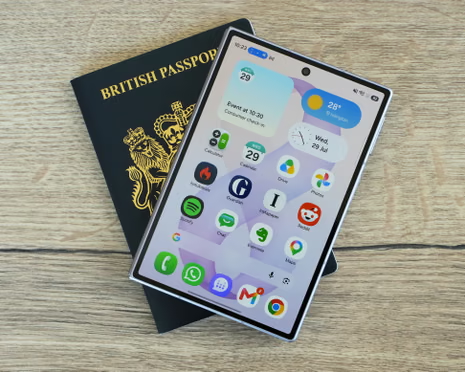
The Galaxy Z Fold 8 is one of the most capable foldable phones Samsung has ever made — and it surprised me. I went in skeptical. Its shorter, wider form factor is unlike any foldable Samsung has previously sold in the US, and my main concern was whether this design would actually hold up in everyday use. It did. Better than I expected.
The Fold 8 proved so competent as a conventional phone that, after getting used to it, traditional smartphones started to feel too tall and narrow. When I need more space, I open the 7.6-inch screen. It’s a phone I’d buy without hesitation — despite the missing telephoto camera and the still-high price.
Galaxy Z Fold 8: Pros and Cons
|
Pros |
Cons |
|---|---|
|
Extremely comfortable shape |
No telephoto/zoom lens |
|
Functions as both a phone and a mini tablet |
Not compatible with S Pen |
|
Two high-quality screens |
Digital zoom loses significant detail |
|
Excellent performance |
High price |
|
Outstanding battery life |
|
|
Multitasking well implemented |
Galaxy Z Fold 8 Review Scores
|
Category |
Score |
|---|---|
|
Design and build quality |
5/5 |
|
Screens |
5/5 |
|
Performance |
5/5 |
|
Cameras |
3.5/5 |
|
Battery |
5/5 |
|
Software and features |
5/5 |
|
Value for money |
3.5/5 |
|
Overall |
4.5/5 |
Who Is the Galaxy Z Fold 8 For?
The Galaxy Z Fold 8 is primarily for people who want a hybrid between a phone and a tablet — without carrying two devices. When closed, it works as a regular smartphone. When open, it becomes a pocket-sized tablet for videos, reading, studying, gaming, or work.
That’s exactly my use case. I use my phone constantly, but occasionally need a larger screen. With the Fold 8, you simply open the device instead of swapping between a phone and a separate tablet.
That said, it may frustrate anyone who needs a large screen all the time. In that case, a standard flagship like the Galaxy S26 Ultra is more practical.
What Are the Main Advantages of the Galaxy Z Fold 8?
The Galaxy Z Fold 8’s biggest advantage is that it works genuinely well as both a compact phone and a mini tablet.
When closed, it has a 5.5-inch external screen, a shorter and wider body, and weighs 201 grams (about 7.1 oz). When open, it offers a 7.6-inch panel. This design exceeded my expectations — I do practically everything on the external screen and only open the device when I truly want more space.
Comfort is another standout. The Fold 8 is easy to hold with one hand, and its weight and thickness don’t feel awkward in a pocket.
Galaxy Z Fold 8 vs. Galaxy S26 Ultra: Which Should You Buy?
The short answer: It depends on how you use your phone.
The Galaxy Z Fold 8 is better suited for people who occasionally need a tablet-like experience but want a compact device the rest of the time. The Fold 8 lets you work, watch videos, or run two apps side by side — then close it back into a pocket-friendly phone.
The Galaxy S26 Ultra, on the other hand, is better for those who prioritize cameras, need an S Pen, or want a large screen at all times. It features a 200 MP main camera and two telephoto lenses, making it the stronger choice for photography enthusiasts.
Personally, I’d choose the Fold 8. Having a larger screen available whenever I need it outweighs the camera advantages of the S26 Ultra for my workflow. The one thing I miss is a stylus for occasional video editing.
Does the Galaxy Z Fold 8 Have an S Pen?
No. The Galaxy Z Fold 8 is not compatible with the S Pen.
This is a notable drawback for a device that doubles as a mini tablet. Reading, studying, and working function very well, but handwriting and stylus-based editing aren’t possible. If S Pen support is important to you, the Motorola Razr Fold has an edge here — it supports the Moto Pen Ultra.
Galaxy Z Fold 8 vs. Galaxy Z Fold 8 Ultra: Which Is Better?
The Galaxy Z Fold 8 Ultra is the more fully featured device, but the Galaxy Z Fold 8 is the better everyday phone for most people.
The Fold 8 is smaller and lighter at 201 grams, with 5.5-inch and 7.6-inch screens. Its shorter, wider form factor is more comfortable to hold, and the internal screen’s aspect ratio feels more natural for most content.
The Fold 8 Ultra is closer in size to a conventional large smartphone, with 6.5-inch and 8-inch screens and a more advanced camera system — including a 200 MP main sensor and a 3x telephoto lens.
- Choose the Fold 8 for portability, comfort, and everyday use.
- Choose the Fold 8 Ultra for power users who prioritize cameras and a larger canvas.
For anyone upgrading from the Fold 7, the decision is less obvious. The battery life and form factor have improved, but the upgrade makes most sense if the new proportions are a meaningful differentiator for you.
How Durable Is the Galaxy Z Fold 8?
The Galaxy Z Fold 8 is well-built, though the inner screen still requires more care than a standard display.
Samsung uses Armor Aluminum in the frame, Gorilla Glass Ceramic 3 on the front, Gorilla Glass Victus 2 on the back, and titanium layers beneath the flexible screen. The device also carries IP48 certification. According to Samsung, the Fold 8 was tested through the equivalent of up to 200,000 opening and closing cycles, plus more than 100 evaluations involving drops, pressure, humidity, and debris.
During my time with the device, build quality inspired genuine confidence. The hinge stays firm and opens and closes more smoothly than on the previous generation. Neither screen picked up scratches or marks throughout my testing period.
The inner display is more susceptible to scratches than a conventional screen, but it doesn’t feel fragile. It comes with a pre-installed screen protector that should not be removed — Samsung does offer an official replacement if needed.
Does the Crease on the Galaxy Z Fold 8 Screen Bother You?
No — the crease is subtle enough that it rarely registers during normal use.
Visually, it nearly disappears when content is on screen. Running a finger across the center, you can feel a faint indentation, but it’s not distracting. It’s the kind of detail you only notice when you’re actively looking for it.
That said, some users of earlier Samsung foldables have found the crease becomes more visible over time. To address this, Samsung has incorporated a titanium plate within the display layers to keep the fold more stable. Whether this fully prevents the crease from worsening long-term remains to be seen.
Is the 5.5-Inch External Screen Too Small?
No. 5.5 inches is sufficient for nearly everything most people do on a phone day-to-day.
Messaging, social media, browsing, and YouTube all work well on the external display. There were very few moments when I needed to open the device simply because the outer screen wasn’t large enough.
Image quality on both screens is excellent. Brightness holds up in direct sunlight, and there’s no meaningful difference in visual quality between the two panels. Both use Dynamic AMOLED 2X technology with refresh rates up to 120 Hz.
Is the Galaxy Z Fold 8 Comfortable to Hold?
Yes — comfort is, for me, the single best feature of the Galaxy Z Fold 8.
Closed, it measures 9.7 mm thick and weighs 201 grams. The shorter profile makes it easy to hold with one hand without resting your pinky finger underneath to stabilize it — something tall flagships often require.
After using the Fold 8 for a while, conventional phones started to feel unnecessarily tall and narrow.
I used the Fold 8 both with and without a case. Samsung’s official protective case barely changes the ergonomics and actually improves grip, since the bare back is quite smooth.
Does the Galaxy Z Fold 8 Replace a Tablet?
Yes — as long as you think of it as a mini tablet, not a full-size one.
Reading, studying, watching movies, working, and running multiple apps simultaneously all work well on the 7.6-inch screen. For tasks I’d normally reach for a tablet during a commute or a flight, the Fold 8 handles them comfortably.
Opening the screen becomes second nature quickly. It’s simpler than putting your phone away and pulling out a separate tablet.
The main limitation remains the lack of S Pen support. For stylus-based writing or detailed annotation work, you’d still need another device.
How Does Multitasking Work on the Galaxy Z Fold 8?
Multitasking is one of the strongest reasons to open the internal screen — and it works very well.
My most common setup was two apps side by side: keeping a WhatsApp conversation open while watching videos on TikTok or Instagram, for example. I also used the larger screen to get ahead on writing while commuting.
The transition between the two screens is seamless, and the system lets you configure what happens to an open app when you fold the device.
Do Apps Work Well on the Galaxy Z Fold 8?
In the vast majority of cases, yes. During testing, only one app — Gringo, used to check vehicle documents and outstanding issues — displayed clear adaptation problems, failing to properly use the different screen format.
Outside of that, I encountered no significant compatibility issues.
Typing does require some adjustment when the device is open. I prefer typing on the external screen, since the split keyboard on the internal screen places the two halves further apart. That said, this improves noticeably as you get used to the format.
Is the Galaxy Z Fold 8 Good for Gaming?
Yes. The Galaxy Z Fold 8 is an excellent gaming device.
On the external screen, the smaller footprint works well for quick sessions — Pokémon Go being a good example. The internal screen shines for more immersive titles like Genshin Impact.
The Snapdragon 8 Elite Gen 5 for Galaxy delivers more than enough processing power. I noticed no performance drops even during extended sessions. The device does warm up under heavy load, but no more than what you’d expect from any high-end flagship.
Are the Cameras on the Galaxy Z Fold 8 Any Good?
Yes — but the missing telephoto lens is the most significant weakness of the Galaxy Z Fold 8 camera system.
The main and ultrawide 50 MP cameras deliver excellent sharpness, accurate colors, and very similar quality to each other. Night mode brightens low-light scenes naturally without an artificial look. Portrait mode produces good subject separation, and video stabilization holds up well while walking.
The issue is zoom. Without a dedicated telephoto lens, digital zoom loses considerable detail — a real limitation for a device at this price point. This is what drives the 3.5/5 camera score.
For anyone who prioritizes photography, the Galaxy S26 Ultra remains the stronger choice.
How Long Does the Galaxy Z Fold 8 Battery Last?
The Galaxy Z Fold 8 easily lasts a full day of use — and then some.
On one of my heaviest days, I reached approximately 6 hours and 50 minutes of screen-on time and still had 13% battery remaining at the end of the day. During lighter use, the phone went over 34 hours without needing a charge.
In Canaltech’s standardized test, the Fold 8 consumed 20% of its battery over four hours of YouTube video playback — a result on par with both the Galaxy S26 Ultra and the iPhone 17 Pro.
A full recharge took approximately 1 hour and 10 minutes. Plugging in for just 15 minutes recovered around 30%. The device supports charging up to 45W, which proved more than sufficient for daily use.
Is the Fingerprint Reader on the Galaxy Z Fold 8 Reliable?
Yes. The side-mounted fingerprint reader is extremely fast and well-positioned.
If anything, it’s occasionally too fast — on a few occasions, the device unlocked accidentally while I was putting it in my pocket because a finger briefly grazed the sensor. It’s not a serious issue, but it does show just how instantaneous the recognition is.
Galaxy Z Fold 8 Release Date and Availability
The Galaxy Z Fold 8 was unveiled on July 22, 2026, with pre-orders in the US beginning on August 6. First deliveries arrived on August 21st.
In the US, Samsung offers two storage configurations: 256 GB and 512 GB, both with 12 GB of RAM.
What Is the Price of the Galaxy Z Fold 8?
The Galaxy Z Fold 8 has a suggested retail price of approximately $1,099 for the 256 GB version and $1,219 for the 512 GB version. Discounted pricing has appeared closer to $989 for the base model.
At its full retail price, I still consider it expensive — particularly given the absent telephoto camera. In my view, the price-to-value proposition becomes more compelling in the $700–$800 range, where the unique format, mini-tablet capability, and top-tier performance better justify the spend.