
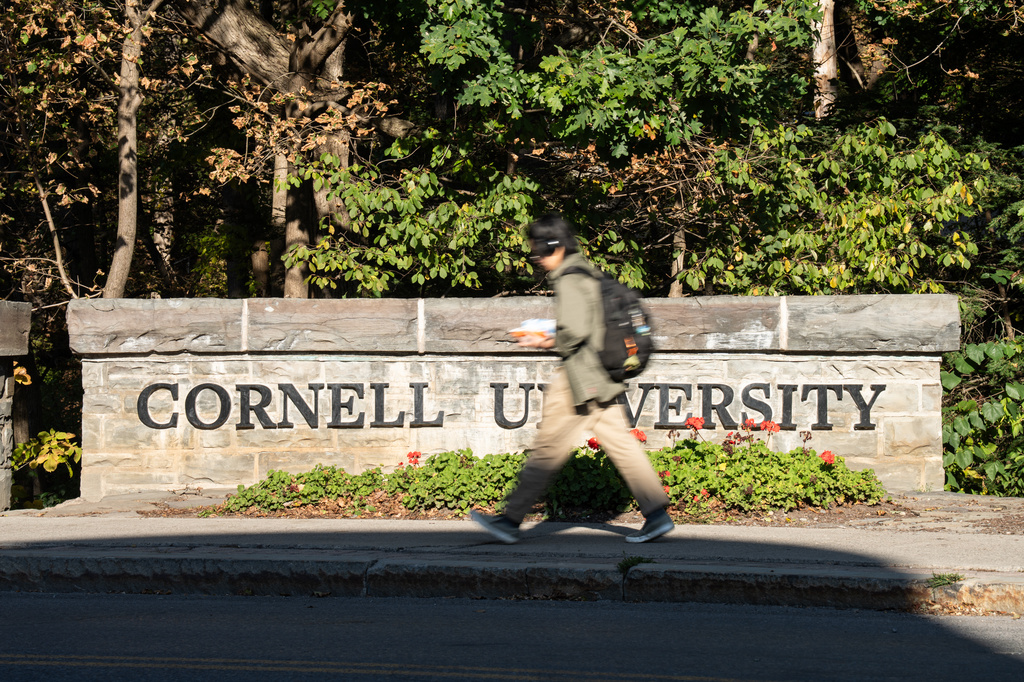
After weeks of protests over allegations of sexual assault at Cornell University, school officials are promising changes, including a ban on fraternity parties for the remainder of the academic year.
In an Oct. 13 statement, President Michael I. Kotlikoff said the changes will also include additional staffing to the Cornell Office of Civil Rights and “the appointment of a dedicated Case Manager who will help individuals who report sexual misconduct.”
A new CNN investigation found that Cornell expelled just two of 16 students found guilty of sexual assault since the mid-2000s.
Kotlikoff, whose leadership has come under scrutiny for his handling of recent allegations, also reflected on the “deeply disturbing prevalence of alcohol and drug abuse” as they outlined immediate measures to address concerns on campus.
The Dangers of Illicit Drugs
In addition to sexual assault, the incident has renewed attention to the dangers of drugs such as ketamine and emerging synthetic substances.
The woman at the center of the Cornell case, identified as Jane Doe, alleges she was forced to take ketamine before being sexually assaulted.
Ketamine is a powerful anesthetic. It has also been used in clinical settings for depression, including in certain treatment-resistant cases.
But drugs sold illegally as ketamine may contain entirely different substances, making their effects difficult to predict.
According to Canberra Alliance for Harm Minimisation and Advocacy, only 57% of 81 samples expected to contain ketamine and tested by Australia’s CanTEST drug-checking service actually contained ketamine as of April 2023.
Zachary Stansbury, harm reduction program manager for Montgomery County Behavioral Health and Crisis Services in Maryland, said illegal drug use removes important safeguards.
“The danger of street use is that it removes those safeguards that exist within that controlled setting,” Stansbury said. “So you don’t know the dose, you don’t know if it’s actually ketamine. You might not have somebody watching over you.”
Ketamine misuse can lead to dependence and serious health complications, including bladder problems associated with repeated use. High doses can also cause a person to lose consciousness or the ability to move.
The dangers extend beyond Cornell and ketamine.
The deaths of two University of Mississippi students in September have drawn attention to products marketed as kratom or synthetic kratom derivatives. According to court documents reported by Fox 13, toxicology findings for both students identified mitragynine, a compound found in kratom, as well as two controlled substances identified as MGM-15 and MGPI.
The findings do not establish that traditional kratom alone caused the students’ deaths. Investigators have examined the products and circumstances surrounding the cases as part of an ongoing criminal investigation.
Kratom comes from a tropical tree and can produce stimulant-like effects at lower doses and opioid-like effects at higher doses. Concentrated derivatives such as 7-hydroxymitragynine, commonly called 7-OH, can pose additional risks.
Stansbury warned that combining substances can increase the risk of a potentially fatal overdose.
“If you happen to mix it with a lot of other things, it becomes, like, a multiplicative depressant with alcohol and other opiates and things like that,” he said. “So you have a really high chance of experiencing some kind of overdose.”
Stansbury said prevention efforts must include restrictions and focus on educating young people about the potential consequences of substance use.
“I think that being honest about what the side effects of the substances are, with youth, is really important,” he said.
Hope In Christ
Campus ministries, like Intervarsity Christian Fellowship, are also working to get to the heart of the issue.
The campus ministry works with students seeking community, belonging and purpose…needs that Vice President for Campus Multiplication Jon Hietbrink said can sometimes lead young people into unhealthy environments.
“Our deep conviction is that every person on every campus is made in God’s image, and sexual assault is always wrong,” Hietbrink said. “No one ever deserves to be assaulted, regardless of the circumstances.”
Hietbrink said college students are often searching for belonging and meaning, but do not always find those things in healthy places.
Despite concerns about substance use and sexual assault, he said there are reasons for hope. Some of InterVarsity’s largest chapters are in fraternities and sororities, where hundreds of students gather to study the Bible, worship and grow in their faith.
He also pointed to a broader spiritual interest among college students.
“We’re seeing that many students are actually weary of the dead ends that they’re finding in those kinds of unhealthy spaces, and many actually want something that’s true and lasting and beautiful,” Hietbrink said.
Federal data also offer a more nuanced picture of substance use among young people.
The Substance Abuse and Mental Health Services Administration’s 2025 National Survey on Drug Use and Health, released in July 2026, found declines in several substance-use measures among young adults ages 18 to 25 compared with earlier years. Those included past-month alcohol and binge drinking, as well as past-year use of several illicit drugs.
The findings suggest that, even as individual cases raise serious concerns, some broader measures of substance use among young adults are moving in a positive direction.
For Hietbrink, those developments underscore the importance of supporting students as they navigate college life and search for purpose.
He encouraged parents and others to pray for young people.
“I would love to invite your audience to actually join us in praying for this generation of students and asking God not only to stoke their spiritual hunger, but to empower faithful and courageous leaders who will declare the goodness and salvation of God right in the heart of what is a beautiful but oftentimes a broken campus environment,” Hietbrink said.