Runoff from rainwater, snow, or snowmelt that occurs over or through the Earth’s surface when precipitation exceeds the soil’s evaporative and infiltration capacity. It is a natural process in the water cycle and positive in many ways as it is the main source of water that fills rivers, lakes and reservoirs.
However, when this flow of water moves through the land it can collect and transport trash, pesticides, oil or heavy metals that can contaminate the water. There are many ways to prevent this type of runoff from reaching local waters, and it doesn’t take much. In fact, a Texas teenager turned an abandoned industrial drum into a rain barrel. According to their own calculations, they prevented about 170,000 liters of runoff from reaching local waterways. Kaitlyn Tran’s project earned her a Gloria Barron Award for Young Heroes this year.
What is interesting about this is not the manner in which he did it, but the fact that he mobilized environmental initiatives around these barrels in his city, an area particularly sensitive to heavy rainfall.
Why does it matter? If rain falls on roofs, roads and parking lots, it cannot seep into the ground. Instead, it goes down storm drains, washing oil, garbage and fertilizer residue into rivers, lakes and reservoirs. This is of particular concern in Cedar Park near Austin.
According to CBS Austin, the city claims that most of its territory is within the recharge or contributing zone of the Edwards Aquifer, a key water source in Central Texas, and that untreated stormwater can carry contaminants directly into local waterways.
origin Tran’s activism began with dogs. Hill Country News reports that toxic algae in Austin’s Lady Bird Lake killed at least six dogs between 2019 and 2022. Tran was allergic to dogs and couldn’t own outlet shares, but the death spurred him to act. Along with his sister and a few friends, he founded a youth initiative called ‘Stewards 4 Stormwater’, which was later linked to his school’s art club.
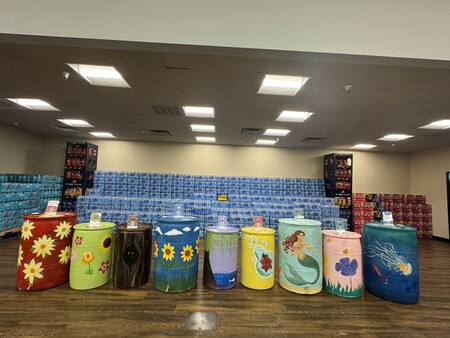
Details. The group’s first project was ‘Rain Barrel for Runoff’. According to CBS Austin, Tran traveled hundreds of miles across Texas to collect used food production drums. Over 40 young artists hand painted them, giving them a fresh touch so that they don’t clash too much with the city. The barrels were sold to local residents and raised more than $2,500 for environmental programs. Tran’s agency estimates they prevented about 45,000 gallons of runoff, which is the equivalent of about 170,000 liters.
The barrel performs two functions at the same time. On the one hand, they collect water from the roof, which does not absorb it, and filter out some pollutants before they reach the storm drain. In a fundraiser, the teenagers auctioned off nine of the painted barrels at a local supermarket, with QR codes allowing shoppers to bid on each piece. Profits were split between the initiative, the school’s art club and environmental non-profits like EcoRise.

between the lines. Algae are expensive to treat once they appear. And as Hill Country News points out, even a small portion of water can cost hundreds of thousands of dollars to treat with lanthanum-modified clay. And he argues that it doesn’t solve anything in a lasting way. “Even if you talk about algal blooms, if you don’t address the fundamental problem of stormwater runoff, they’re going to keep coming back,” he told the outlet.
Tran says many people don’t realize that pouring motor oil or trash down storm drains can get into nearby waters, where it can harm wildlife and pets.
Beyond the barrel. CBS Austin reported that Tran was concerned about the redevelopment of the Lime Creek Quarry, which he believes could increase the amount of contaminated runoff reaching the Edwards Aquifer. For eight months, he taught himself groundwater modeling and GIS mapping software, and worked with local hydrogeologists to compare how different development scenarios might affect groundwater, presenting his findings to the Cedar Park City Council.
As shared by CBS Austin, the investigation helped the City Council consider removing about 26 hectares of land. He estimated that this could prevent about 1.74 million gallons (about 6.6 million liters) of polluted runoff from entering the wetlands each year.
What next? The Gloria Barron Award recognizes 25 young leaders each year, with 15 receiving $10,000 for their service or education. Tran’s group said they hope to find a city or school to partner with for educational outreach, and plan to use keg sales to fund more ambitious projects. “People always have a desire to protect what they love. They just need the tools to be able to do that,” he told the outlet.
In Xataka | With 2,000 plastic bottles, some students demonstrated the simplest way to recycle: building a greenhouse