Of all the Trump rallies I have covered, there is one that really sticks out in my memory: Dalton, Ga., on Jan. 4, 2021.
President Trump had lost re-election two months earlier, but he wouldn’t admit it. He had poured his anger into a campaign of denial, one that brought him to Georgia, where he urged Republicans to turn out in two Senate runoff elections happening the next day, even as he complained that the state’s voting systems had been rigged.
What was clear that freezing night was the strength of his following. People in the crowd were as angry as he was. Many of them were on their way to Washington, where they planned to answer the president’s call to join him there two days later. Even the Wi-Fi password hinted at what was coming: “SeeYouJan6!”
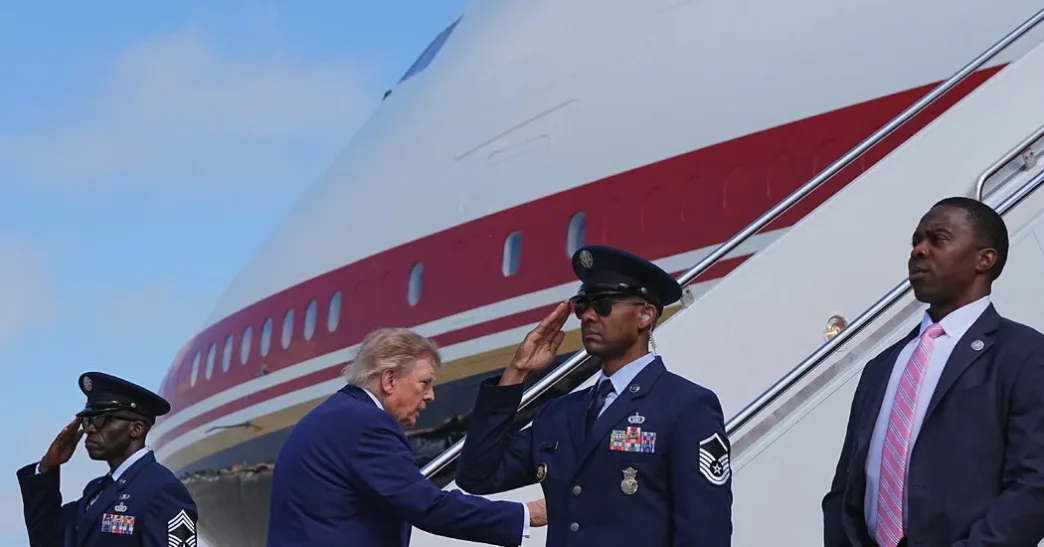
Trump was back in Dalton today, on another rescue mission. But a lot has changed since 2021.
His falsehoods about a stolen election have remade his party, but there are questions about whether his base is as devoted to him today as it was five years ago. Marjorie Taylor Greene, a Republican who represented Dalton in the House, left Congress and has openly feuded with Trump since. Senator Jon Ossoff, one of the two Democrats who were elected the day after that 2021 rally, now holds a commanding position in the polls as he seeks re-election.
Is the map shifting under Trump’s feet? I asked Tyler Pager, a White House correspondent who has been following the president through a series of red states this week, and Pati Mazzei, who covers Republicans, to join us from the road to discuss the president’s strategy in the closing weeks of the midterms. (We chatted yesterday, but both have followed the campaign trail elsewhere since then!)
Jess: Thank you both for parking your cars and joining me from … where are you, anyway?
Pati: Hello! I am outside a frozen custard shop in Durham, N.C., though a few hours ago, I was in Raleigh.
Tyler: Hi Jess! I am in a cafe in Kalispell, Montana, before I head to the airport to make my way to Georgia.
Tyler, your travels with President Trump this week have also taken you to Alaska. This is a state he won by 13 percentage points in 2024, and one that is very far from Washington. Why, exactly, did he go there, and what was the scene like?
Tyler: The president remarked on how long it took to get to Alaska multiple times during the rally! I think it tells us two things: 1) The races in Alaska are super close, and Republicans think Trump can actually help with turnout. 2) Trump’s declining approval among voters is a real drag on the party, and he can’t go everywhere. Some of the candidates in the closest races do not want to appear with Trump at this point in the cycle.
Still, the rally felt like a throwback to one of Trump’s rallies during the 2024 campaign. Our colleagues have attended rallies in recent weeks where swaths of the arenas are empty and the mood is much lower-energy. That was not the case in Alaska or Montana. Both were packed to the gills, and all the voters I talked to were fully behind Trump and the Republican ticket.
Trump — and his party — are devoting a lot of time and money to saving incumbents in deep-red states. Pati, where does that leave Republicans where you are, in North Carolina?
Pati: National Republicans have pulled ad money from the North Carolina Senate race, leaving their candidate, Michael Whatley, in a tough spot. Whatley is a former national G.O.P. chairman, and he led the state party. But turn on the TV here now and most of the ads are gone — a huge change from just three weeks ago, when ads were bombarding viewers.
It tells us the party doesn’t think the race is as competitive anymore — even though Trump is planning to rally in the state next week.
That’s interesting. The party might be pulling back, but Trump is not. How is Whatley handling this? Does he view Trump as a help or a hindrance?
Pati: Unlike other Republican Senate candidates who have distanced themselves from Trump, Whatley has run a campaign siding with the president, betting that if Trump voters who don’t usually vote in the midterms turn out, he will have a better shot.
Democrats in both Georgia and North Carolina would tell you it is a mistake to think their states are layups for their party. They’ve been cautioning against complacency, especially because they have seen very tight races before. Senator Raphael Warnock of Georgia was actually in Durham on Thursday telling North Carolina Democrats to “run through the ticker tape” for Roy Cooper, the Democratic nominee for Senate here.
Tyler, as you travel the country with them, what is the mood among Trump and his advisers? Are things going according to plan for them?
Tyler: Once Trump steps out onstage, he is jubilant. He loves the adoration of screaming fans. I’ve also noticed a touch of nostalgia from the president, who has really been campaigning nonstop since 2015. He has reminisced about the crowds during his first run for president and reflected on his political career.
At the same time, things are certainly not going to plan, and the president is miffed about his nonstop travel. Behind closed doors, some of Trump’s aides acknowledge Republicans are likely to lose the House and that the Senate is much closer than they would want.
There’s also drama within the upper echelons of Trump’s political operation. After our colleague Ken Vogel reported that Chris LaCivita and James Blair, two of Trump’s top political advisers, traveled overseas to help a Russian-aligned government, the president lashed out at them on social media. Knives are out in Trumpworld, and Republicans have told me that’s not helpful in the final sprint before the midterms.
In Washington
-
The U.S. budget deficit approached $2 trillion in the 2026 fiscal year, new data from the Treasury Department shows. That’s the highest level since the pandemic.
-
The Trump administration has argued that the Presidential Records Act is unconstitutional, saying Congress cannot order the executive branch to preserve its records. A panel of appeals court judges appeared deeply skeptical of that claim.
In the midterms
-
An online influence operation, backed by the Russian government, is trying to use Israel as a wedge issue to divide Americans before the midterms, according to a new study.
-
Ken Paxton, the Republican Senate nominee in Texas, partied in Dubai with two men wanted on federal fraud charges, according to a lawsuit.
-
The concept of socialism, once unpopular in the U.S., has gained some momentum, a Times analysis of polling data shows — though support is still limited.
What we’re watching
-
Gov. Gavin Newsom of California, a possible Democratic 2028 hopeful, will be in New Hampshire this weekend to campaign with Chris Pappas, the Senate candidate, and Cinde Warmington, who is running for governor.
-
Trump is hosting a rally tomorrow in Highland Heights, Ky., near the Ohio border, to boost Republican candidates in both states.
-
There are more than 2,500 No Kings events planned across the country tomorrow, which organizers hope will promote early voting.
NUMBER OF THE DAY
$650 million
That’s the current Republican advantage in general-election advertising, according to Teddy Schleifer and Matt Zdun, who have been analyzing a bonanza of election finance filings that came in last night.
Democratic candidates have out-raised their Republican counterparts in every Senate battleground race, and in 38 of 42 competitive House races, so far this year. But even those massive fund-raising hauls — led by James Talarico’s $114 million in Texas — pale in comparison to the war chests of Republican super PACs.
In the video below, Teddy explains the role that one particular superdonor, Elon Musk, has played in boosting Republicans’ hopes.
Quote of the Day
“Oh, shut up.”
That was Troy Jackson, the Democratic candidate for Senate in Maine, snapping at Senator Susan Collins, the Republican, in last night’s debate.
Jackson and Collins have debated four times in the past two weeks. But last night’s was the first with a live audience, and at one point a protester interrupted the proceedings, yelling: “A.I. data centers are destroying our climate. They’re poisoning our water.”
Collins quipped that the demonstrator was “obviously one of Troy’s supporters.” Jackson, visibly annoyed, replied: “Oh, shut up. I don’t even know that kid.”
In the U.P. with A.E.S. and A.O.C.
Dr. Abdul El-Sayed, the Democratic Senate candidate in Michigan, and Representative Alexandria Ocasio-Cortez zigzagged across Michigan’s Upper Peninsula yesterday, two progressives campaigning in an area Trump won handily in 2024.
Traversing northernmost Michigan with them was Times reporter Tim Balk, who kept a diary of the eight-hour bus tour, which wove through three cities in two time zones.
Here are some of Tim’s entries. Read the rest of his diary here.
-
11:03 a.m., Escanaba — Hundreds of people have lined up outside a large red storage barn on a fairground in this tiny lakeside city, in a county Trump carried by more than 30 percentage points in 2024. Many in the crowd describe themselves as committed Democrats who are thrilled, and surprised, to receive a visit from such high-profile guests. “Nobody ever bothers to come to the Upper Peninsula,” says Michelle Ottensman, 63.
-
3:52 p.m., Iron Mountain — Zwelakhe Koehs, 9, asks El-Sayed and Ocasio-Cortez whether they are going to become president or vice president. El-Sayed responds, “Here’s what I’m interested in doing — I’m interested in being your next United States senator.” He cracks that he hopes Zwelakhe could be an intern for him during his second term in the Senate.
More on the Michigan race: Ocasio-Cortez announced today that she would contribute $1 million to El-Sayed’s campaign. Ayanna Pressley, a progressive congresswoman from Massachusetts, praised the move and said it was “shameful” that Senate Democratic leaders weren’t sharing more money with “diverse candidates” such as El-Sayed, Angie Nixon in Florida and Scott Colom in Mississippi.
ONE LAST THING
Don’t believe your eyes
A wave of political ads that use A.I.-generated imagery has flooded the internet and television screens. Candidates and political action groups, mostly tied to Republicans, have rushed to adopt the technology, according to researchers.
Among the 220 A.I. ads that researchers identified, nearly half contained A.I.-generated depictions of real politicians, and about 70 percent contained no disclaimer that A.I. was used.
Taylor Robinson contributed to this newsletter.