When talking about mega construction, the name of China comes to mind. The country has undertaken some of the most complex works in recent years and has pharaonic projects such as the world’s largest new dam or the most complex tunnel. In this respect, Europe is not far behind with two projects that aim to be the world’s longest tunnels in different areas: the largest submerged tunnel and the world’s longest railway tunnel: the Brenner Base.
A project from 2006 that finally yielded results.
Brenner Base Tunnel. We are talking about a job that has taken a lot of time, with several changes in plans and estimated completion dates Construction officially began in 2007, but excavation did not begin until 2015. It is part of the European Scandinavia-Mediterranean Corridor (or SCAN-MED) and will include the Munich – Verona axis. The objective is to facilitate communication between countries by crossing an imposing natural barrier: the Alps.
It is important to improve commercial and passenger networks in Europe because trains are becoming a tool to rely less on planes on the path to decarbonization and, in addition to allowing faster connections between Germany and Italy, a large part of Alpine freight traffic will be transferred from road to rail. The idea is less traffic jams on the roads, less CO₂ emissions and, obviously, an acceleration in the supply chain between northern and southern Europe.
huge. Tunnel properties are imposed. In total, it will have a length of 64 km, which will make it, according to its promoters, the longest railway tunnel in the world at the time of its opening. The main section between the Italian city of Forza and the Austrian city of Innsbruck will be approximately 55 kilometers long and will consist of two parallel tunnels each with a single track.
They will be connected by service tunnels every 333 meters to allow quick evacuation in case of failure and unique is that it will be a “flat” tunnel, with almost the entire route at about 794 meters above sea level. This is necessary to allow trains to run at low cost, since some current routes through the Alpine region have trains that require several locomotives due to the inclination of the track.

out of transport. The idea is that it will allow freight trains of up to 3,000 tons and passenger trains that will be able to travel at higher speeds (250 km compared to the current average of 50 km/h due to terrain demands), but since they are digging holes in the mountains, they will take advantage of something else.
A dozen meters below the main gallery, there will be another tunnel, five meters in diameter and about 56 kilometers long. This will be what is known as an exploratory tunnel, a channel that will allow groundwater extraction facilities as well as geological investigations into that mountainous area.


Status and next steps. Initially, the tunnel was supposed to be ready by 2025, but estimates have changed. The Alps are a complex area due to the presence of faults and groundwater, which has forced a rethinking of both mining methods and solutions for riverbeds such as the Isarco. Administrative delays also played a role in the story as Austria and Italy were building their respective sides of the tunnel. And the COVID-19 pandemic has forced work stoppages.
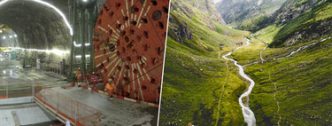
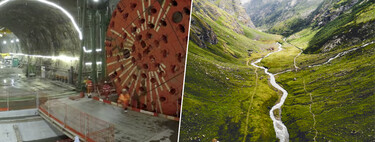
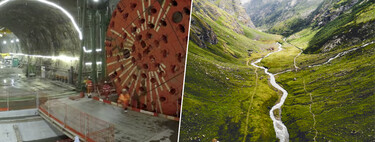
All this raised the initially planned budget from 6 billion euros to about 8.4 billion, but recently we witnessed a green shoot. Using tunnel boring machines like the ‘Flavia’ that allow digging while lining the tunnel, in September last year, Italian and Austrian tunnel boring machines met, achieving an underground connection between the two countries.
Also, the cross-border connection of the two main galleries was completed this summer, although the cladding, roads and systems are missing.

Drill through the Alps. Sights are set for 2032, when it is estimated that the work will be completed and the tunnel can begin to be exploited to move goods and passengers. Now, although huge, this is not the only project currently in development or already completed in the Alpine region.
The other major indicator of this corridor is the Mont Cenis corridor, which will connect Lyon to Turin by 2033 with 57.5 km. There is also the 57.1 km Sun Gothard base which was inaugurated in 2016 and is a contender to beat it. In recent years, more ‘modest’ projects have also been opened, such as Koralam (32 km), Seneri (14.5 km) and Lotsberg (34.6 km).
A previous version of this article was published in September 2025
Picture | bbt-se
In Xataka | Japan created an artificial peninsula to build an airport. Soon there will be an underwater airport