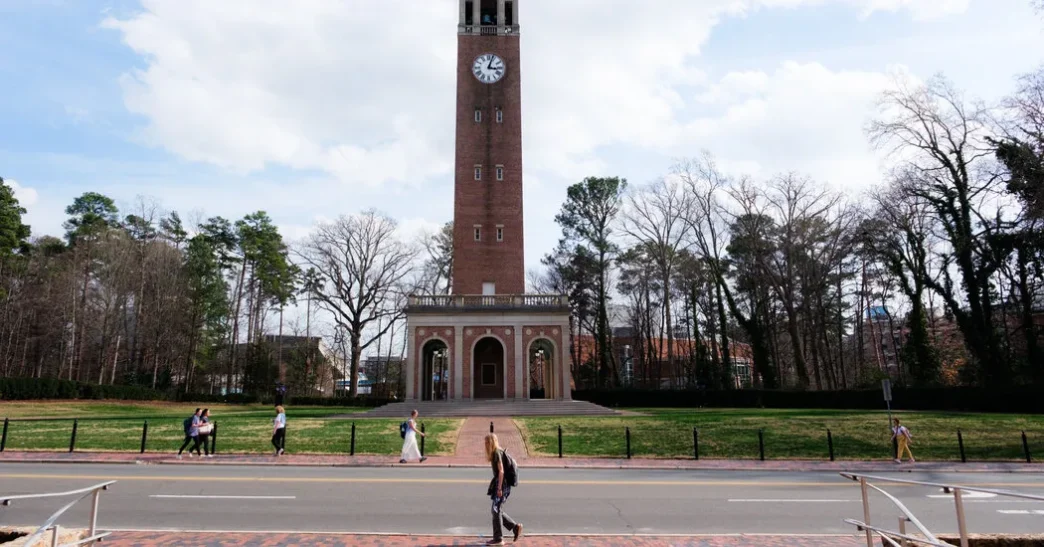
The University of North Carolina at Chapel Hill and the federal government said Monday that they had reached a settlement to close 19 federal inquiries. The agreement made U.N.C. the latest school to align itself formally with the Trump administration’s vision for higher education.
The university, which did not acknowledge wrongdoing, will not pay any money in connection with the agreement, setting it apart from schools that pledged to shell out tens or hundreds of millions of dollars. But it agreed to abide by the Trump administration’s views on matters like admissions; diversity, equity and inclusion; and the punishment of student groups for actions perceived as antisemitic.
In return, according to U.N.C. and the Justice Department, the university preserved its access to federal research funding — crucial for a school that draws most of its research money from Washington. The government also said it would not use the agreement to control “academic speech or curricula” at U.N.C., long regarded as one of the nation’s top public institutions.
And the government agreed to shut down 18 investigations by the Education Department’s Office for Civil Rights, as well as a compliance review the Justice Department opened last year. According to U.N.C., the investigations concerned matters like antisemitic harassment and sex and race discrimination.
Lee H. Roberts, U.N.C.’s chancellor, said in a statement that the settlement “reinforces our commitment to the fair and equal treatment of everyone at Carolina.”
The Justice Department, which has put legal pressure on schools from coast to coast, seized on the agreement to argue that other universities should curtail their fights against a government that many in academia believe is suppressing dissent and debate.
“Higher ed policies and practices that tolerate antisemitism or favor certain racial groups over others, frustrate our colorblind justice system,” Harmeet K. Dhillon, the Justice Department’s top civil rights official, said in a statement. “The Civil Rights Division commends U.N.C. for its cooperation in meeting its obligations under federal law without the need for litigation; we hope other institutions will take note and do the same.”
The settlement comes just more than three years after U.N.C., along with Harvard, lost before the Supreme Court when the justices rejected the schools’ affirmative action programs. Monday’s agreement puts significant attention on admissions — a recent focus of the Justice Department — at U.N.C.
The university agreed, for example, that it would not “by any means, including considerations of racial diversity, preference applicants in admissions based on any protected characteristic.” The university also promised to “not allow or tolerate, and shall actively eliminate, the use of racial proxies as a means of preferring applicants for admission on the basis of race or other protected characteristic.”
In recent years, students and faculty members at U.N.C. have blistered the university for embracing some conservative priorities, such as a civic life school. The university system as a whole has moved to stamp out D.E.I. programs, and Mr. Roberts, a former state budget director under a Republican governor, has been repeatedly criticized for his reluctance to challenge a White House that has openly threatened elite higher education. Mr. Roberts has denied any partisan motivations for his strategy.
But some of U.N.C.’s toughest critics had no immediate reaction as they digested the surprise settlement. Few people at the university had known that it had been in talks with the government.
The Trump administration has reached settlements with a handful of other top schools, including Brown, Columbia, Cornell and Northwestern. But the U.N.C. agreement may be most similar to one the government signed with the University of Pennsylvania, which also inked a settlement that included no financial penalties.
Noel T. Brewer, a professor in U.N.C.’s public health school, expressed skepticism about the endurance of the administration’s agreements with universities.
“These settlements between the universities and the current administration appear to be politically expedient and existential,” he said in a text message.
U.N.C.’s agreement expires on Dec. 31, 2028 — weeks before President Trump is scheduled to leave office.