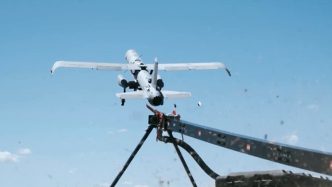

What if you could take a weapons factory to the battlefield? That’s the idea behind technology from Firestorm Labs: giving American troops the ability to manufacture what they need, when and where they need it.
“With 3D printing, we’re able to modify our designs very quickly, and so what we did was we containerized an industrial-grade 3D printing manufacturing line, and put that as far forward to the edge of battle as possible,” said Chad McCoy, Firestorm co-founder.
McCoy, a former soldier himself, spent more than two decades in the military before co-founding Firestorm.
The company started with drones, developing affordable systems that could be easily modified for different missions.
Then came XCELL, a mobile manufacturing system, taking that same ability to build and adapt closer to the fighting.
Production ranges from drone components to replacement parts for military vehicles and more, with new uses still emerging.
“What we’re offering is the fact that you can build at the point of need, and if the designs change over the next few years, you build the newest design and the newest integration or payload,” McCoy said. That could help solve two problems: getting troops their parts and systems faster, while avoiding stockpiles of technology that could be outdated before it’s ever used.
Providing manufacturing to those using the weapons has also resulted in innovation the Firestorm team couldn’t have anticipated.
“We’ve already seen that with the Army. It’s parts repair for vehicles. It’s systems that we would never even consider being a market,” McCoy explained.
“We did 1,000 parts on the USS Essex for RIMPAC, and within those 1,000 parts, I mean, 999 of them were probably unknown to us before we started.”
RIMPAC is a large joint naval exercise that takes place in the Pacific. It allowed Firestorm to put XCELL through conditions a land-based factory would never face.
“We printed during Sea State Five, so pretty big seas, and we wanted to see how the prints would be. You know, were they going to be affected by that? They weren’t,” McCoy said.
That kind of versatility could take on greater significance in a conflict across the Indo-Pacific. That’s because the U.S. would have to sustain forces across long distances while potentially facing disruptions to its supply lines.
“I think there’s two scenarios. I think one is the pre-positioning,” McCoy said. “And then the other one is just-in-time production. So we talk about the Essex, so we can put these systems on mobile platforms to push them forward.”
In a large-scale conflict, demand for this technology could be enormous, with drones and other equipment in constant need of repair or replacement.
“It won’t be hundreds; it will be thousands. So the attrition for these systems and how they’re using these in Ukraine, we’re talking thousands upon thousands per week,” McCoy said.
The military is already investing. Firestorm has received contracts from the Air Force, as well as funding aimed at scaling systems into the Indo-Pacific.
McCoy told CBN News an early challenge was simply getting the Pentagon to understand where a new capability like this could fit, but now that’s changing.
“There’s so many…guys and gals that got out of the military in the past. They have insider knowledge of where the problems are and how to solve them. And now you marry that with really smart engineers, and you build best-in-class products,” McCoy said.
For decades, the U.S. military has depended on a global network to deliver equipment to its troops. Now, technology like this is challenging that model, putting the ability to build and adapt what’s needed directly into the hands of the warfighter.