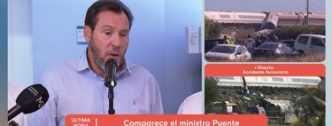
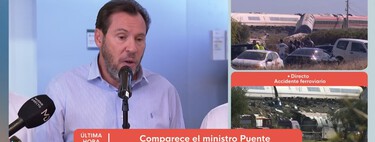
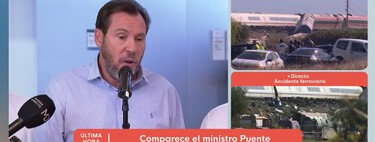
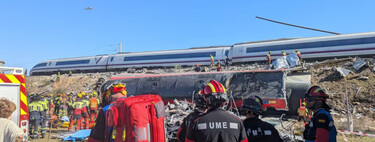
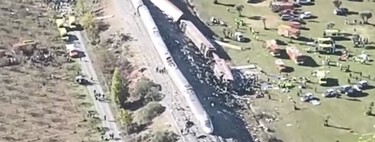
October 28 at 8:53 am. AVE 2080 hits Irio 6076 near Urda (Toledo) on the Madrid-Seville high-speed line. The rear-end collision was defined hours later as “inexplicable” by the transport minister, Oscar Puente, and placed the focus of responsibility on operator Adif who ordered the Renfe train to continue traveling “as normal”, once the LZB protection system fell and there was no safety backup.
Workers, however, point to a more explainable factor.
“Atocha CRC has inhumane actionsRaquel Ailon, head of circulation and spokeswoman for the Railway Circulation Union (SCF), summarized that the state operated within the control center from which the protocol dictated was wrongly ordered to circulate “normally” instead of “running on sight”.
The CRC is the control center from which Spanish railway lines are monitored. There, a line or a part of it is assigned to those responsible for the traffic. For example, in Madrid-Seville, the Atocha CRC’s responsibility extends to Córdoba.
There are 16 CRCs that control conventional and medium-distance lines, and four Spanish high-speed lines. Above, H24 is the top of the “Railway Traffic Control Pyramid. It is supervised from here. Permanently developing infrastructure conditions as well as rail traffic,” described Adif himself.
Aylon emphasizes that this decentralization is very unbalanced. “You charge the same anywhere else except Madrid. Yes, there is a small compensation for traffic volume but it doesn’t reach 1,000 euros per year,” he explains. And that, he assures, is not sustainable for a worker who has to operate a line like Madrid-Seville.
Twice the passengers, same workers
In three years, the line doubled its traffic volume. In 2022, the year before the campaign began on the first Erio tracks, 2.8 million passengers were counted. It will reach six million in 2025. The number of traffic controllers in the Madrid department remains unchanged: one.
In a CRC, a circulation manager confines his work to a specific section of the line, regardless of the number of circulations he has to handle. That’s for Madrid-Córdoba sectionWith one of the most high-speed traffic in Spain, there is only one traffic controller. Same number for Madrid-Badajoz, a line with the fewest trains on the track.
Aylon gives an example of the pressure this can cause. “Imagine a Cercanías line, with trains every three minutes. It’s the same but with trains that go 300 km/h,” he explains. Above the person in charge of circulation, a supervisor controls what happens to those several tables at the same time. And finally, the issue of manpower shortage.
Their union has been demanding for years more staff and less workload for those who go to the CRC daily with the highest workload in all of Spain. They are out the world The SSCF, a body attached to the transport ministry, has sent a letter to the State Railway Safety Agency (AESF), asking “traffic control and control staff not to exceed limits that compromise railway safety due to fatigue.” This letter is dated 2025 but in 2021 they have already made the same complaint. According to union sources, no reply was given to the letter.
Aylon reinforces the story by confirming that “AndAt Atocha CRC they could not even get up to go to the bathroom. In this case you need someone to replace you, because believe me there was no one. They couldn’t even catch a break. “They had to maneuver each other to go to the bathroom.”
Circulation chiefs and union spokespeople condemned the situation at the start of the year as “distressing”. “Sometimes, there was only one controller in the room (the person who supervises more than one line at the same time). There must have been a controller from the north and the south (Atocha created this division between the CRC lines), because sometimes there was only one.
These, he tells us, are just some of the problems they face. Lack of experience is another. And the thing is “You have to be 10 years old to go to a CRC in Atocha, today outsiders get in straight away.” Employees who, the union assures us, undergo 10 months of theoretical and practical training.
During this period, also, the trainee may receive training from more than one person in charge of circulation. That is, at the same time it receives training from the line that works with different security systems and protocols. “From the union we ask that there are six hours of work and two training. At high speed, new instructions and new documentation are constantly coming. We have to train constantly. Now they put the book on the table and you read it when you can,” he concluded.
Picture | Adif
In Xataka | Toledo crash minute by minute: Reconstruction of an “inexplicable” crash between an AVE train and an Erio train