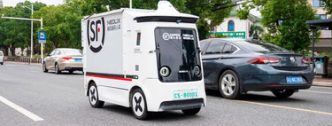
It was about six in the afternoon on a busy street in the center of Tallinn where a city bus full of passengers was plying. Suddenly, some roads crossed and the driver was forced to brake, sending several standing passengers to the ground. Whoever made it calmly went on his way without looking back.
The culprit in this incident didn’t have a driver’s license or ID: it was an autonomous delivery robot that ran a red light and caused an accident. Now Estonian police are investigating it, and Europe is faced with a question that still doesn’t have a clear answer: Who is responsible if an autonomous machine is the cause of the accident?
One Red Crosser and nine others were injured. As reported by municipal transport company TLT, on Monday, October 26, a Bolt autonomous delivery robot arrived at a pedestrian crossing and, without thinking twice, crossed the road through a red light. The driver of a bus traveling at a traffic light was forced to brake suddenly. This caused several standing passengers to fall and nine others were injured as a result of the fall.
Video of the bus shows the crash and how the robot is pushed to the side of the road and then continues on its way as if nothing happened. TLT Director Andrei Novikov told local media this information ERR That “robot ran, so to speak.” A spokesman added that leaving a position without complying with the law “can be a criminal offence.”

Manufacturer’s version. Pepe Aviksu, head of operations at Starship, the company designing the robots, explained that it was night and there was an illuminated advertisement behind the traffic lights, which made it difficult for pedestrians to recognize the crossing lights. Moreover, pedestrian and vehicle traffic lights were on the same line. The person in charge acknowledged the failure of the robot’s light sensitivity. “There are many lessons to be learned, but exceptional circumstances do occur,” ERR News reported.
However, Starship denied the leak. According to Aviksu, the robot waited around the incident for about 10 minutes and notified its support team to move it off the road. For him, “the situation was clear, as evidenced by the bus leaving the scene.” He said his staff had not seen the police or health services.
A legal loophole that Europe has not closed. This situation, which is little more than anecdotal at this point, presents a new challenge for European regulations, now that its roads are starting to be filled with autonomous cars and other delivery vehicles: Who pays if there are no drivers?
In terms of civil liability, the EU has the new Defective Products Directive, which treats software and AI as products. However, the law will only apply to products marketed after December 9, 2026, so autonomous robots already in circulation in Tallinn and other European cities will remain under the 1985 standard.
The commission has withdrawn the AI Damages Liability Directive, a regulation that could cover damages caused by these autonomous driving systems. MEP Axel Voss, who supervised her, said Euronews That it was a “tactical error”.

In criminal matters, each country does its own thing. Fortunately, the Estonian incident had no major consequences for the passengers. But if you suffer them, then criminal proceedings are another matter. The EU can only set minimum standards for a specific list of serious offences, so leaving accidents are punishable according to each country’s law.
Since 2017, Estonian traffic laws include autonomous delivery robots and consider their owners as drivers. That is, if the robot belongs to a last-mile delivery platform like Bolt for legal purposes, it will be the company’s liability and must have liability insurance to cover damages that may result from accidents. If the company that makes it owns it and offers it as a service on the platform (eg rental), then that responsibility falls on the manufacturer.
There are more and more robots on the road. The Tallinn accident comes at a time when there are more autonomous home delivery services and just as the first autonomous driving tests are being approved in cities like Madrid.
Starship announced more than 10 million deliveries and more than 3,000 robots in 300 locations in eight countries in June. Uber Eats, which already uses them in Leeds, plans to add more European countries in 2026. In Spain, Zaragoza had its own premiere with the Goggo network in 2022. Its mobility advisor, Natalya Chueka, said the rules don’t need to change because robots are “not vehicles.” In Estonia, the law treats them as such and they must take the same responsibility as any driver when running a red light.
In Xataka | A veteran Tesla engineer summed up his employees’ feelings about FSD: “We’ve all seen it fail.”
Picture | Starship