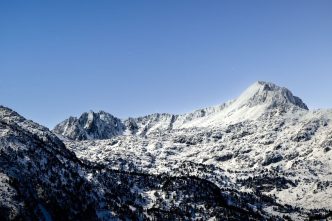
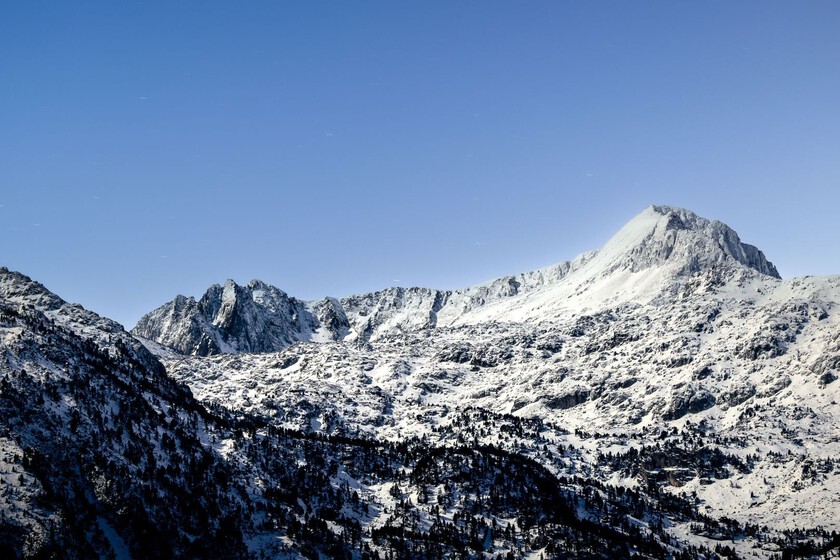
The glaciers of the Pyrenees are experiencing their lowest hour. The landscape, dominated for centuries by the vast dominance of permafrost, is transforming at a rate that is no longer measured in centuries, but in very hot summers. This is indicated by the latest data from the 2025-2026 campaign, which confirms that we are witnessing the real-time disappearance of the last glacier of the Iberian Peninsula, an irreversible process that may end in 2034.
a breath It may seem that 2026 gave the summits a break, since during the spring, the Pyrenees recorded a lot of snowfall that set record values in early March. However, CryoPyr’s report released at the end of October noted that winter snow is no longer the slope we face in summer.
And no wonder, as this season closed as the third year with the most ice loss since annual records began in 2012, surpassed only by the 2021-2022 and 2022-2023 campaigns.
Measurements. To measure this decline, researchers have abandoned old assumptions and now use drones that create high-resolution 3D models. By superimposing these models with previous years, it was found that the average loss in Ossoue (French side) was 3.1 m thick, which lost 4.9 m.
But we have other points like Anetto, with an average loss of 2.4 meters or Monte Perdido, where the loss has been 2.3 meters, with local peaks of up to six meters on the surface.
Fragmentation. The ice is not only losing thickness, but it is breaking up, as seen in the Aneto Glacier, where in 2025 it was reduced to only 30 hectares after its eastern part split. Now, a new fragmentation seems to be condemning it to be broken up into ever smaller parts.
Added to this is the gloom, which is a phenomenon that causes glaciers to lose their mobility and stop flowing, as they no longer have the energy to excrete rock and sediment. The result is that, at the end of summer, the surface of the ice darkens and loses its whiteness, it absorbs more solar radiation, further accelerating its own melting.
time limit A study published last year carried out a climate simulation to see how this phenomenon would progress and determined that the Pyrenees would be ice-free by 2034. Even under a moderate emissions scenario, the Annatto will lose 79% of its ice by 2030. And if summer repeats like 2022, the end will come even sooner.
Will it affect the water? The answer is no, since the hydroelectric effect of these glaciers is almost negligible on the flow of rivers in the region today. Its loss is, after all, a huge landscape, environmental and symbolic tragedy, more than just a water supply problem.
Picture | Marek Punicki
In Xataka | Last year we killed all the fish from two Pyrenees lakes: after 10 months they were full of life again