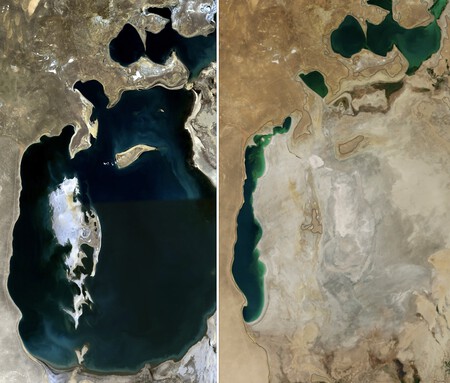
In the 1960s, the Aral Sea (between Kazakhstan and Uzbekistan) was the fourth largest lake on the planet, with an area of about 68,042 square kilometers and 1,100 cubic kilometers of water. Also in the 1960s, USSR planners made a decision: they turned the Amu Darya and Sir Darya rivers into irrigation canals for cotton cultivation.
As a result, by the early 90s the lake had shrunk so much that it split into two parts (the North Aral Sea and the South Aral Sea), its volume had decreased by 91% by 2004, and where the water once was, a new desert, covered in salt and waste, appeared, the Aralkum. A true environmental tragedy to which Uzbekistan is responding by land, sea and air: its battle is not to restore the lake (that is now an impossible mission), but to stop erosion with millions of bushes.
Paradigm shift. It goes without saying that the first thing they tried to do was return the water, but the Soviet dam on one side and the huge demand for cotton, the region’s staple crop, made recovery unlikely. In fact, only the northern Aral in Kazakhstan had some success: thanks to a dam, they were able to raise the northern lake by four meters and, according to World Bank statistics, its salinity was reduced by half.
Uzbekistan took another route: In 2018, at the initiative of then-President Mirziyoyev, he approved a large-scale state program to transform dry beds with soil reclamation work, as reported by the Astana Times. They were no longer seeking to restore the original ecosystem, but rather to prevent the bottom from becoming a permanent source of harmful salt dust storms and improve the ecosystem. The shrub chosen to fix the bed was saxaul.
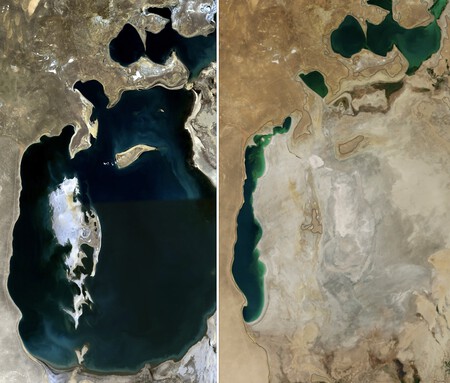
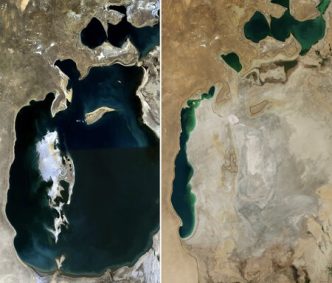
The Aral Sea didn’t fare so well without the USSR: left, 1989 photo. Right, in 2014. NASA
Why that bush?. saxaul is a desert shrub of Central Asia that reaches a size that ranges between a large shrub and a small tree. Its wood is heavy, it has very small leaves, as well as its yellow flowers. But what is really interesting and differentiating about Saxaul is that it is almost a sponge: its bark is spongy and full of water, and it has roots that reach between ten and fifteen meters. According to one study, a seven- to ten-year-old specimen can hold two to four tons of sand.
But the Aralkum desert is not just another dry land: we have already seen that its conditions are extremely saline. Well, Saxaul tolerates salt well, as they have already tested in another desert (Taklamakan in China). Therefore, it was the ideal species to revive. However, it is accompanied by other shrub species such as tamarisk, salsola and ephedra, and another form is used on the Kazakh side, black saxaul or Haloxylon aphyllum.
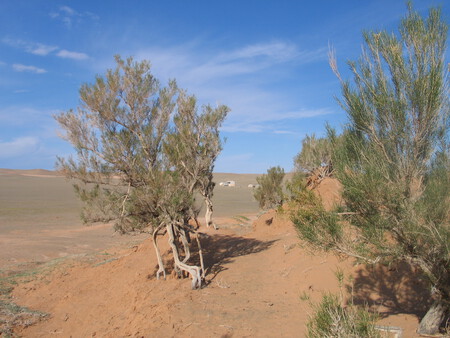
Saxaul
Forestry by land, sea and air. Official data (up to mid-2024) details that more than 1.73 million hectares of forest were planted in Aralkum, of which more than half a million hectares will be covered in the next 5 – 6 years. Even if the seedlings are planted manually after germination in the nursery, its logistics againForestry is truly art: 360 tractors open one-meter-deep trenches in the ground every ten meters, and seeds are spread by airplane.
More than 300 people in Karakalpakstan, one of the areas most affected by the sandstorm, are collaborating with 150 forestry agency employees to collect and plant seeds. Half of Kazakhstan is doing something similar: by 2025 they plan to plant saxaul on 275,000 hectares and reach 1.1 million, according to its Ministry of Ecology.
AndFunctionality with precision. If the question is whether this massive afforestation works, the answer is: it depends. Uzbekistan claims to have reduced the proportion of degraded land from 30% to 25% in four years, and the good news is that plantings have created cover, although growth and stored carbon have been lower than in other Central Asian deserts where the initiative has been implemented.
As Turakson Xiaotov, a scientist at the Tashkent Forest Research Institute, explained to Mangabay, the survival of saxol seedlings is about 50-70% in rainy years and drops to 30% in low rains. So, even if football fields worth about two and a half crores have been planted, it does not mean that they have turned into forests. On the other hand, the drought doesn’t help either; In fact, explains researcher Dildora Aralova, water shortages can compromise the sustainability of projects.
In Xataka | China wanted to stop the advance of the desert by planting trees. After four decades, water has become a major problem
In Xataka | Half of Spain on track to become desert: European desertification map warns experts
cover POT. Collage by producer Cunningham