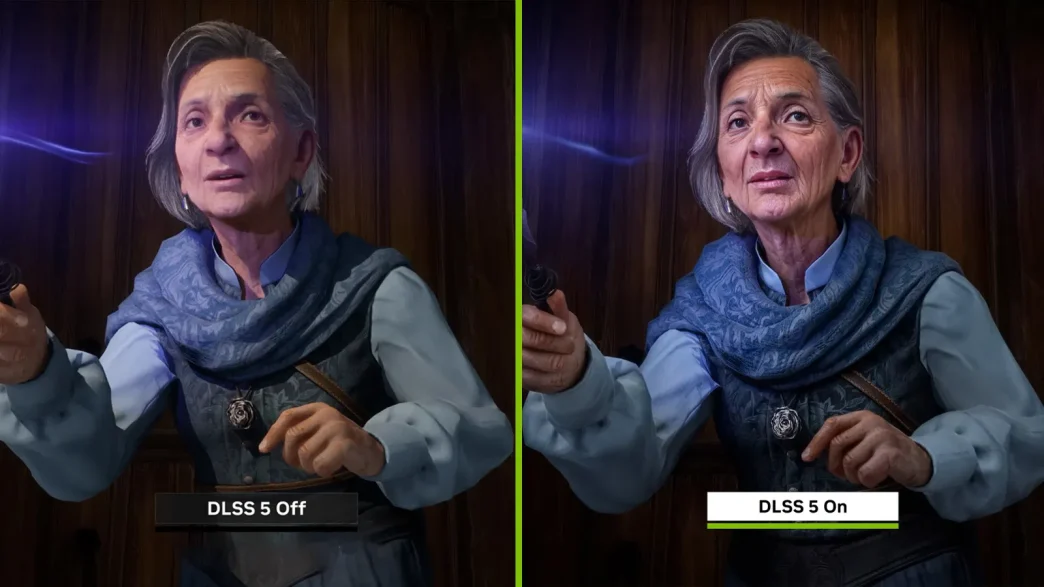
One of the most controversial reveals of 2025 in gaming, DLSS 5 has finally launched. And now it actually looks very different from what we saw in March. And forget about it arriving, bro, it had already leaked earlier, after which a lot of people even tried it. And that’s why Nvidia has now launched it for everyone as well. So, today I’m going to tell you everything about DLSS 5, what it is, what changes have come between March and September, and what kind of impact it has on graphics and performance. Whether someone likes it or not, look, DLSS 5 is here to stay, and in the next few years it will become a staple, where Neural Rendering will become very common. So, in today’s video I’m going to explain everything to you, just watch until the end.
By the way, if you still don’t understand what is going on with all this? How did comparisons and videos of DLSS 5 suddenly start appearing in our feeds? Then look, let me start right from the beginning. The thing is, NBA 2K27 launched on 4th September, but around 4–5 days before that, some people got access to an early access build of the game. When people looked through its files, they found a file named ‘dlssnr’, which means DLSS Neural Rendering. The size of this entire DLSS package was 158MB, which was larger compared to previous DLSS DLL files. Like, the files for DLSS 4 were around 20 to 50MB. Now, as soon as this file was found in the game, it was immediately uploaded publicly on the internet, after which some modders started making mods for it, and it started being tested by putting it into almost all games. Control, Death Stranding 2, Cyberpunk 2077, Black Flag Remake, The Last of Us 2, Final Fantasy 16, Starfield, Palworld, Forza Horizon 6, you name it, DLSS 5 has already been tested in all of them. In some, it is quite impressive, but in some games like Palworld, it gives a slightly strange and weird feeling.
But yes, the thing is that it looks much better than the initially revealed DLSS 5, and it seems that now it is not changing the geometry of the face or the character model that much. But still, the internet is divided. Some people are starting to like it, and some people still hate it quite a lot because of AI. But why is this happening? Look, to understand this, you have to understand DLSS.
So, DLSS, which means Deep Learning Super Sampling, was introduced by Nvidia in 2018 with the RTX 20 Series. After that, in 2019, it was available in only a few games. Because the original version of DLSS had to be specifically trained for every game. But the big problem was that the launch experience of DLSS 1 was not good. The image in many games became soft or blurry, fine details were also lost, and in return, the performance improvement was not that good either, because of which people overall did not like it. So, after this, in 2020, DLSS 2 arrived, and this time the approach was quite different. For example, with DLSS 2, different games did not have to be trained separately, and at the same time, DLSS 2 could use temporal information, meaning information from previous frames could be used in the current frames. And this is where upscaling also came in, which provided a major improvement in both image quality and performance. That is why, compared to DLSS 1, DLSS 2 received a much more positive response.
Then comes DLSS 3 in 2022, and here Nvidia added a very important thing, which is frame generation. Basically, a GPU traditionally renders one frame, then renders the next frame. DLSS 3 generated one additional frame between these two with the help of AI. Yes, these generated frames were not perfect, but you couldn’t notice them that easily either. Then in 2025 came DLSS 4, and here Nvidia took frame generation to the next level. DLSS 4 introduced multi-frame generation, which could create up to 3 additional AI-generated frames for one traditionally rendered frame. And then, bro, in 2026 came DLSS 4.5, which brought 6x frame generation, and even dynamic frame generation, meaning this multiplier would automatically keep changing according to your screen and performance. After that, we now arrive at DLSS 5.
Now, its idea is somewhat different from performance. But at the same time, it is also controversial, so much so that the DLSS which people had started liking, its branding was slightly damaged as soon as this arrived.
Look, until now, what DLSS was doing was that its focus was on boosting performance. And it used to recover the performance loss caused by Ray Tracing and Path Tracing that came with the RTX generation. But DLSS 5, bro, does not focus on performance. Rather, it actually reduces it, because its focus is on enhancing detailing, lighting and shadows, and not just on faces but across the entire frame. So, if I say it briefly, achieving photorealism is its focus. They themselves have said that with DLSS 5, they want to achieve Hollywood-level VFX. But until now, the problem has been that achieving that level of photorealism was not that easy. Especially in gaming, where you have to generate at least 60 frames for every second, and that too in real time. So, this is where DLSS 5 comes in, which will directly take the frames from the game engine, from which it will only use the color and motion vector of the frame, and improve the lighting and material details on top of that. Meaning, DLSS 5 will not change the geometry of models or ruin it. It will basically be a filter, powered by AI. But it will use DLSS 5 separately on every frame so that frame-by-frame enhancement can be done. Apart from this, bro, there will be 3 different models in it. Nvidia has named them Model A, B, and C, but in the leaked DLSS 5 they are Default, Natural and Cinematic. And you can change their look however you want. Like, Structure Intensity will decide how realistic the overall scene should become, Tone Intensity controls lighting and color, and apart from this, bro, you could select specific assets, like the Face, the Chair, and the fruits separately, and DLSS 5 would only be applied to those. They even explained that every scene can be created with a different model and setting, and all these options will be available to developers.
Now, if you ask anyone, they will clearly tell you that the new DLSS they have shown looks much better than the previous reveals. I mean, the AI slop filter that it used to look like earlier has now been reduced. In that reveal, the problem was that the character face models were being made by DLSS 5 to look as if we had told AI, “make this image realistic.” Because of that, even the geometry of the characters’ faces was changing, but at the same time, extra details and sharpness were also being added to the frame. And look, with human faces, as you keep getting older, different types of lines and age start appearing on the face, wrinkles come in, which we also call aging, and DLSS 5 was doing the same thing with the faces of character models. Because the face model was created without DLSS 5 being used, based on how it would look under the current lighting, but when DLSS 5 tried to enhance it, because of extra shadows and extra textures in the same wrinkles and same features, it started looking a little too aged. Even now, in some examples, it still seems to do this. I saw a video where GTA 5’s Michael looked like Walter White. So, in these cases, adding extra details is causing problems. Because the game was not made for DLSS 5 in the first place. And the leaks also damaged its reputation a little. Some people even say that NVIDIA intentionally leaked it so that they could check gamers’ reactions. But I don’t think that’s true because, bro, this leak put developer-level controls into people’s hands. Because of that, they are pushing every slider to maximum and recording clips, and there are also games where people are putting DLSS 5 just to see what happens, even though it was never made for those games. Final Fantasy, Palworld, Trails of Sky Remake, Hi-Fi Rush, these games have their own artistic choices. These games were not made to look realistic, so using DLSS 5 on them makes no sense, because of which their examples looked extremely uncanny.
Look, as far as I understand, DLSS 5 is made for those games that say, “we are making a real-looking game.” I wouldn’t put GTA, RDR, Crimson Desert, or 007 First Light in this category, because these games have a chosen art style, and in my opinion DLSS 5 may not look that good on them, because their goal is to make the game immersive, not completely realistic. But DLSS 5 is best for games like Microsoft Flight Simulator, Forza, Sports, or Cars games, because photorealism, bro, was the intention of the developers for NBA 2K. They want the faces of the real-life NBA players you are playing with to look realistic, and the jersey they are wearing should also look completely realistic because it also directly relates to merchandise and so on.f I talk about Kingdom Come Deliverance 2, that is also a good example. According to its creative director, they had quite a lot of problems with ambient occlusion. Because it was difficult to show the shadows of small objects like hats and helmets and all that. But the biggest upgrade of DLSS 5 is these contact shadows. Apart from this, it is adding shadows to hair. When light comes close to them, they look realistic. Now, they themselves made the game, and they wanted to make it as realistic as possible. So, this is not going against their vision. So, if a developer wanted their game to look completely photorealistic, then DLSS 5 could be a savior for them. But for the rest, Witcher 3, or fantasy games or open-world games, and even Cyberpunk 2077, I would say that I don’t think it makes much sense, especially because even now the faces with DLSS 5 look somewhat strange. Maybe because they are not fitting according to the scene, and secondly, if every game starts looking like realistic footage, then all games will not look the same. But yes, with a lot of controls, DLSS 5 can definitely be used for environment details and NPCs, which can make the overall environment look sharper, improve its lighting, improve shadows, and also reduce some of the developers’ workload.
There is just one small problem with DLSS 5. It is cutting FPS in half, like seriously, directly half the FPS, and this is when we are talking about modded gameplay. I’ll just look at Nvidia’s NBA 2K graphs. With 4K ray tracing on with the ultra preset, on an RTX 5090 it is getting 370 FPS, while with the RTX 5080 it is getting 233 FPS. Very good, right? But just below this chart, if you look, multi-frame generation is at 6x with Super Resolution Performance Mode turned on. Meaning, for the number of frames you are seeing, divide them by 6 and then you might approximately get the raw numbers, which will only be around 60 or 40. Meaning, a graphics card like the RTX 5090 is only giving 60 FPS without frame generation turned on, on DLSS 5. Whereas with DLSS off, they said that the RTX 5090 is giving 227 FPS, which is such a huge performance hit. Even in all the benchmarks, the comparison is only between DLSS 5 and DLSS 4.5. We are not seeing raw performance anywhere. So, what kind of days have we come to now, bro? Until now, we used to compare raw performance versus frame-generation performance in DLSS, but now raw performance has completely disappeared, and perhaps that is why DLSS 5 will only support the RTX 50 Series.
Because people tested the leaked mod on the RTX 40 Series, 30 Series, and even 20 Series. On the 20 Series, the game itself would not start, on the 30 Series the game was giving only 1 FPS, and on the 40 Series it was playable but the performance was very low. So, for the RTX 50 Series, if you only keep the technology, there will be this problem that games have a specific art style which will become exclusive only to the 50 Series. I mean, previously, what difference was there between the 30 Series and 50 Series? Performance, graphics, resolution, you would get fewer FPS, but the characters would look the same. Now, the face models themselves will look different between the older generation and the newer generation.
But the biggest advantage of DLSS 5 is neural rendering. Neural rendering, bro, is going to be such a technique for rendering graphics in video games that it can achieve final photorealism, and you will see that AMD, PlayStation, and other gaming companies are also going to implement it. Where neural rendering will use neural networks, AI, and machine learning to give us realistic graphics. Although this topic is a little big, so I can explain neural rendering in a separate video, if you want.
But for now, if we have to give a conclusion on DLSS 5, how is it? Look, bro, your opinions may be different, which you will probably be writing in the comments. But if we look at the overall picture, there have been quite a lot of improvements since the last announcement. The AI slop now feels less noticeable, developers have more control, and for some specific games, this looks very good. But on the other side, it causes a huge performance dip. It is exclusive only to the RTX 50 Series, it makes some games unnecessarily realistic, and in my humble opinion, it changes the artistic vision of the game itself. So, I believe that this should be an optional feature, which should only be used by those people who really want to play CCTV footage instead of their game, or want to experiment with older games. And if that were the goal, then instead of launching it under DLSS, they could have launched it as a separate feature, which would be an optional feature for the RTX 50 Series. Or even the upcoming 60 Series. But if it has been given the name DLSS, that means it is going to become an important part of the gaming industry. A few years from now, the new games that will come out will be made specifically keeping DLSS 5 in mind.