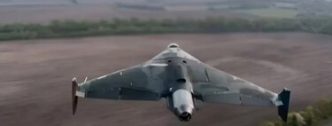

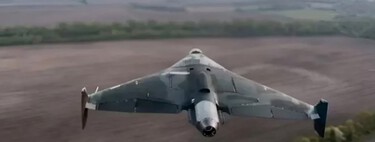
Russia has found a way to further complicate Ukraine’s air defenses: replacing the propellers of some of its attack drones with small jet engines capable of propelling them to speeds approaching 600 km/h. Acceleration has reduced the time available to detect and shoot them down, forcing the Kiwi to seek increasingly quick solutions. The latest: robotic turrets equipped with large-caliber machine guns, artificial vision and intelligence that have already been able to take down these devices.
Speed as a weapon. Russia is intensifying its use of drones equipped with small turbojet engines, an evolution of the propeller model that has been attacking Ukrainian cities and infrastructure for years. Among them, the Geran-5 stands out, capable of reaching a speed of approximately 600 km/h, a speed that significantly reduces the reaction window of anti-aircraft defenses.
Russia launched about 350 jet drones in June and increased that number to 2,800 in August, according to figures released by kyiv. The problem is reflected in the interception rate: while conventional aircraft such as the Geran-2 are shot down more than 85% of the time, the percentage of jet models is between 50% and 70%, according to the Ukrainian Air Force.
A machine gun with AI. The Ukrainian response included deploying automatic turrets capable of detecting, tracking and firing high-speed aerial targets. Air Force spokesman Yuri Ihanat confirmed that these systems have already intercepted Russian jet drones, including the Geran-5, using artificial intelligence and vision.
Armaments include .50 caliber machine guns, equivalent to 12.7 millimeters, and allow part of the target acquisition and tracking process to be automated. Ukraine previously introduced the Sky Sentinel, a turret with similar capabilities, although authorities have not identified the specific model responsible for the new interceptions. Nor did they detail the extent to which target selection and firing authorization depended on human operators.
Battle for Kiev. President Zelensky announced that more than a dozen of these bastions have already been installed around the capital, and eight more are planned to be deployed in the region. Among the larger attacks against civilian infrastructure, some will be used to protect bridges that have been subjected to numerous Russian attacks. Its main limitation is the relatively short range of machine guns, which forces them to be placed closer to points that need protection.
Ukraine is complementing this strategy with increasingly fast interceptor drones, some of which are capable of destroying jet aircraft. Zelensky highlighted the Barrs model, to which he attributed a 30% kill rate, a figure that reflected the difficulties of intercepting targets moving at such speeds.
Where soldiers can hardly move. Automation is also transforming land warfare. In certain sectors of the Ukrainian front, reconnaissance and attack drone concentrations have created what the military calls a kill zone, a danger strip that can reach 50 kilometers deep. Any movement of troops, vehicles or equipment can be detected and attacked, complicating the use of even traditional short-range weapons.
Oleg Fedoryshyn, director of research and development at Ukrainian manufacturer Devdroid, told Business Insider that its military customers faced a particular problem: using RPG anti-tank grenade launchers required reaching positions where the operator’s survival was increasingly difficult.
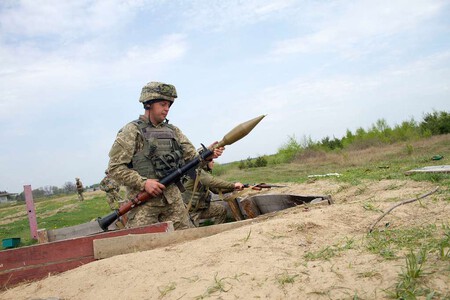
Rising in RPG robots. A solution that some units found was to install these grenade launchers on unmanned ground vehicles that already carried machine guns. In this way, robots can approach targets and use short-range weapons while their operators are away from the most exposed positions. According to Fedoryshyn, a team requested to experiment with this configuration and received satisfactory enough results that DevDroid began studying its incorporation into other systems.
The Temerland company is also developing a platform called the Gnom-VP, which is equipped with two RPG-7 launchers and the ability to transport other weapons. This adaptation allows conventional weapon systems to remain operational on battlefields where physically reaching the enemy has become the greatest risk.
A battle that is updated like a mobile phone. Plus: Direct collaboration between manufacturers and combat units is dramatically accelerating the development of new capabilities. DevDroid maintains a permanent support service for units that use its robots and ensures that it can design a change, test it with a brigade, and distribute it to the rest of the deployed system in about a week.
Fedoryshyn compares this method to updating mobile phones and their operating systems. In fact, they told Insider that the soldiers themselves offer uses that the creators didn’t initially anticipate, from installing additional weapons to using the robots in situations that ended with the Russian military surrendering to them. The priority is to quickly adapt relatively cheap and replaceable equipment to the changing needs ahead.
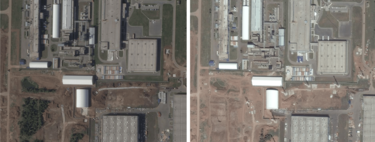
A new race of machines. We have been counting it. The two developments reflect a transformation that is affecting heaven and earth simultaneously. Russia has increased the speed of its drones to make interception more difficult, while Ukraine has incorporated sensors, algorithms and robotic weapons to reduce reaction time. On the land front, the proliferation of those same drones is pushing the military to shift conventional weapons to unmanned platforms.
The result is a mad technological race in which each innovation forces the opponent to find an answer, and in which the speed of industrial adaptation begins to matter as much as the performance of the weapon. The paradox, if you will, is that as drones fly faster and faster, troops have less and less freedom of movement, a combination that is making automation an increasing necessity for both armies.
Picture | United24, Picryl
In Xataka | Ukrainian drones are achieving something that energy transitions have failed to do for years: Russians start buying electric cars
In Xataka | We already know what World War I soldiers felt when they saw a tank: just like our drones