
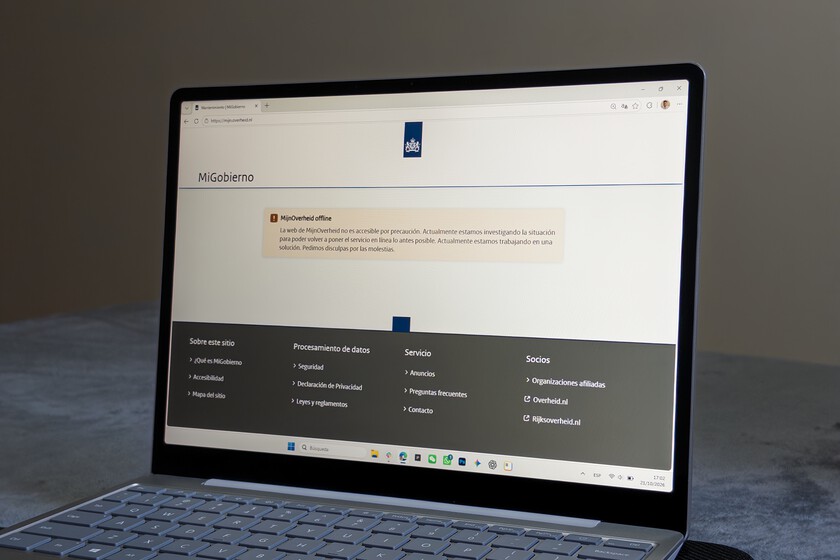
The Internet works so well most of the time that we rarely think about what happens behind a page before it appears on our screen. We just go in, do what we need to do and move on. But today the experience can be different: one official website shows maintenance, another gives an error and some are no longer available We’re not looking at a page that randomly fails, but rather the visible consequence of a problem that affects a deeply pervasive technology and that has forced several organizations to make an unusual decision: disconnect rather than stay open.
Now we know what’s behind these barriers: PHP, one of the most widely used languages on the web, has had to release fixes for two critical vulnerabilities, CVE-2026-109618 and CVE-2026-109619. The cybersecurity authority’s recommendation is straightforward: update as soon as possible, and if that’s not possible or temporary mitigation isn’t enough, consider taking the system offline. This warning has already been translated into concrete decisions in Europe, where administrations and other services in the Netherlands, Finland, Denmark and France have temporarily withdrawn part of their public infrastructure.
The authorities’ response is as forceful as it is unusual: update immediately and, if it’s not possible to apply patches or mitigate risks in time, remove the system from the Internet. This is the line set by the recommendations of the British NCSC and by NSA Cyber. In Europe we are already seeing this decision on the ground: companies and services in the Netherlands, Finland, Denmark and France have temporarily removed websites or platforms while they work on the fix. In some cases a simple maintenance page is displayed; In others, a 503 error or No Service.
in development.
In Xataka | How often we should change all our passwords, according to three cybersecurity experts