Although it seems that the Big Bang as the origin of the universe is one of the most accepted ideas in science, even astronomers disagree. While many experts consider it a theory that solves most cosmic problems at once, others believe there are too many pieces that don’t fit. To know exactly what happened, it would be better to travel to the dawn of the universe and study what happened. But of course, it is not easy. Generally, calculations made in this regard have a percentage uncertainty that invites caution.
Therefore, scientists have been able to determine what happened in the first 5 minutes of the universe with only 0.5% uncertainty, a milestone. Although, again, another milestone that needs to be taken with caution. This is astronomy.
Three Robberies on the Birth of the Universe. To study what the early moments of the universe looked like, scientists took into account three phenomena: microwave background radiation, the expansion of the universe, and primordial helium. The first two have been studied quite a bit. However, the third, although it has been calculated, has not received as much attention from astronomers. Moreover, those who measured it obtained calculations with too much uncertainty. Now, a team of researchers at the University of Minnesota has found a more accurate way to calculate it.
A few galaxies are better than many. Typically, primordial helium calculations are made by analyzing many, low-metallicity galaxies and extrapolating their data to what would happen in a zero-metallicity galaxy. In astronomy, all elements other than hydrogen or helium are known as metals, so the more primitive a galaxy is, the lower its metallicity. The problem is that this extrapolation is not easy, which is why there is so much uncertainty. For this reason, these scientists wanted to select a few galaxies, small and with very low metallicity, so that they could be viewed as a time capsule.
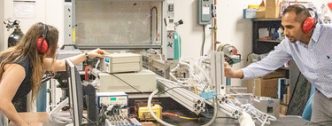
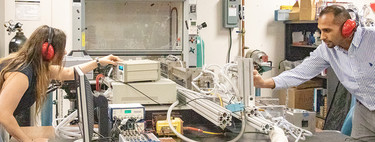
new device. They chose 15 galaxies, but there was a problem. Being so small, they could not be analyzed in depth with readily available telescopes. So they turned to the MODS spectrograph developed at Ohio State University. According to the statement of the authors of the study, this instrument was designed for something, so it was ideal to finally break with the uncertainty of the first minutes of the universe.
Thanks to this, they detected 10 spectral lines related to helium and 15 related to hydrogen, which were already known, but were not able to be studied in depth with extrapolation to large galaxies. In this way, small errors were corrected and a more accurate drawing of the first minutes of the Big Bang could be made, with an uncertainty of only 0.5%.
25% helium. Theories about the Big Bang and its aftermath suggest that, with the very high temperatures that followed, particles called quarks were created first, followed by protons and neutrons. Their fusion will give rise to deuterium, which then collides with more protons, neutrons or deuterium and becomes helium. However, in the initial moments of the Big Bang, the temperature would be so extreme that there would be too much energy and the deuterium would annihilate. This could start to happen as the temperature dropped slightly, but there came a point when it was too cold for the reaction to continue.
All this lasts about 3-5 minutes, according to the sources. At least, that’s what the existing assumptions say. Over time, helium levels will change as stars are born, but at that initial moment, the helium will be the result of the Big Bang. Now, thanks to this new study, the hypothesis has gained strength, since 25% of the mass was detected in the form of helium in that first minute. This is what the calculation said and also what the spectrographs now observe.
Make points in favor of the Standard Model of Physics. Evan Skillman, one of the study’s authors, noted that this was perhaps one of the most important findings of his 40-year career. And by measuring what happened in the first five minutes of the universe with so little uncertainty, what the Standard Model of Physics says is supported. Observations prove correct those who made predictions based on calculations alone.
Picture | ESA and the Planck collaboration
In Xataka | Disproving Einstein is one of the greatest challenges in physics. We could not achieve that even by changing the scale.