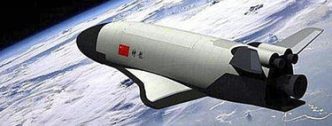
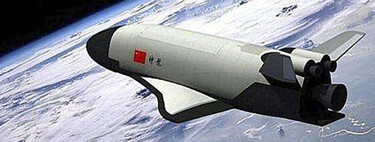
For years, a photo taken from space raised suspicions that China had developed its own version of one of the US’s most secretive military vehicles. The image was circulated on the Internet, it even appeared in a presentation by the US Space Force, and no one has publicly confirmed what exactly it shows. Now, a report from Washington’s military intelligence agency has solved the mystery: Beijing has a reusable space plane remarkably similar to the American X-37B. And the details that have emerged indicate a new level of antagonism between the powers.
Waiting for an answer for years. In 2024, Colonel John Patrick, then head of US space forces in South Korea, showed a low-resolution image of a mysterious vehicle in orbit during a conference. Its appearance was so reminiscent of the X-37B that it was not even clear whether the photograph showed a Chinese aircraft or one of the two small ferries operated by the United States.
Specialized media The War Zone then sought an explanation from Space Force and Maxar, the company that owned the satellite that captured the image. Both companies declined to comment. The photo has remained for more than two years as one of the most intriguing clues about the Chinese military space program.

Confirmation. The United States Defense Intelligence Agency (DIA) released a declassified report hours ago on security challenges beyond Earth’s atmosphere, a report that includes a higher-resolution version of that photograph. The document clearly identifies the device as a space plane of the People’s Republic of China and explains that these vehicles can place objects in orbit, conduct experiments and return to Earth for reuse.
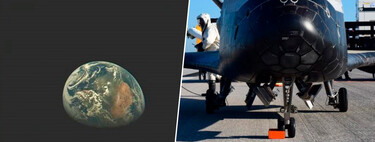
The image shows a small ship with wings, two vertical stabilizers, a central cargo hold that opens upward, and a rear-mounted solar array. Its configuration is remarkably similar to the American X-37B, although the wing geometry of the Chinese vehicle is different. In other words, the official confirmation removes doubt about the device’s identity, without demonstrating that Washington was previously unaware of its origin.
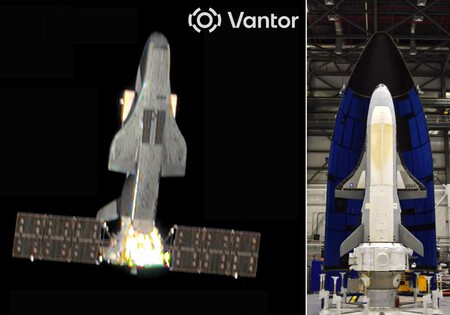
Side-by-side comparison of in-orbit images of the Chinese experimental reusable spaceplane (left) and a US X-37B equipped with an extended payload module during launch preparations (right).
A satellite photographed it at just 90 km. The update published by TWZ provides a particularly revealing detail: Vantor, formerly Maxar, confirmed that the photo was taken on May 28, 2024 by its Worldview-3 satellite, located less than 90 kilometers from the Chinese car. The agency also spotted a second satellite docked to the back of the spacecraft, with its structure and solar panels visible.
A great mystery is associated with the cargo hold doors that were clearly open during the capture. The scenario demonstrates the extent to which orbital observation systems can monitor each other and document activities that are responsible for keeping out of public knowledge. It also raises questions about the nature of the docked object and the activities the craft was performing.
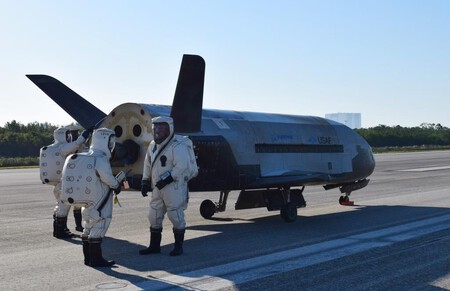
X-37B 2 at the Shuttle Landing Facility after the OTV-4 mission, ground personnel wearing protective suits
Sending his secret plane into space for six years. Since 2020, Beijing has conducted four orbital missions with a reusable test vehicle believed to match the photograph. The third was launched on December 14, 2023 and ended on September 6, 2024 after about nine months in orbit. During that period, the release of several small objects was detected, the function of which remains unknown. The fourth mission launched on February 7, 2026, and was still active at the end of October, having revealed at least one other object, according to available data.
The previous flights apparently took place at a military facility in northwestern China equipped with a nearly five-kilometer runway, one of the longest in the world. The complex has undergone significant expansion and is also used to test other advanced aeronautical technologies.
Analogy to the X-37B. The United States is using two of its designs to allow experimental payload transport, equipment deployment and orbital maneuvers.
The DIA report identified two major Chinese projects, Shenlong and Tengyun, of which the car pictured belongs. Shenlong is the name most commonly associated with experimental devices that China has been launching since 2020, while Tengyun was unveiled in 2016 as a two-stage system that would use a mother plane to facilitate access to space. Beijing is also developing the Haolong, which is designed to transport supplies to its Tiangong space station.
The real concern. Reusable spaceplanes allow small satellites to be deployed, retrieve experiments, and change their trajectory to approach other orbiting objects. These capabilities are particularly valuable for intelligence, inspection and surveillance missions and can also be used to jam adversary satellites or develop anti-satellite systems.
The fact that the Chinese ship released objects during its mission and took pictures with other docked satellites reinforces the military interest of these operations, although none of these observations prove that it has carried out offensive activity. DIA specifies the maneuvering and reuse of these vehicles as a benefit of certain traditional space platforms.
New military career. China is investing in intelligence satellites, reusable vehicles and rockets capable of retrieving their first stages, technologies that could lower launch costs and facilitate more frequent space missions. The United States has been building similar capabilities for years, and both countries see it as increasingly important to protect their orbital infrastructure.
WorldView-3 photographs summarize that transition. A US commercial satellite was able to observe a Chinese test vehicle at close range while it was conducting an operation whose purpose remains unknown, and DIA’s confirmation has finally allowed the protagonist of that image to be identified. The question that remains open is what exactly it was doing hundreds of kilometers from Earth and what role these ships would play in a possible clash between the two powers.
Picture | Vantor, US Space Force, Wikimedia
In Xataka | The satellite has been searching for a clue to the missing in China for six years. Everything you see around you is starting to get too big
In Xataka | Satellite images leave no doubt: China has launched an underwater creature that defies naval engineering