There is an access channel between the Brazilian cities of Santos and Guaruja that separates them and helps to access the largest container port in Latin America, Santos: in 2024, it will be able to transfer 5.48 million containers (TEU), which is about 1.56 million more than the second (in Manzanillo, Mexico).
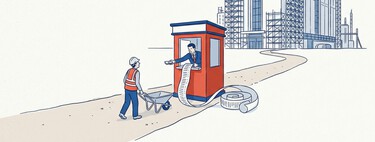
To get from one municipality to another you have two options: use the ferry system which takes about 18 minutes on average or go by road and spend an hour traveling about 40 kilometers. If you opt for the boat, bad news: Queues can last for hours, as more than 21,000 vehicles pass through this connection a day, according to the Ministry of Ports and Airports. Brazil wants to solve this by sinking a tunnel under the canal connecting the two cities.
Brazil’s first submerged tunnel. The tunnel will be 1.5 kilometers long, of which 870 meters will go under the access channel to the port. Also, it will have three traffic lanes on each side, an exclusive walkway for pedestrians and cyclists and a service gallery. Towards Guaruja, a two-kilometer access is planned that connects to the BR-101 (Rio-Santos highway), thus strengthening the road connection between the port and the north coast of the state.
When it opens, authorities hope to cut car journeys from an hour to a maximum of five minutes, Bnews Sao Paulo reports. The work will be carried out by Portuguese group Mota-Engil, which won the tender for Spanish Acciona in September last year and whose shareholders include Chinese CCCC, which also has experience in this type of work. It is a public-private collaboration, with an initial investment of 6.8 billion reais (about 1.15 billion euros) and which will employ 9,000 people, according to the official project website. The concession lasts for 30 years and covers construction, operation and maintenance.
why a tunnel. Building an infrastructure under water and being able to build a bridge, especially knowing that the route is less than two kilometers, is a decision that attracts attention but makes sense: the ships coming to Santos are increasingly long, so the underwater route was considered the most effective option to not hinder their movement, which would happen with a drawbridge. Furthermore, according to Governor Geraldo Alcomin, it was necessary to build an 80-meter bridge, which could affect the Guaruja airport project.
How are they going to do it?. The technique is similar to submerged tunnels: concrete modules are built in a dry dock, floated and sunk into a trench dredged from the bottom of the canal. One of the many examples of such constructions: the tunnel between Hong Kong-Zhuhai-Macao, a 6.7-kilometer underwater section consisting of 33 elements. The tunnel will be about 21 meters deep so as not to interfere with navigation.
At least until 2031. Official calendar 2026 saves for projects and licenses. Construction will begin in 2027 with dry docking and dredging. They will begin building the modules in 2028 and submerge them the following year. The Assembly’s work will last until 2030, as explained by the Secretary of State for Investment Alliance, Raffaele Benini. The most favorable forecast indicates that the tunnel will open in 2031. However, the timeline for this work is delicate and the Fehmarnbelt tunnel between Denmark and Germany, for example, is experiencing delays due to problems with modules sinking. Of course, the European tunnel will be much bigger.
In Xataka | When Brazil flooded the Amazon to create a reservoir, it caused something different: a massive graveyard of trees and animals.
In Xataka | Latin America’s “first airport city” begins to take shape: this is the project that wants to change transportation
cover CNT Agency – Flickr