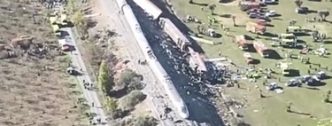
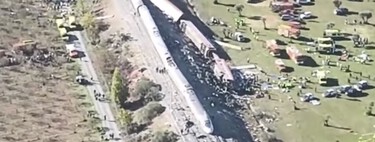
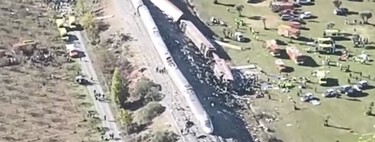
The train accident in Urda (Toledo), in which at least 69 people died, left many unknowns about how railway safety works. We wondered about the LZB system and whether it is more secure than the more modern ERTMS. Also about the role of regulators. And, of course, about using seat belts or not.
Transport Minister Oscar Puente spoke on the matter.
Passive safety. “We are going to evaluate the installation of additional passive safety systems in the vehicle,” said Oscar Puente in this morning’s speech to the press. This decision will be taken based on the feedback of the experts who will be entrusted with the technical study.
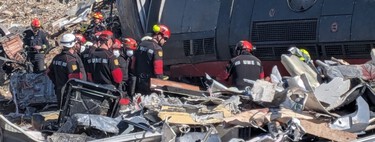
Since the October 28 Urda (Toledo) train accident, the advisability of wearing seat belts or otherwise having a separate compartment for luggage has been tabled.
lay off.
“I ordered a coffee in the cafeteria on the train to Seville. The waitress served it to me. Another waiter announced that a mixed sandwich was ready for one. That’s the last thing I remember. I felt a brutal shock that I don’t remember well and I felt a blow to the head when I thought I went to the edge of another car, then I saw the floor of the car. Someone in the cafeteria said it was an accident and it responded to me and with me. What’s going on.”
The story is by Antonio Jimenez Barca journalist the country who was traveling in one of the trains that crashed last week. In its opening he mentions how, in one moment, he went from one end of the train cafeteria to the other, due to the brutal impact caused by one train colliding with another at 160 to 200 km/h.
Along with the passengers, the luggage was also thrown. And that’s worrisome because at that speed, the impact of a backpack, no matter how small, is like a projectile. In a car, at 50 km/h, an object multiplies 50 times its weight on impact.

trunk. In his statement, Puente emphasized asking experts about the appropriateness of leaving suitcases and backpacks in a closed luggage rack. Currently, large suitcases go in an open luggage rack at the end of the car The overhead compartment even has space for small cabin suitcases.
He assured a press conference that the government will ask that companies be forced to offer trains where luggage racks are “closed compartments that prevent sudden braking or guesswork in case of impact. We are taking ideas for safety measures from the wind sector.”
Puente assured that the idea is to prevent luggage from becoming a “missile” in the event of an accident like last week.
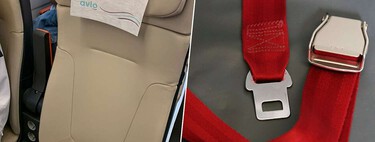
Seat belt. What Puente did not mention in his statement was the possibility of mandating seat belts on trains. This question was already on the table after the Adamuz (Cordoba) accident.
The purpose of the seat belt is to restrain the occupants during an accident and thus prevent them from being thrown. However, it must be taken into account that the behavior of a car and a train is very different, which is why some studies are against the use of seat belts in rail transport as opposed to cars and airplanes.
A vehicle has a survival cage that should remain intact in case of an accident. On the outside, the chassis must absorb the impact so that the force reaching the cage does not deform it and the passenger can be rescued even in the event of a serious accident. In aircraft, it is used because if there is severe turbulence or a sudden drop in altitude, the passenger may be ejected.
And on the train? The difference between a car and a train is that studies show that when a car experiences an impact, the passenger’s body decelerates much more, which is why it is essential to restrain the passenger in the seat.
On a train, no matter how brutal the crash, studies show that passengers are subjected to forces between 2 grams and 3 grams (two or three times the passenger’s weight, respectively). In a car, the reduction is equal to 30 grams. What a car does differently is that the seats and tables are designed to absorb the impact of a crash rather than keeping a person securely in place.
Apart from this, it has also been analyzed whether it is beneficial to keep seatbelts with two-three anchors. In no case were benefits observed due to hip injury (first case) or because the seat lost its impact absorption capacity (second). Moreover, the task of picking up passengers will be further complicated by the kind of accident that usually turns some cars into huge iron masses.
Picture | Moncloa
In Xataka | Burgos faces Spanish railway paradox: Renfe is a public service but refuses to have more trains due to low profitability