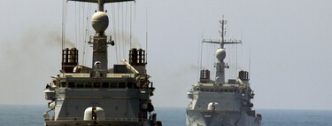
The Spanish Navy had just made a show of strength in Atlantic waters. A state-of-the-art submarine, a warship with decades of history and a single torpedo participated in maneuvers that went beyond a simple military exercise. Also, there is one particularly interesting detail: the sunken ship’s connection to the Moroccan fleet.
A torpedo south of the Canary Islands. Spanish submarine S-81 Isaac Peral sinks former patrol boat Infanta Elena during SINKEX 26 live fire exercise conducted in Atlantic waters south of the Canary Islands. In an operation to test the combat capabilities of the first S-80 class submarines, a single torpedo launch was enough to send the vessel to the bottom of the sea.
The target was not an enemy ship, but an ex-Navy ship decommissioned and clearly prepared to sink under controlled conditions.
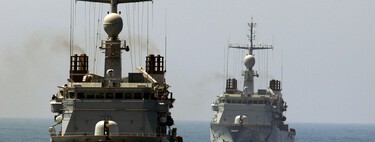
Connection with Morocco. The most curious detail is the identity of the chosen ship. The Infanta Elena belonged to the Discover class, a family of corvettes built by the former Empresa Nacional Bajan, today Navantia, of which Lt. Col. Erhmani (F-501) is a part, built in Ferrol for the Royal Moroccan Navy and delivered in 1982.
The Moroccan ship entered service in 1983, so Spain used as a target a ship of the same class exported to the neighboring country more than four decades ago. Of course, this does not mean that a Moroccan ship was attacked or that maneuvers were carried out against Morocco: the objective was an old Spanish ship, but the coincidences in choosing the target and the moment do not seem trivial.
From patrolling the sea to becoming a target. Infanta Elena had accumulated nearly 46 years of experience since her induction into the Spanish Navy. Originally conceived as a corvette and later reclassified as a patrol vessel, it has been part of the country’s surveillance and naval presence capabilities for decades.
Its ultimate destination is very different from its previous mission: to serve as a practical objective to test the effectiveness of Spanish submarine weapons. The reason? Choosing a hull with these features allows you to rehearse attacks against targets the size and resistance of a military ship.
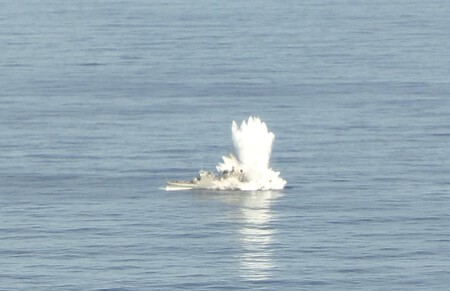
Image of drowning
A single shot. According to information published by Infodefense, the Isaac Peral used a DM2A4 heavy guided torpedo, a German-made weapon with a caliber of 533 millimeters. This type of torpedo can receive instructions via a cable during its journey and is designed to attack both surface ships and submarines.
Its destructive capabilities lie in powerful explosive charges and underwater explosion effects, capable of causing structural damage and severe flooding. The Navy confirmed the sinking with a single torpedo, although its statement did not clearly identify the model used or detail how the explosion occurred.
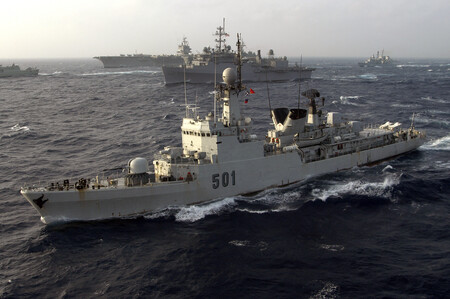
Moroccan Lt. Col. Erhmani
Much more than a shipwreck. Isaac Peral, delivered to the Navy in 2023 and built by Navantia, is the first Spanish submarine of the S-80 series. As we have said before, its main advantage is not only the power of its torpedoes, but also its ability to maneuver and attack discreetly underwater without revealing its position in advance.
SINKEX 26 made it possible to demonstrate this capability with real weapons and verify the readiness of its crew. As the Navy emphasizes, its deterrent value lies in the possibility that a submarine patrolling undetected and can neutralize a threat from a distance.
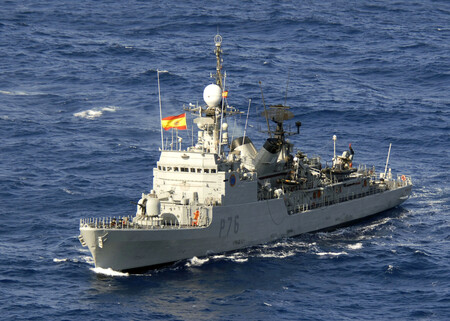
Infanta Elena
Full military deployment. While the sinking has focused all the attention, the Navy said numerous units were involved in the exercise. For example, the frigates Cristobal Colon (F-105) and Navara (F-85), the multirole ship Carnota (A-61), the maritime action ship Rilampago (P-43), three AV-8B Harrier aircraft, a naval helicopter, a Scan Eagle drone and Air Space Time Army Serv and Air Time Maritime participated.
Under the direction of Captain Rafael Mira Calvo, the objective was to verify how surface, submarine and air means are coordinated in situations close to real combat.
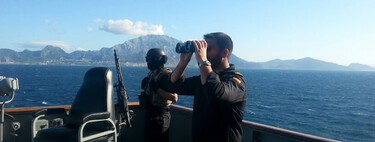
A sink prepared down to the last detail. Before using the Infanta Elena as a target, the Navy removed its fuel, oil and pollutants to minimize environmental impact. It has previously assessed the hydrographic conditions of the area and activated surveillance protocols for cetaceans and other protected species, in addition to safety measures for civil navigation.
In other words, an exercise planned down to the millimeter resulted in the hull of the old patrol boat ending up at the bottom of the Atlantic. For Spain, the result represents proof of the offensive capabilities of its new submarines. For the Infanta Elena, the end of a decade-long career that began as a class corvette associated with Moroccan naval history.
Picture | Navy, James C. Davis
In Xataka | If you’ve ever wondered what the pride of the Spanish Navy looks like inside, this virtual tour takes you inside the S-81
In Xataka | The S-82 is Spain’s second new generation submarine: it completed a complex test before delivery