
The end of October was very busy. Anthropic has finally released its documents for a future IPO, and in the meantime, we’ve seen how the world’s leading tech companies are scrambling, with Google leading one of the most infamous pushes. In China, that stagnation is a direct decline.
And, in these past four months, its AI and semiconductor industries have dropped 40%.
In short. A few days ago, Reuters published a rather harsh article titled “China’s AI bubble has already burst.” After months of hearing how Jensen Huang says there is no bubble and that this situation is completely different from the previous experience, the truth is that the STAR50, which is the Shanghai index and which combines the leading AI and semiconductor companies in mainland China, lost 40% from its peak in July.
That means $480,000 million in capital has evaporated, and the news didn’t come alone. The CSI300, an index of the country’s largest listed companies, is down 20% from the peak it hit in July. Reuters compares that to the American Nasdaq, which has fallen 6% since a record hit just three weeks ago, and Bloomberg notes that the drop in the STAR50 is notable because it is the world’s worst-performing major technology index this semester.

Why does it weigh so much?. That 40% decontextualized doesn’t say much, but Goldman Sachs claims that Chinese AI stocks account for 42% of Chinese market capitalization and 57% traded on mainland and Hong Kong stock exchanges. If the market in the US is dominated by big fish, in China it is dominated by small investors and they claim that few are protected. There are several cases that illustrate this:
- Unity (humanoid robots) who received over 8,000 times retail demand and whose shares have halved since trading.
- CXMT (Smriti) has lost more than a quarter of its value in the past month.
- MetaX vs Moore Threads (chips) have risen 700% and 400% respectively since their debut in 2025 and have lost half their value since July this year.
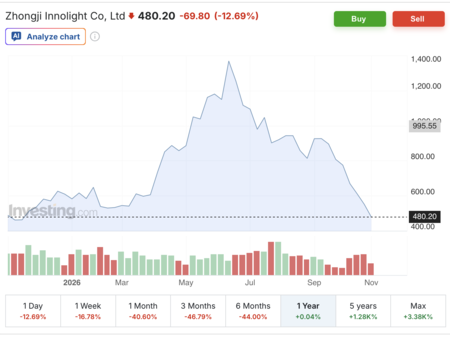
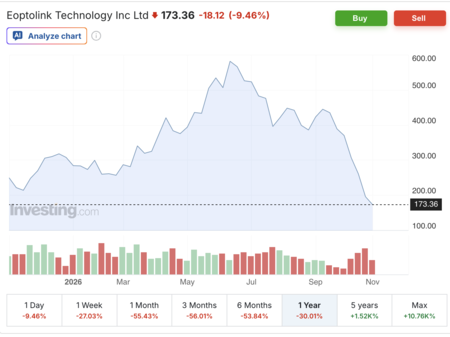
- Zhongji Inolite vs Eoptolink (optical components) are down about 60% from their highs this summer.
Now, an asterisk is that, although we look at the value graph in recent weeks there has been a clear drop, despite the drop the situation is much better than a year ago.
Explosion? Global sales of AI hardware hit Chinese stocks the hardest after foreign investors flocked to the sector in the previous quarter, according to Bloomberg analysis. There are also cases such as Zhongji Innolight and Eoptolink where equipment was discontinued as Washington moves to veto them as equipment suppliers for US data centers. In both of these cases, they are worse than ever, which may reflect the difficulty of selling outside of China:
Reuters, for its part, pointed out that there was no obvious trigger. High prices, tax burdens and the threat of Western countries banning Chinese components are problematic, but this is something they should not experience as a downfall.
subtlety. As Reuters itself points out, the STAR50 is still trading at around 100 times trailing 12-month earnings. It came from 250 bars and that’s what broke. Investors fear that the decline will continue, but it must be taken into account that the Chinese index is not remotely as stable as the Nasdaq or the Dow Jones.
It is a very young market compared to the other two and is dominated by small investors who work in packs and react more strongly to ups and downs than other global funds. That is why, if they see a positive trend or, on the contrary, a danger sign, they start trading their shares, drastically changing the value of the companies included in the STAR50.
Additionally, it differs from the other two in being a smaller basket and highly concentrated in semiconductors and AI. The Nasdaq has hundreds of standards and the Dow Jones, although it has only 30, companies from many sectors, very mature and very diverse. Does this mean the AI bubble has burst in China? Well, the truth is we’ll have to see if it comes together or if it’s a flash in the pan in such a volatile market.
Picture | Unitree (edited)
In Xataka | Unitree is one of the Chinese technological gems. It wants to do the same thing with robots that Xiaomi did with mobile phones