
The story begins in 1856, when an 18-year-old chemistry student locks himself in the laboratory he built in his London home with a mission: to develop a drug against malaria. That experiment was about to end in failure, but in the waste appeared something no one could have imagined: a color so intense that it overpowered half of Europe’s clothing and would change the chemical industry forever.
An anti-malarial drug. In the mid-19th century, quinine was one of the most effective treatments against malaria, a disease that especially threatened displaced Europeans in the tropics. The problem was that it was obtained from the bark of the cinchona tree native to South America, an expensive and limited supply.
August Wilhelm Hoffmann, director of the Royal College of Chemistry in London, saw his synthetic synthesis as a tremendous scientific and commercial opportunity. One of his students, William Henry Perkin, decided to take up the challenge during the Easter holidays of 1856, when he was only 18 years old.

That failure changed everything. Parkin worked in a small home laboratory and used compounds related to coal tar, the abundant waste product of the gas industry that lit Victorian cities. He first tried to obtain quinine by reaction with allyltoluidine, but did not achieve the expected results.
He then tried aniline and obtained a dark mass which seemed entirely useless. On treating that residue with alcohol, a purple solution appeared which dyed the silk with surprising intensity. He didn’t find quinine, he didn’t even come close, but he did find something that could be worth a fortune.
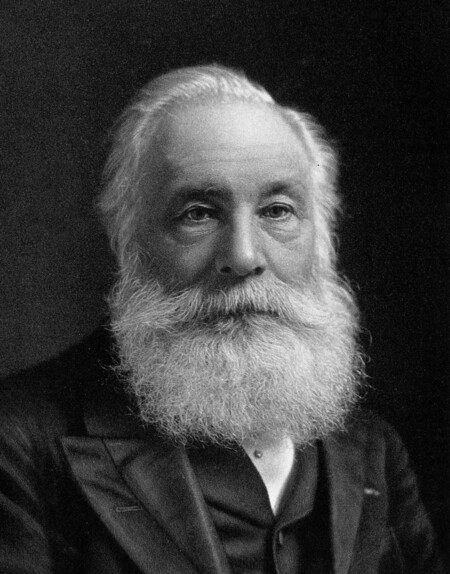
Perkin in 1906
Purple was a luxury. Until then, the textile industry was dependent on dyes derived from plants, insects and other organisms. Not only that. Some shades were particularly expensive, such as the famous Tyrian purple, historically produced from marine molluscs through a laborious process.
Perkin’s invention offered an industrial alternative capable of producing a brilliant purple without resorting to that raw material. In addition, the new dye resisted light and washing relatively well, although initially it worked better on silk than on cotton. The young chemist later developed a treatment with tannic acid to facilitate its application to subsequent tissue.
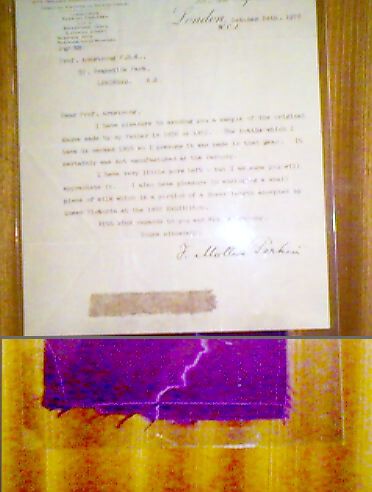
Perkin’s son’s letter with samples of dyed silk
From Home Laboratory to Factory. Perkin quickly realized the potential of his invention and filed a patent in August 1856. His professor did not welcome Hoffman abandoning his academic career to devote himself to dye production, but the student found a decisive ally in his father, a construction businessman who financed the project.
Thus, in 1857 he opened a factory at Greenford Green, near London, to manufacture dyes commercially. This decision turned a laboratory curiosity into a business and paved the way for the first major industrialization of synthetic organic dyes.
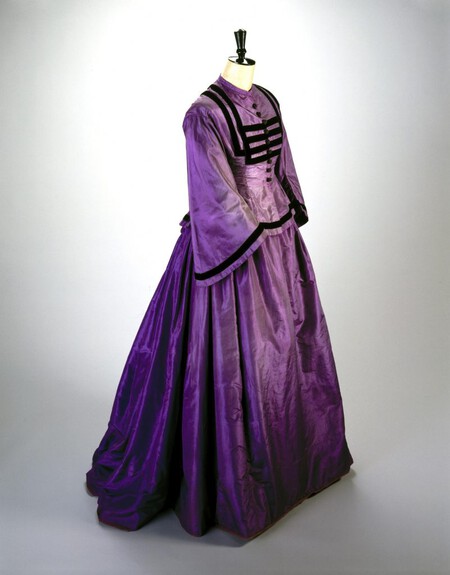
Europe is scarred by mauve fever. Because the invention came at a perfect time: lilac, purple and purple tones were fashionable among women of the wealthy class. Empress Eugenie, wife of Napoleon III, was one of the greatest references to Parisian fashion and helped popularize that range of colors.
Although British textile manufacturers received the new dye with some initial skepticism, its adoption in France in late 1858 led to a veritable fever for mauve that later spread to London. The dye, initially named aniline violet and commercially known as mauve from the French name for mallow flower, would receive the scientific name mauve in 1863.
A revolution much bigger than fashion. Perkin’s success proved that chemistry could transform industrial waste into entirely new commercial products. Other synthetic dyes soon appeared, such as fuchsin and magenta, as laboratories perfected methods for making increasingly complex molecules.
That industry paved the way for new drugs, explosives, synthetic materials and polymers, in addition to promoting the creation of industrial research laboratories. However, another paradox also occurred: while the United Kingdom pioneered the business, Germany took the lead from it to invest heavily in research, chemical training, and technological development.

Inheritance of a failed test. Perkin sold his company at age 36 to devote himself to research, and in 1906 received the first Perkin Medal, created to recognize his contributions to industrial chemistry. His discovery continued to raise scientific questions long after his death in 1907.
The structure of mauvein was not elucidated until the 1990s, and subsequent analyzes identified new components of that dye. Ironically, as we shall see, Perkin never produced the quinine he sought to “save the world,” but his failure helped lay the foundation for an industry that would also transform pharmaceutical production. He started trying to cure a disease and literally, his failure changed the color of the world.
Picture | JWBE, Wikimedia, Henry Rzepa, Science Museum
In Xataka | We all know that green traffic lights are for moving. Except in Japan, who maintain that green is actually blue
In Xataka | We used to believe that air conditioning was the only way to escape the heat. A Mexican architect has been cooling homes with paint for decades