There is knowledge that can be used both to solve a problem and to create it. It all depends on who uses them, for what purpose and under what circumstances. This distinction, which we recognize easily in fields such as computing or scientific research, takes on another dimension when we speak Artificial intelligence. Today’s models can use tools and tackle increasingly complex tasks, but their abilities don’t depend solely on the instruction they receive. They are also conditioned by what they learn during their development, and there is a decision that deserves attention.
Tencent has just unveiled Hy4, the latest version of its family of AI models, after releasing a preview version last August. According to the Chinese company, the leap compared to that version has resulted in extensive training and improvements in following instructions, handling wider context and solving multi-step tasks. The launch is looking to strengthen its position in a competition where companies like Dipsik and Alibaba are also participating. But there is one aspect of the documentation presented by Tencent that deserves as much attention as its technological advances.
One of the great innovations of the Hy4 is that it incorporates vision and computing capabilities for the first time. It allows you to interpret images, analyze complex graphics, and work with both commands and graphical interfaces. The company claims to have prepared you to use special programs, eg Blender and CAD design toolsIn addition to addressing video game programming and development tasks. These capabilities can also be combined: the model is designed to perform tasks that require different steps and the use of different tools.
An AI that learns to do more, but not all
However, there is a less visible decision in Hy4’s development that deserves as much attention as its new capabilities. In the official documentation, Tencent explains that it has prioritized defensive cyber security information, aimed at identifying vulnerabilities and facilitating their correction, and that it has explicitly excluded offensive elements related to exploiting these flaws from the training. The distinction is important because it is not just a matter of preventing the model from answering specific questions, but of choosing which data is used to develop it. This is a deliberate decision by the company, although it has not yet been proven that these restrictions prevent potential malicious use.
This does not mean that Hy4 is unaware of how a computer system is analyzed or how its defenses are tested. According to Tencent’s official statement, the model also includes Knowledge of reverse engineering and penetration testing for analytical purposes, two disciplines used to test programs and assess system security. What the company wants to distinguish is its application of protection from content intended to exploit vulnerabilities for offensive purposes.
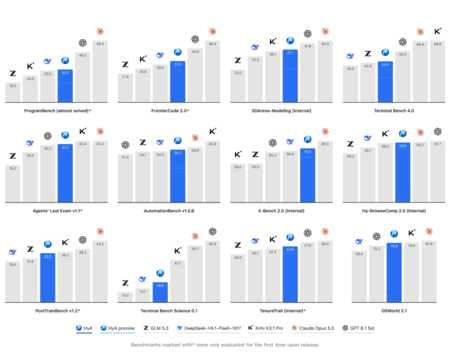
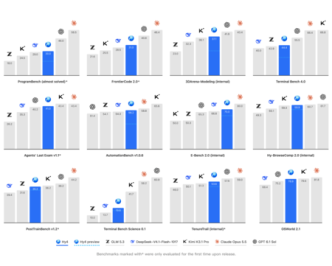
Tencent compared Hy4 performance with models from OpenAI, Anthropic, DeepSeek and other competitors Photo: Tencent
To put the Hy4’s capabilities into perspective, it’s also worth looking at its results against other models. In a comparison published by Tencent for Terminal-Bench 4.0, in a test of tasks performed from the terminal, the Hy4 scored 44.4 points, compared to 55.5 for the GPT-6.1 Sol from OpenAI and 66.8 for the Kimi K3.1 Pro. In another evaluation conducted by the company with 213 professionals and 579 financial functions, it was narrowly ahead of Dipsic V4.1 Flash: 3.04 compared to 2.97. For its part, the Nov. 3 Arena Agent rankings put the Hy4 in 14th place, behind the Gemini 4 Carbon, second, and the GPT-6.1 Sol, sixth. They are tests of various activities, conducted using their own methods and do not allow the establishment of a universal classification.

Beyond its performance, it remains to be seen whether the data filtering strategy actually works. The Chinese firm claims that experts from its Xuanwu Lab and Qin Security Lab laboratories have subjected Hy4 to evaluations on cryptographic reverse engineering, binary file deobfuscation and vulnerability exploitation. According to their conclusion, No significant problems were detected Regarding the offensive ability in the examined area. Of course, we are looking at the results reported by the company. Later, they say, will come the weight of the model and its technical safety documentation, materials that could facilitate new evaluations.
Tencent isn’t the only company to explore this approach. The Moonshot AI responsible for Kimi, during the development of Kimi K3.1 Pro, removed cybersecurity information during both intermediate training and reinforcement learning. In an internal evaluation that allowed three attempts per problem, a version without this limitation solved 90.5% of vulnerability exploit tests, compared to 81% for the final model. For its part, the British AI Security Institute investigated the filtering of potentially dangerous biological information in experimental models. Their results were promising, although not directly extrapolated to Hy4.
Picture | Tencent
In Xataka | The data center also ran in the US elections and lost miserably