
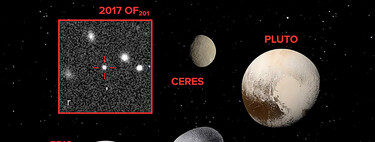
Many consider Pluto’s demotion from a planet to a dwarf planet a shame. There are scientists who believe that, in fact, it was the most beautiful thing and there is nothing wrong with it, since the title of dwarf planet is also very special. In fact, it is so special that very few have been found in the solar system. Today only five are confirmed: Ceres, Pluto, Haumea, Mekmek and Eris. Several other candidates have been identified over the years, but they have not been confirmed. Now, an international team of scientists has found another candidate for observations made from the Vera Rubin Observatory.
Statistics. The new dwarf planet candidate is called 2026 ED138. It is an object between 600 and 1,500 kilometers in diameter, at a distance equal to 46 times the separation between Earth and the Sun. It is so far from the Sun that it takes 281 Earth years to make a complete revolution around it, and its orbit is inclined at 25º compared to the rest of the planets.
Not asteroids or planets. Broadly speaking, a dwarf planet is an object that cannot be considered an asteroid but is not large enough to be classified as a planet. Its mass must be sufficient so that, due to its gravitational force, it has acquired a spherical shape like a planet. However, it has not been able to clear the vicinity of other objects crossing its orbit. This criterion is the last by which an object without the last name cannot be considered a planar planet.
We know that 2026 ED138 is quite large and is not alone in its orbit. What is not so obvious is that its mass has rounded its shape. Therefore, it is necessary to analyze the object more precisely, if possible by light curve and infrared analysis. James Webb, for example, might be a good option.

Discovered by chance. The Vera Rubin Observatory in Chile has been operating for about 16 months. However, its most ambitious project started recently, in June 2026. It will map the skies of the Southern Hemisphere with greater precision than ever before. It has a 3,200 megapixel camera, which takes a detailed image approximately every 40 seconds. The telescope observes the southern sky every few nights for 10 years, so with this technique it can collect data from each point in the sky about 800 times. It allows detecting subtle phenomena and moving objects. In fact, the final result will not be fixed, but in the form of a time interval.
A scientist named Matthew Holman was analyzing these images when he saw something that caught his attention. It was an object that must have been very large given its brightness and distance. Initially he thought it might be a mistake. He checked everything again, but the mark was still there. By notifying other colleagues and continuing the search, the same signal was detected in 30 images taken by Vera Rubin between March 4 and July 11, 2026. It is clear that this was not a coincidence.
was unnoticed. 2026 ED138 is a trans-Neptunian object; Which, as its name suggests, lies beyond Neptune. It is located in a region with a large concentration of stars, so its brightness made it difficult to detect the object in images of the region by other instruments. It was necessary to map the sky with Vera Rubin to bring it to light. Never said better.
And now what? For now, the International Astronomical Union’s (UAI) Minor Planet Center has confirmed these scientists’ observations. However, it needs to be accurately measured in the infrared to confirm that it is indeed a dwarf planet. Other candidates, such as Sedna, Gonggong, Orcus and Quaore, are also awaiting a resolution from the UAI. Therefore, we have to take this information with caution. Until it is fully confirmed, Pluto stands alone with four dwarf planets in the entire solar system. It is so special that it has less number than normal planets. Or at least found less. That may be the key.
Picture | Illustrated by the Vera Rubin Observatory. Alice Kitterman and Gavin Flowers/US National Science Foundation
In Xataka | The definition of a planet is wrong, and Pluto is a major victim of this confusion