
Nothing announced its new generation of smartphones in July 2023 with the Nothing Phone (2), and you can now follow our detailed analysis of the new top-of-the-line model. Following the same bold aesthetics of the first generation and the same concept, the phone features a transparent design for the back with the traditional Glyph, which is an LED interface that interacts with the operating system.
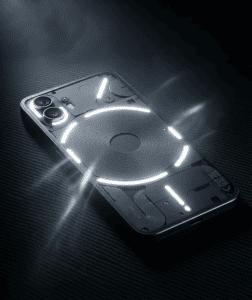
Visually, the Nothing Phone (2) has changed almost nothing compared to its predecessor. Apart from some minor details in the positioning of the Glyphs — which are the LEDs on the back of the phone —, everything is very similar to the Nothing Phone (1).
It’s clear that the “different” look is one of the main attractions of this brand, so it’s natural that the company doesn’t change the transparent back structure much.
All of this is accompanied by a very premium build: metal on the sides, glass on the back, and Gorilla Glass for the screen. Only the water resistance leaves a little to be desired: it has an IP54 certification, instead of the IP68 expected of a flagship.
Configuration and performance
As for the standard test, it achieved 1,167,098 points on the AnTuTu Benchmark — a great average for a top-of-the-line device. For comparison, the
scored slightly higher, at 1,181,150.
Screen
On the screen, Nothing continues to bet on the OLED panel. The Nothing Phone 2 has a 6.7-inch display with a 120 Hz refresh rate and a resolution of 1080 x 2400 pixels.
The display is good, and the brightness level is medium to high: it’s not bad, but it falls a little short of expectations — exactly as it was on the Nothing
The OLED panel is of good quality and is great for saving energy, but it doesn’t reach the level of an AMOLED, for example.
The color level is acceptable, but it lacks the pleasant intensity and vibrancy of advanced cell phones. It’s good, but a little “bland”.
Cameras
The Nothing Phone (2) has a dual rear camera setup with 50 MP each, and this combination delivers excellent images. Photos taken with it, whether using the ultrawide or main sensor, are very sharp and rich in detail.
Selfies work the same way, and even indoors, the device manages to deliver good results. A highlight is the portrait mode, which, both on the rear and front cameras, has a very precise cutout.
The maximum recording resolution is 4K with the rear camera and 1080p with the front camera. The overall definition is quite satisfactory in both cases, as is the stability.
Battery
The Nothing Phone (2) battery leaves a little to be desired in everyday use. Not that it’s actually bad. But, in our tests, the battery life was a little below average. After using various apps for more than six hours, interspersed with screen-off time, the consumption was 31%.
Considering that this is a test simulating real-world use, in this scenario it is estimated that the phone’s full charge will last approximately 17 hours. For comparison, the average consumption of other cell phones—whether top-of-the-line or mid-range—is 24% to 26%.
Resources and connectivity
In terms of wireless connectivity, the Nothing Phone (2) leaves nothing to be desired. The phone already features the Wi-Fi 6 standard, which allows for faster and more stable connections with routers compatible with the technology. In addition, 5G is built-in, as well as NFC for contactless payment.
But the big difference of the Nothing Phone (2) is the interface, which consists of some LED points positioned on the back that interact with the operating system. In this way, they light up or blink when they receive calls, notifications or when the phone is charging, for example.
The Nothing Phone (2) is a device that makes a lot of sense and, for the price range, is worth buying. It is a very competent top-of-the-line device and delivers performance as expected.
Its camera setup is also quite respectable and delivers excellent images. Although it leaves a little to be desired in terms of battery life, it’s not far behind its main competitor, the Galaxy S22 Ultra, in this aspect.
However, it’s worth noting that the device isn’t sold in the Brazilian market, and the price may still increase slightly due to taxes. Therefore, if you want a fairer price, the best choice is the Galaxy S22 Ultra, which is already sold in our country.