With each new smartphone release—especially a flagship model—tech enthusiasts (myself included) commonly complain about the limited advancements from one generation to the next. The Galaxy S26 Ultra, finally, broke that rule.
Samsung’s most advanced phone in 2026 arrived with undeniably significant changes compared to the Galaxy S25 Ultra. Not only because of the “anti-spy” screen or the stability mode that locks onto the horizon, but because of the overall package.
The new Korean flagship arrives with advancements that break the mold, the “cliché”: it’s not just a more powerful phone or one with better cameras. It’s the phone that will make you want to upgrade yours.
But is it worth it? In this review, I’ll share my experience using the Galaxy S26 Ultra over the past few days, and what really won me over when using it as my main phone.
Privacy screen and super steady mode with horizon lock
If you follow the smartphone market, you’ve probably seen countless Reels and TikToks about these two specific features. After all, Samsung spared no effort in promoting them—although the features could already speak for themselves. They are, in fact, quite interesting and work perfectly.
Anti-spy screen
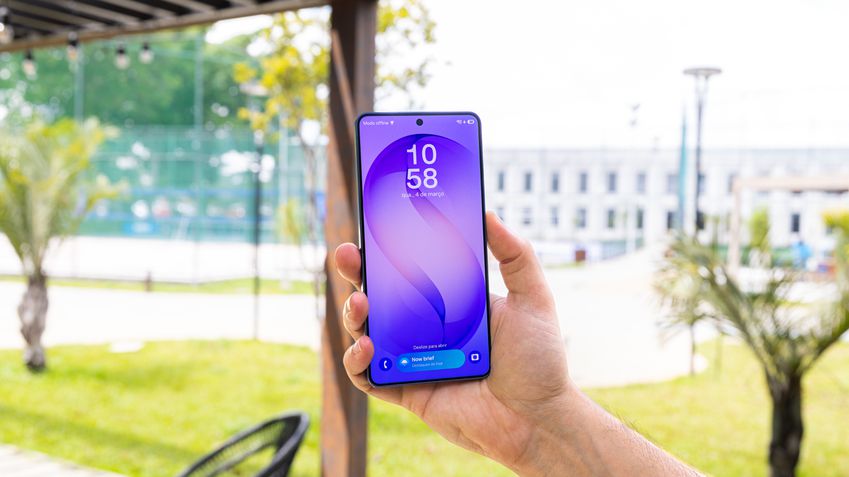
The “anti-spy” screen offers two levels of blocking for anyone trying to look at the panel from the sides or from above. It’s like having a privacy screen that can be activated or deactivated.
And here I must advocate a little more for this feature: some “critics” argue that it’s easier to buy a privacy screen protector, but Samsung’s magic is in the details.
With this feature, you can select specific apps to dim —such as banking apps— just an area of the screen, or only the notifications that appear. Therefore, it works differently from screen protectors.
This is good because you don’t always want the screen to be obscured. A screen protector, for example, prevents you from clearly seeing the screen when the phone is on a table at an angle that isn’t ideal for your eyes. Similarly, this type of accessory also tends to significantly reduce display quality.
Super stable mode
With the S26 Ultra, Samsung introduced a super stability mode for video recording. This mode locks the focus on the horizon, allowing for shake-free filming. This is particularly useful for recording landscapes or shots in open fields.
The feature went viral with “absurd” tests, with users rotating their arm to show how stable the video remains in one spot, or even in more extravagant scenarios, such as attached to a power drill or even a car wheel.
The result is always very satisfactory: even with a lot of rotation, the phone always remains in the correct orientation, without turning upside down.
Although these applications are quite different and somewhat “unusual” — after all, who’s going to make a video by constantly rotating their phone? — the feature is more interesting in practice, for actually stabilizing a recording more efficiently.
It’s useful for filming in moving cars, driving on rough roads, or any time when you can’t have much hand stability. In the video below, you can see that my hand shakes quite a bit, but the horizon is fixed, without replicating the movements.
New AI features
As I said, these two features are the most viral, but what really caught my attention are the new AI functionalities. Introduced with the Galaxy S24, Galaxy AI has improved significantly each year, but this latest update brought even more interesting advancements.
Now, the noise reduction feature works not only for video editing in the gallery, but also in third-party apps. It can reduce the noise level in apps like TikTok, YouTube, Instagram, and others.
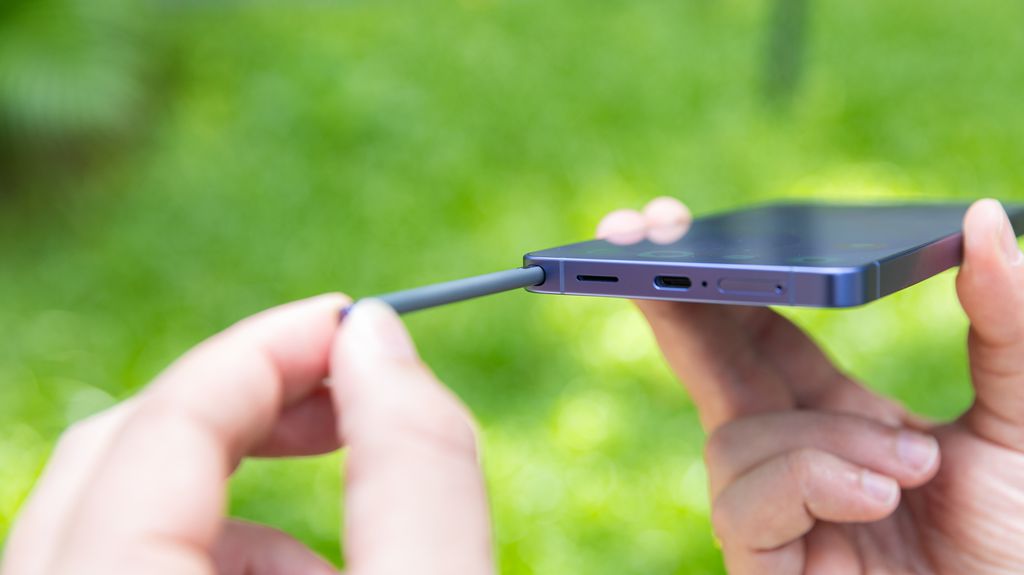
Photo editing, however, has seen even more improvements. Now, you can not only erase an object and expect the AI to do random work, but you can also define exactly what you want in the photo, no matter how specific it may be.
It’s possible to replace a car with a truck, a crescent moon with a full moon, eyeglasses with sunglasses—in short, practically anything. In the image below, for example, I asked to replace a common stone with an amethyst, and the result was quite satisfactory.
In the previous generation, if I just removed the stone, it would be replaced by something random or the AI would simply complete my hand. Now you can choose what you want.
Current chatbots, such as ChatGPT and Gemini, already perform similar tasks, but Galaxy AI appears to do so more effectively.
Design and construction
Samsung has made significant changes to the design of the Galaxy S26 Ultra. After four generations with the same visual identity, the South Korean company has abandoned the aesthetic with “loose” cameras on the back in favor of a pill-shaped module that houses the three larger sensors, while the other two remain loose to the side.
I, personally, didn’t like this change that much — I prefer the “all or nothing” approach: either everything is loose or everything is grouped together. But beauty is quite subjective, and there are those who prefer this new look.
Opinions aside, there are other structural changes: the corners are now more rounded, and it’s increasingly leaving behind that right-angle look that has been gradually abandoned since the last generation.
The material used in the phone also changed, and the phone abandoned titanium to bring back aluminum. This allows the phone to be lighter — it went from 218 grams to 214 grams — and dissipates heat better, but sacrifices some impact resistance.
Settings and performance
The Galaxy S26 Ultra unit I received for testing is the 16 GB RAM and 1 TB internal storage version. This is the most powerful version, as the others are limited to 12 GB of memory.
Regarding processing, the phone is equipped with the Snapdragon 8 Elite Gen 5 chip. Qualcomm’s most powerful component this year promises not only more processing power, but also a more powerful NPU to perform AI tasks.
The performance leap is quite significant. Although barely noticeable in practice — after all, the S25 Ultra is already a “monster” in terms of speed — the phone reaches a very high level in benchmarks. In AnTuTu, it achieved a total score of 3,866,404 points. For comparison, the iPhone 17 Pro reached 2,569,953 and the Galaxy S25 Ultra scored 2,397,597.
These numbers are more useful for showing which one is more powerful on paper, and the millisecond difference is barely perceptible in “real life.” But they do show that, in the long run, Samsung’s latest phone can withstand more strain.
In any case, it’s a phone that can handle practically any task, not just artificial intelligence, but also running very demanding games.
Battery without upgrades
While it has evolved significantly in other aspects, the Galaxy S26 Ultra’s battery remains at a level equivalent to the Galaxy S25 Ultra.
In our standard power consumption test, the Galaxy S25 Ultra consumed 30% of its battery, while its successor only used 20%. In everyday use, however, both can last a full day away from the charger, with very moderate usage.
If you use the device intensively, with social media and frequent camera use, you might need an extra charge before the end of the day. In my daily routine, with moderate to heavy use, I can get through a whole workday on a single charge, but I need to plug it in as soon as I get home.
The charging, however, has improved. Now the phone supports 65W charging — previously it was 45W. With this power, it can achieve a full charge in approximately 45 minutes.
Cameras
The Galaxy S26 Ultra’s camera setup retains the same resolutions as the previous generation, with incremental changes to the size and aperture of some sensors.
In practice, however, the differences are subtle. The phone maintains very good HDR, which manages to highlight both darker and lighter areas well, but I noticed a significant improvement in the level of detail, with more realistic textures. This is most noticeable when capturing each mark on the skin with precision.
The maximum digital zoom mode, at 100x, also seems to capture more detail, but it still makes text images look quite artificial—something natural for this type of recording.
For video recording, the phone films in 4K at 60 fps with both the front and rear cameras. With the main camera, it can reach 8K at 30 fps.
Galaxy S26 Ultra or iPhone 17 Pro?
Comparison is inevitable: Samsung’s new release will always raise the question of whether it’s better than Apple’s. And vice versa. Ultimately, the choice will come down to preference for the system and ecosystem.
In everyday use, both are equally powerful and each has its strengths. Apple offers a more powerful battery and better video features. Samsung has truly useful and functional AI functions, and some interesting new features for both video and image editing.
Regarding price, the 1TB iPhone 17 Pro can be found for around R$13,000, while the Galaxy S26 Ultra with the same storage, despite being more recent, is already being sold for R$500 less. This price difference is likely to increase even further in the coming months.
Is the Galaxy S26 Ultra worth buying?
Yes, the Galaxy S26 Ultra is worth it. Even though the launch price of the most complete version is still quite high, it’s a very complete phone, with significant changes compared to the previous generation and exclusive features that make all the difference.
My recommendation, however, is to wait. As amazing as the phone is, its price could still drop significantly over the next few months, and if you’re patient you might find a better deal in the not-too-distant future.