You may be overwhelmed trying to keep up with all the coverage of the battle for Congress. Or your head may still be spinning from the fact that a staggering $10 billion has been spent so far on advertising in this election — exceeding the total cost of ads booked during the 2025-2026 N.F.L. season.
So one thing that may have escaped your attention — but is really important — is the fact that nearly every state is electing state legislators as well.
State legislatures can serve as laboratories of democracy, enacting laws on everything from data centers to taxes to abortion before Congress does. But this year, there’s an extra incentive to win these state races: Whichever party has control over a state legislature could potentially redraw congressional maps in time for the 2028 election.
So my colleague Ashley Wu and I came up with what we hope is a reader-friendly guide to some of the key states where partisan control of the legislature is at stake.
If one party sweeps the legislature and the governorship, the resulting “trifecta,” as it’s known, gives the ruling party the power to pursue ambitious policies — like redistricting — with minimal headwinds.
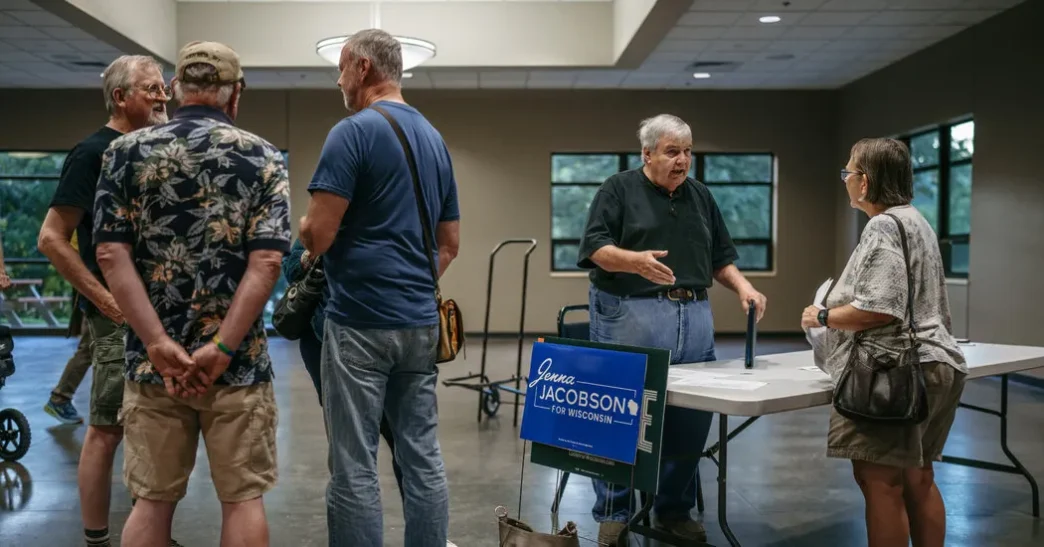
Redistricting is very much on the minds of Democrats in Wisconsin. Since the state’s Supreme Court ordered new legislative maps to dismantle a Republican gerrymander, Democrats have been whittling down the Republicans’ edge. Now they think they have a decent chance of claiming a trifecta. So keep an eye on a State Senate race in a rural district southwest of Madison, and three Assembly races in districts bordering Minnesota.
Also, pay attention to whether a party gains or loses a supermajority in the legislature.
Having a supermajority — usually, that means controlling two-thirds of seats — allows a legislature to override a governor’s vetoes. That is a powerful tool when the governor is from the other party. Just ask Gov. Laura Kelly of Kansas, a Democrat who has often been blocked by a Republican-dominated legislature. Or Gov. Phil Scott of Vermont, a Republican who gained more leverage after Republicans broke the Democrats’ supermajority in 2024.
Then again, legislative races are notoriously difficult to forecast, in part because hyperlocal issues can often make the difference. So don’t forget to vote — and to check back in after Nov. 3.
Get Caught Up
In 2024, shortly after he won the presidential election on a platform to make America more affordable, Trump told NBC News, “I won on groceries.”
But two years later, groceries, like so much else in the United States, have gotten even more expensive.
Our reporters visited supermarkets in four battleground states — Iowa, Ohio, Maine and Michigan — to see how voters were feeling about the cost of stocking their kitchens. Here’s what some of them had to say.
“I don’t think he has lowered prices for anything.”
— Jessy Hakizimana, 44, of Indianola, Iowa
“I think Trump did a better job as president like eight years ago.”
— Rebecca Guerrette, 58, of Thomaston, Maine
“I’m worried that some of the Democratic policies would have made it worse.”
— Bob Behrens, 56, of Polk City, Iowa
What Vance’s insult says about Vance
Vice President JD Vance was in Texas this week, rallying for the Republican Senate nominee, Ken Paxton, when a member of the crowd shouted out, “I love you!”
Vance’s response:
“I love you too, sir. In a totally platonic way, to be clear. I’m the vice president, not James Talarico.”
Democrats criticized the vice president’s gay joke as offensive and juvenile. Senator Jon Ossoff of Georgia called it “feeble and weak.”
But it was also a telling moment for Vance. As he wades further into the 2028 presidential race, Katie Rogers writes, Vance will have to decide which version of himself to lean into — the very-online millennial who enjoys expletives and insults, or the fraud-seeking missile who suggests that Americans lean toward sanity.
Number of the Day
$64 million
Speaking of Talarico … that’s how much the Texas Democrat raised from July through September, according to his campaign. The sum, his campaign said, was the most any Senate candidate has ever raised in the third quarter of the year.
Talarico’s haul was far more than the $18 million that Paxton, his Republican opponent, raised in the same period — though Paxton has benefited from hundreds of millions of dollars in spending from outside groups.
The Texas Senate election is on track to be the most expensive nonpresidential race in U.S. history. And, as our polling editor Ruth Igielnik noted yesterday, the gap between Talarico and Paxton appears to be tightening.
The ouster of Kimberly Guilfoyle as ambassador to Greece this week was part of a larger pattern in Trump’s second term, Erica Green writes: Most of the prominent figures who have departed the administration — either voluntarily or involuntarily — are women.
In addition to Guilfoyle, there was Attorney General Pam Bondi; Lori Chavez-DeRemer, the labor secretary; Homeland Security Secretary Kristi L. Noem; and Tulsi Gabbard, the director of national intelligence.
All four of them were replaced by men.
Taylor Robinson contributed to this newsletter.