

At the turn of the 20th century, one of England’s largest cathedrals was slowly sinking into the ground where it had stood for more than 800 years. Engineers found an extraordinary and very scary solution: sending a diver to work beneath its flooded foundations in virtually complete darkness. For five and a half years, William Walker tossed around 26,000 bags of concrete under several meters of water.
His work is recorded in the history books.
A cathedral built on a geological trap. Winchester Cathedral began to be built in 1079 beside the old bed of the River Itchen in southern England. Beneath its massive walls were layers of peat, wet silt and gravel, making the foundation extraordinarily complex.
Medieval builders tried to solve the problem by using oak piles and, during the 13th century extension, a double layer of beech logs to support part of the building. This solution allows the works to continue, even though the weight of the structure progressively compresses the land.

The crack declared disaster. Structural problems began long before the 20th century, but by 1905 they had reached an alarming intensity. Large cracks ran through the masonry and some areas of the cathedral showed obvious signs of settlement.
Architect Thomas Graham Jackson and engineer Francis Fox studied a particularly delicate situation: foundations resting on waterlogged soil whose behavior changes with the seasons. The stability of one of England’s great medieval monuments depends on finding ways to strengthen its foundations without causing new ground movements.
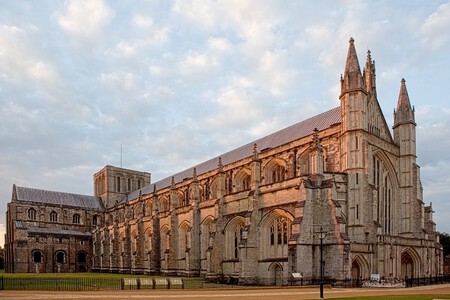
Present Winchester Cathedral
The problem was six meters under water. The conventional solution was to excavate around the foundation, remove unstable material and build new concrete supports. However, every time the excavation went beyond the pit, water flooded the wells and the ground lost stability.
Pumping it down before it is consolidated can displace the silt and increase damage to the wall. In March 1906, Francis Fox proposed an unusual alternative: introducing a diver into the flooded excavation to remove wood and peat residues and place concrete bags directly under the water.
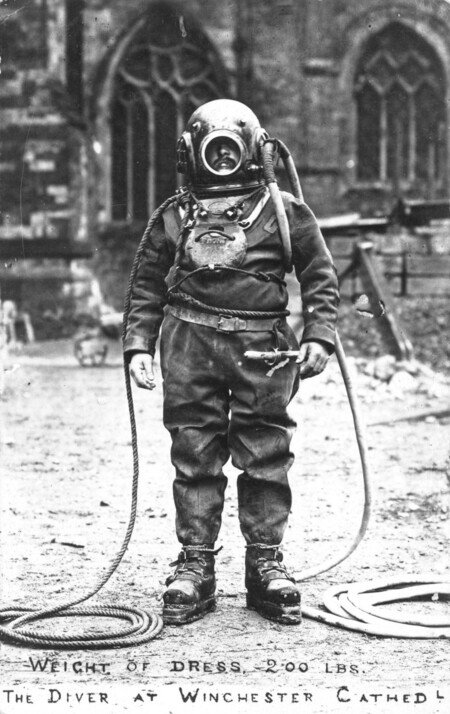
Walker before starting action
Act blindly under a cathedral. One chosen was William Walker, an experienced professional diver who had worked in port facilities and underwater. He arrived in Winchester in April 1906 with another specialist, Rayfield, with whom he initially shared the work. After the first year, Walker began working underwater until it ended in September 1911.
Equipped with a heavy diving suit and a diving suit, which was fed with air from the surface, the man descended into the flooded well where the mud made it practically impossible to see anything. There he removed the decaying materials and hung each sack above his workspace, guided mainly by touch, on the cathedral walls.
25,800 bags are kept each. Historians say Walker usually worked two four-hour shifts, during which he sunk about six hours a day. Their goal was to clean the bottom of the wells until a resistant layer was reached and build a foundation with bags of hydraulic cement that could harden underwater.
The operation involved 235 excavations and required the handling of approximately 25,800 bags in near-zero visibility conditions. Over five and a half years, divers repeated that operation thousands of times, which became an essential part of the most unique foundation work of its time.
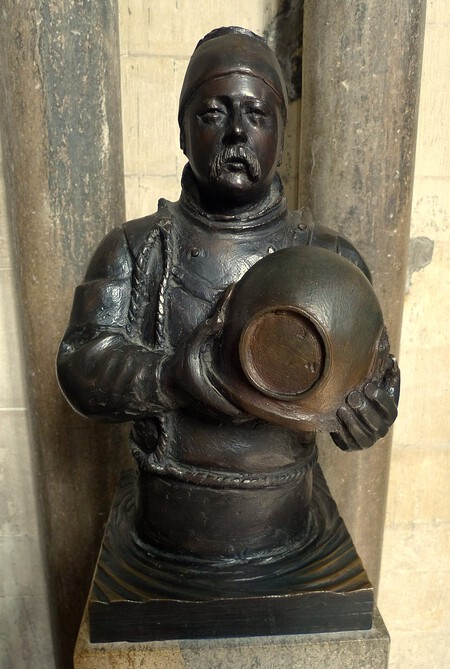
Bust of William Walker, the man who saved the cathedral by diving under it
Time to draw water. Once the base built by Walker solidified, workers were able to pump water from the excavation with greater safety and complete the cathedral’s new supports. About 150 workers participated in various stages of the restoration, which included the installation of about 114,900 concrete blocks and the use of about 900,000 bricks in repairs.
The method made it possible to transfer the weight of the walls to a more resistant level and stop the deterioration that threatened the building. Walker’s intervention was decisive because it made possible the later work of masons and builders.

That hero left under the foundation. This achievement made William Walker a celebrity and earned him the recognition of King George V, who made him a member of the Royal Victorian Order, although his life ended prematurely on October 30, 1918, aged 54, during a flu epidemic.
Today, a statue with his diving equipment commemorates his contribution inside the cathedral, where some of the cracks that inspired that intervention can still be seen. The building still stands and its foundations are under surveillance, more than a century after a man spent scuttling underwater to help save it.
Picture | Henry Burrows, Hampshire Archives and Local Studies, WyrdLight.com
In Xataka | After the fire of Notre-Dame, Paris only wanted to rebuild it and shade it with trees: the land returned to Lutetia.
In Xataka | The Etruscans designed their tombs 2,500 years ago with an overwhelming “cathedral effect”: death was a sensual spectacle.