ChatGPT came in November 2022 and turned everything upside down. OpenAI was the first, but soon rivals appeared and a frantic race to get the best possible AI began, ending in a hundred lawsuits with extensive training and questionable methods. but The best AI doesn’t have to be the most usedNot that most people are willing to pay because well, it’s a business and what a business.
Well, analytics company Similarweb has put statistics on the question of which one is used the most and the last 12 months’ diversity results have more substance than it seems. And since a picture is worth a thousand words, Visual Capitalist turned it into a graph where each cell is a chatbot and its size is its usage rate. Spoiler: ChatGPT is still the clear leader, but its lead is shrinking. Indeed, it shows that the market for AI models is not monopolistic, with little by little more people gaining access and some companies and models taking off while others stagnate.
The graph answers the question How many enter each AI model through the browser, and this marks the first limitation: AI used in apps or through APIs, or integrated with other products, does not count. Additionally, visits are not actual users or usage: a visit can be a seconds-long consultation or a long work session. And the data is estimates, not counts: It calculates it from a panel of similar web users, data from partners and internet providers, direct measurements from web trackers and sites that combine its analytics.
That said, the absolute leader is ChatGPT, with nearly 5.9 billion visits in September. Its share went from 71.8% to 56.4% in eleven months, but not because it lost traffic: its web visits went from about 5.7 billion in January to about 5.9 billion in September. What happens is that Gemini and Claudius grow up fast.
Usage rate of AI models in a graph
Between them they accumulated 34.6% of traffic (Gemini, 25.0%; Claude, 9.6%), and Anthropic’s chatbot moved from fifth to third. Gemini has an ace up its sleeve: its distribution through the vast Google ecosystem (according to TechCrunch, the Gemini app has surpassed 750 million monthly active users). Claude, for his part, has found his niche in programming and knowledge work, and is making himself known to the general public through campaigns like his Super Bowl commercials. And the tug-of-war with the White House doesn’t seem to have taken its toll: After clashing with the Pentagon, it climbed to No. 1 on the US App Store.

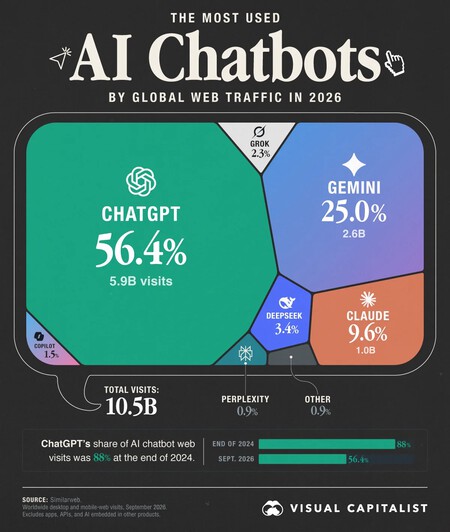
The most used AI chatbots in 2026 according to global web traffic. Visual Capitalist with a similar web
ChatGPT leads with estimated 5.9 billion visits and 56.4% share in September 2026. Gemini follows, with 2,615 million visits and 25.0%, and Claude, from Anthropic, completes the podium with nearly 1,000 million visits and 9.6%. This trio was followed by, in that order, Dipsic (356 million visits and 3.4%), Grok, from Elon Musk’s emporium (2.3%), Copilot, from Microsoft (1.5%), and Perplexity (0.9%).
The most interesting thing is evolution Last year: ChatGPT lost 15.4 points, Gemini gained 11.4 and Claude 7.3. Since April, however, ChatGPT has recovered slightly (53.7% to 56.4%) and Gemini has declined slightly (26.7% to 25.0%), while Cloud continues to grow, albeit slowly. Notable for Copilot and Grok: Both lost half a point despite the former’s preferential position with Microsoft’s vast ecosystem and support for the latter. Confusion worsened, falling 1.6 points.
Of course, the measurement method works against several. Copilot, which resides between Windows and Office, is deprecated. But of course, it’s reasonable to think that this penalizes Claude for use in its apps, APIs, and programming tools, or that Dipsic is most affected: due to its open weight, a good portion of its use likely occurs outside of its website, and if a significant portion of its audience is in China, a similar web-like panel has predictably less coverage.
In Xataka | Who’s really winning the AI race, in a graph that has Google in trouble
In Xataka | If the question is which big tech companies are winning the AI race, the answer is: none
cover Visual Capitalist