
For decades, millions of people believed that Tang, the popular powdered orange drink, was invented by NASA to feed its astronauts. The reality is much more curious, because the product was already sold in American supermarkets before John Glenn circumnavigated the globe, and its initial sales were far from encouraging to its creators. It was enough for the space agency to include it in its mission for a simple drink to become a symbol of space conquest. The association led to one of the most profitable misunderstandings of the space race.
That invention was born in a supermarket. The story begins in 1957, when a food chemist at General Foods, William A. Mitchell created a mixture of flavored crystals that made it possible to create an orange-flavored drink by simply adding water. The product, known as Tang Flavor Crystals, arrived in American supermarkets in 1959 with a proposition quite typical of the time: to offer a practical alternative to juice, rich in vitamin C, that did not require pressing or refrigeration before preparation.
However, initial sales were modest, and the drink struggled to stand out among the many processed products flooding American homes. In any case, its creator worked for a food company and his goal was to conquer the breakfast table, years before NASA became interested in the formula.

Behind half the American pantry is a chemist. Mitchell represented the post-war food industry’s fascination with transforming food through alchemy. He worked on food substitutes during World War II and created such well-known products as Pop Rocks effervescent candy, Cool Whip whipped topping, and quick-make gelatin mix.
Throughout his career he collected about 70 patents and became one of the inventors of General Foods. Tang fits perfectly into that industry philosophy: reducing food storage, transportation and preparation issues with easy-to-market solutions. The formula arose from that search for domestic comfort, its development not linked to any mandate of the American space program.
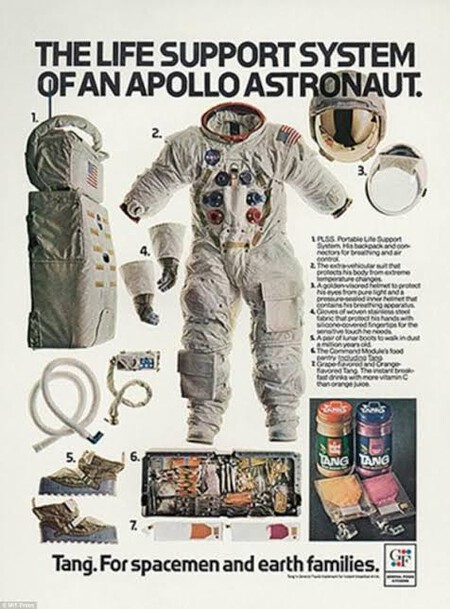
An unexpected utility. By the early 1960s, space agency engineers were required to solve everyday problems that became extremely complex beyond Earth. Drinking in weightlessness required special packaging, and some ships’ water sources had unpleasant tastes derived from their production and storage systems. Tang offered a simple solution: it was lightweight, easy to transport and could be mixed with water without having to carry a ready-made liquid drink.
NASA acquired the commercial product and adapted it to its needs by using containers that allow water to be introduced, the contents mixed, and consumed directly. The company itself confirmed that it never invented Tang and that it did not limit itself to include a formula already available in the market.
John Glenn and his rise to fame. On February 20, 1962, John Glenn became the first American to orbit the Earth aboard the Friendship 7 capsule on a mission lasting about five hours. The tang was associated with that historic flight, although the available documentation does not allow us to establish with absolute certainty whether Glenn ate it during that particular mission.
The drink was part of the American space diet and gained particular prominence during the Gemini program, which began with its manned flights in 1965. On this mission, the water obtained through the fuel cell could have an unpleasant taste, and flavoring preparations helped make it more acceptable. A practical solution to improving astronaut hydration provided General Foods with an advertising partnership that could rarely have been purchased otherwise.
The ad did the rest. General Foods quickly realized the commercial potential of associating Tang with the men leading the space race. Their advertisements began to highlight that the drink was chosen for NASA missions, capitalizing on American fascination with astronauts and Cold War technological advances. The strategy reached one of its highlights in 1968, when Tang sponsored ABC’s coverage of Apollo 8, the first manned mission to orbit the Moon.
The product has evolved from a limited commercial reception to a widely recognized beverage associated with modernity, science and the future. The power of that image fueled historical confusion: many consumers assumed that if astronauts drank tang, it must have been made for them.
A story not fully shared by the astronauts. The identification between Tang and space conquest was so intense that even the heroes of that mission had to answer questions about the drink decades later. Buzz Aldrin, the second man to walk on the moon, admitted that astronauts ate tang, though in 2013 he summed up his opinion of the taste with a devastating phrase: “The tang sucked.”
The anecdote is particularly revealing because it separates the extraordinary effectiveness of the advertising campaign from the actual experiences of those who have used the product. NASA included it for its practical benefits, while advertising presented it as a symbol of space technological sophistication.
Surviving myths of the space race. Tang’s popularity eventually declined in the United States over the decades, although the brand found important international markets, particularly in Latin America and other regions. In 2011, advertising industry publications already described it as a global brand with annual sales of more than $1 billion.
Trajectory, if you will, demonstrates how much a cultural association can transform the perception of a product and prolong its commercial success long after the circumstances that made it famous have disappeared. Tang was born in 1957 as an instant drink for the general consumer, went into space because it was useful, and became a supposed NASA invention for its advertising power. The space agency never needed to take credit for its creation so that the public would end up going for it.
Picture | Tang, MIT,
In Xataka | In 1971, an astronaut carried 500 seeds to the moon. Half a century later they are giant trees spreading across the globe
In Xataka | In 2008, a man was exploring the Australian desert on Google Earth. And then he discovered a strange hole