
In 1908, a railroad worker found a shiny rock while removing sand from tracks in the Namibian desert. It was a diamond, and the discovery unleashed a rush of riches so extraordinary that German settlers built a small luxury town in the most inhospitable place on the planet. There was a hospital, casino, theater, ice factory and even opera shows. Over the years, diamonds appeared practically under the feet of its inhabitants. Until precious stones became scarce, and the desert took its toll.
It started with a stone. The Kolmanskop story begins in April 1908, when Namibian railway worker Zacharias Lewala found a shiny stone while clearing sand that had accumulated on the tracks near Lüderitz in southwest Africa. Lewalla handed the find over to his German supervisor, August Stauch, a mineralogist who immediately suspected it was a diamond.
Engineer Söhnke Nissen later confirmed its nature and the discovery revealed a true mining fever. Stauch and Nissen won exploitation rights over vast areas of the desert, while Lewala, according to National Geographic, never received the prize for finding the rock that would change the region’s fate.
Diamonds everywhere. The wealth hidden in that terrain was extraordinary. In the early years, workers could collect diamonds directly from the surface, crawling over the sand and filling small jars with stones they found. In 1912, the Kolmanskop mine produced about one million carats a year, about 11.7% of world diamond production.
The fever attracted traders, fortune-tellers and laborers to an area where infrastructure was scarce. German colonial authorities responded by establishing the Sperrgebiet, a vast restricted area reserved for diamond mining by authorized interests and access to which is still controlled today.
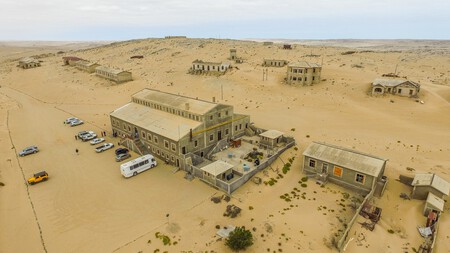
Aerial view of Kolmanskop
A small Germany in the middle of the desert. The fortune of mining allowed the construction of a city with surprising advantages for a settlement surrounded by dunes. Kolmanskop has German-style housing, electricity, a school, a hospital, a theater, a dance hall, a bowling alley, a casino, a bakery, a butcher shop, a post office, and an ice factory that supplies household refrigerators. Potable water had to be transported from great distances, while European opera companies traveled to that corner of Africa to perform for its inhabitants.
His hospital once had X-ray equipment, considered one of the first in South Africa, which, according to some accounts, was also used to detect hidden diamonds by workers. It was a display of wealth that was hard to imagine in a place where virtually everything had to come from outside.
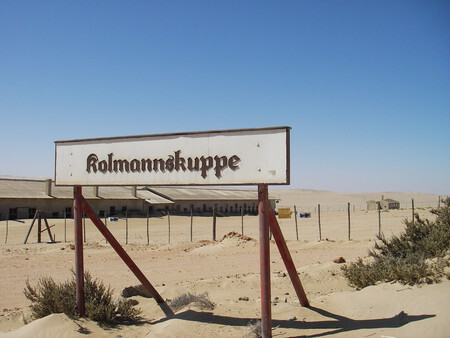
Kolmanskop town sign
Fate had another side. That prosperity was built within German Southwest Africa, a colony marked by violence and exploitation of the African population. Just four years before the discovery of Lewala, the colonial authorities had launched a genocidal campaign against the Herero and Nama peoples, responsible for thousands of deaths. In Colemanscope, African laborers endured harsh working conditions and lived in isolated facilities, while the European population enjoyed the city’s services and amenities.
Some estimates from the 1920s speak of about 350 European residents and about 800 African workers, a difference that explains why historical population figures vary so much depending on the sources consulted. The resources that transformed the desert were deeply unevenly distributed.
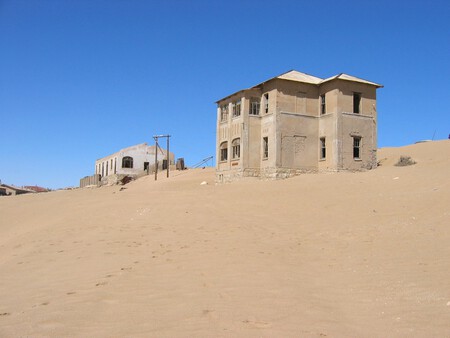
Abandoned house in the city
The day the diamond went south. The decline began when intensive exploitation exhausted the most accessible deposits in the surrounding area. In 1928, richer deposits were discovered about 270 kilometers south near the mouth of the Orange River, and mining activity began to shift to that new area. In the 1930s, Kolmanskop gradually lost its economic importance and some of its machinery was transferred to other farms.
World War I had already changed activities and ended German colonial rule in 1915, subsequently leaving the region under South African administration. If an industry could not sustain its expensive existence, it no longer made sense to maintain a luxurious city in the middle of the desert. The last residents left in the 1950s, and 1956 is often cited as the year of its final abandonment.
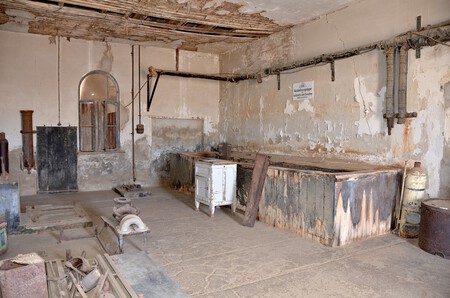
Old ice factory
The desert has taken its toll. For decades, residents kept the dunes away from homes through constant cleaning and maintenance work. When the population disappeared, the wind began to introduce sand through doors, windows and any openings in the building.
The result is one of the world’s most disturbing and fascinating urban landscapes: rooms with sand dunes that reach a good part of the walls, hallways transformed into small dunes, and old houses where visitors walk on desert accumulated soil. Remnants of wallpaper, door frames and furniture allow us to recognize spaces that were part of an extraordinarily prosperous community just a few generations ago. The same sand that provided the diamonds took over the houses built with that destiny.

A city that is disappearing. Kolmanskop has become a tourist and photographic destination within the former restricted diamond region, now associated with the exploitation of Namdev, a company owned by the Government of Namibia, and De Beers. Since 2002, organized tourism activities have allowed parts of its buildings to be preserved and opened to the public, although the structure continues to deteriorate due to erosion.
The diamond industry hasn’t disappeared from Namibia either: most mining has shifted to coastal and underwater deposits, where giant ships retrieve minerals from the seabed. Meanwhile, evidence of a prosperity at Colemanscope was as fleeting as it was intense. In 1908, the desert provided a fortune that allowed the construction of a city that seemed impossible to live in.
Half a century later, when that wealth ceased to justify its existence, it began to be reclaimed from house to house.
Picture | Damien du Toit, SkyPixels, Wikimedia, Harald Süpfle, Olga Ernst
In Xataka | In 2013, an Indian engineer created an artificial glacier in one of the world’s driest deserts. After 13 years, Agriculture stopped its innovation
In Xataka | In the middle of the Atacama desert is a mountain of 39,000 tons of clothing from around the world and is visible from space.