
In October 1977, a Saudi prince received an ancient piece of ice to travel from Alaska to a university in the middle of the United States. It required divers, a helicopter, an airplane and a refrigerated truck to move it. Its purpose was to demonstrate that humanity could solve part of its water supply problem by dragging giant icebergs from Antarctica to the deserts of the Middle East. The operation brought together scientists from 18 countries and sparked debate over one of the most extraordinary engineering proposals of the 20th century. As the ice reached Iowa, the massive ice never reached Saudi Arabia, and that demonstration ended with an outcome that is difficult to discover.
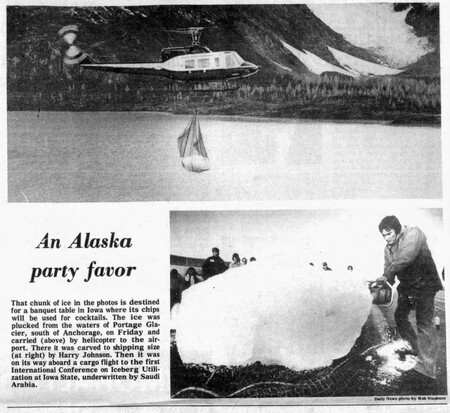
An iceberg in the most unlikely of places. The scene took place in Ames, a small college town in Iowa, thousands of miles from the polar regions. There, between October 2 and 6, 1977, the first International Conference on the Use of Icebergs was held under the auspices of Prince Mohammed Al-Faisal. To accommodate the participants, its promoters transported a block of ice weighing an estimated 1.1 tons from the Portage Glacier near Anchorage, although some later events raised this number to two tons.
According to reconstructions from the time, a team of divers intervened in its extraction, a helicopter lifted it out of the water, and it was later transported by plane and refrigerated truck to the university. Those demonstrations cost between $5,000 and $7,500, depending on the source. It was an incongruous operation to bring ice to an American city, but perfectly calculated to draw attention to a much larger project.
Bring Antarctica to the desert. Mohammed Al-Faisal was a member of the Saudi royal family and was closely involved in the development of his country’s desalination infrastructure. Saudi Arabia had a lot of oil resources, but converting seawater into usable water required a huge investment of energy and money.
Population growth and urban expansion put pressure on that system, leading the prince to explore alternatives. Their argument was based on a simple observation: every year, huge blocks of fresh water from glaciers break off and melt into the ocean. If it is possible to trap them and transport them to dry areas, those floating mountains can become a reservoir of drinking water of extraordinary magnitude.
A 100 million dollar idea. Plans by Iceberg Transport International, the company promoted by the prince, envisaged picking up an Antarctic iceberg of around 100 million tonnes and dragging it thousands of kilometers to the Arabian Peninsula. To minimize the loss of ice during voyages, engineers proposed wrapping it with insulating materials including cloth and plastic and using powerful tugboats capable of pulling such masses across the ocean.
Calculations presented then estimate a trip of about eight months and costs close to $100 million. Even admitting a loss of 20% of its volume during the voyage, its defenders considered that the resulting water could compete economically with desalination. The prince even announced that he expected an iceberg off the Saudi coast in three to five years.
Two hundred scientists and some very serious lunatics. The Iowa conference brought together about 175-200 participants from 18 countries, including glaciologists, engineers and water resources experts. Iowa State University participated in the organization through researchers such as Abdo Husseini, while the National Science Foundation contributed $25,000 and the prince another $50,000 to fund the meeting. Discussions addressed key questions: how to control towing speed, what materials can protect the ice, how much volume will be lost during the journey, and what the environmental consequences might be for parking a large iceberg near the desert coast.
Projects were also proposed to bring Antarctic water to California and other drought-prone regions. That meeting was held in the same year that the United Nations held its first major global conference on water, reflecting growing concern about the future availability of this resource.
Problem: Bringing more than just a rope. Difficulties did not take long. Antarctic icebergs may be relatively suitable for towing because of their tabular shape, but they have had to cross thousands of miles of ocean, contend with strong currents, and reach increasingly warm waters. Wilford Weeks, a researcher at an American laboratory specializing in cold regions, issued a very accurate warning: when crossing the equator, tugboats can only pull a rope.
The phrase summarizes the fear of the ice melting or breaking into pieces before reaching its destination. Added to this are the problems of building effective containment, having sufficiently strong ships and managing the water received after the iceberg reaches the coast. The enormity of these barriers prevented initial assumptions from being transformed into a viable commercial operation.
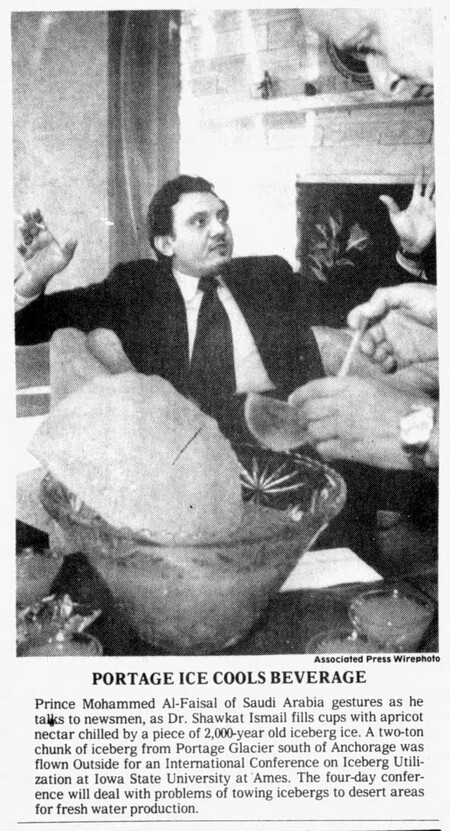
The water of the future ended up in glasses. While experts discussed how millions of tons of ice could be transported to Saudi Arabia, there was a much more domestic fate on display ready to impress them. The block from Alaska broke into pieces, and some of that ice ended up in participants’ drinks, as documented by TIME in October 1977.
Some reenactments describe large bowls of chilled punch with glasses of apricot nectar and chunks of ice, while The New York Times, later citing historian Ruth Morgan, reported the case of a couple who bagged, a bucket, and an ice cube to take home a batch. The age of the ice was estimated at thousands of years, with figures ranging from 4,000 to 10,000. The maddening contrast was, no doubt, revealing: a project designed to transform the world’s water supply… had managed to offer extremely expensive cubes.

Half a century refused to melt. The truth is that Prince Mohammed Al-Faisal never managed to get an Antarctic iceberg to Saudi Arabia and died in 2017 without ever seeing his project come to fruition. However, the proposal continued to re-emerge in subsequent decades. French engineer Georges Mougin, associated with the original research, resumed the calculation through computer simulations in 2011, after a company in the United Arab Emirates announced in 2017 that icebergs would be moved from Antarctic waters to the Persian Gulf.
Proposals related to the Cape Town water crisis also emerged in 2018, although none could establish a viable transportation system of this size. Advances in instrumentation, navigation and modeling have allowed some key issues to be revisited, while costs, ocean currents and environmental consequences continue to raise huge questions.
Thus, nearly half a century after that conference, humanity continues to search for new sources of fresh water. The only iceberg that Mohammed al-Faisal managed to carry to its destination fulfilled a much more mundane mission: to cool the drinks of those who dreamed of deserting Antarctica.
Picture | PX here, DNA
In Xataka | This iceberg was bigger than the community of Madrid. Now it is going to disappear
In Xataka | Saudi Arabia’s Crown Prince Gets Seasick, So He Orders a $500 Million Yacht to Fix It