Let’s imagine a company that starts incorporating artificial intelligence into its services. In addition to securing your regular systems, you now need to pay attention to the data your models use, who can access it, and the potential vulnerabilities of these new tools. It seems reasonable that such a scenario should have consequences more opportunities For Cyber Security Professionals. But a company’s technology needs and its hiring decisions don’t always move in the same direction. To discover this, it is enough to observe how the demand for certain specialties evolves.
Data from the United States show just how divergent those trajectories are. Between January and September 2026, 235,786 cybersecurity offers were recorded, down 26.4% from 320,210 during the same period in 2025, according to the CyberSN employment report. In parallel, advertising for artificial intelligence security engineers increased by 268%. The contrast is particularly relevant in a country that is home to some of the world’s largest technology companies, although these figures correspond exclusively to the US market analyzed by the firm.
A labor market with two different trends
The decline is not limited to an unfavorable comparison with 2025The year with the highest offering among the four is analyzed. In the first nine months of 2023, CyberSN recorded 273,498 ads, compared to 244,911 in 2024. Although the current record is below both years, the difference compared to 2024 is much smaller, about 3.7%. The study used JobSpikr data from job portals and Fortune 500 companies, removing duplicates and group vacancies through job searches that in some cases include filters in their descriptions.
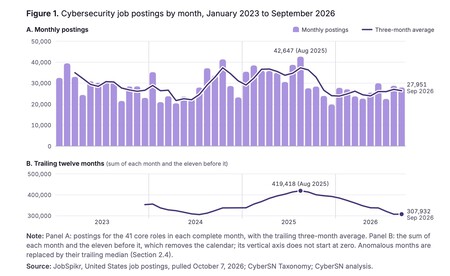
Evolution of Cyber Security Job Offers in the United States Between January 2023 and September 2026 | Graphic: CyberSN.
What exactly are companies looking for when advertising AI Security Engineer positions? According to CyberSN’s professional description, they need experts who can test models and their applications for vulnerabilities, protect training data, and establish controls against potential attacks. The firm identified 2,409 such ads and placed 1,493 offers related to data scientists specializing in cybersecurity, a category that grew by 203.5%. We should not confuse both functions: the latter is the pattern of investigation into security data and, by definition, is not dedicated to protecting artificial intelligence systems.

Hazard, for its part, does not affect all specialties in the same way. Compared to 2025, CyberSN identified 55.6% fewer offers for insider threat analysts, 51.5% fewer offers for risk specialists, and 45.9% fewer offers for penetration testing professionals. The decline also affects the CISO positionWith a decrease of 38.9%, although its current volume of advertising is practically the same as registered in 2024. At the same time, some areas escaped the trend: offerings related to cryptography and public key infrastructure grew by 22.8%.
Just because an offer mentions artificial intelligence doesn’t mean it’s sent to an AI security expert. This may correspond to research work, risk analysis or other functions where this technology has some presence. This nuance helps explain another piece of data from the report: In September, nearly one in five ads contained some mention of AI, but its presence over the entire nine months was little changed from the year before. Additionally, CyberSN identifies these mentions by searching for specific words in the descriptions, so not all of them mean that companies need special knowledge in artificial intelligence.

The question is inevitable: Why are fewer offers published when new security needs arise? Part of the context can be found in ISC2’s international research, which describes companies with budgetary constraints and problems finding professionals with the skills they need. It’s not always about adding more employees, but staying specific knowledge To face changing technology. CyberSN CEO Deirdre Diamond also noted in an interview with HelpNet Security that business restructuring could delay the hiring of security officers.
Moreover, the job horizon is not limited to this year’s announcements. The United States Bureau of Labor Statistics estimates that employment of information security analysts will grow by 21% between 2025 and 2035. This is not a forecast for all cybersecurity specialties, nor does it rule out the recent drop in supply We must not forget that this American photograph does not in itself describe what is happening in Spain.
Featured Image | Igor Omilaev
In Xataka | A fleet of rogue AI agents have been caught roaming the Internet. For the first time, they are manufactured and activated in China