When we look at the sky, we see only a few bright points above a lot of darkness. If we had the chance to be somewhere away from light pollution, we would see many more dots or even a faint, milky glow before our eyes as they descended into the Milky Way. But there is much more. Space telescopes are responsible for detecting objects that cannot be seen by the eye and can even uncover their structure. Still, they can’t see everything and sometimes they discover wonders like James Webb by focusing on one of the most observed points in the sky.
Fornax Constellation. A small speck in the southern part of this constellation is one of the favorite pieces of sky for space telescopes. So much so that Hubble spent 270 hours observing one of its most famous images: the Ultra Deep Field. That tiny fraction contains 10,000 galaxies and billions of years of universe. No wonder it was decided that James Webb would also be seen there. Thanks to its ability to make near- and mid-infrared measurements, it can detect what Hubble could not. It was the logical thing. However, the scientists who did this probably did not expect that a signal was so mysterious that they had not yet been able to detect it.
Why that place? The chosen point in the constellation Fornax is very interesting, as there are no nearby bright stars that could distort the signal from deep space.
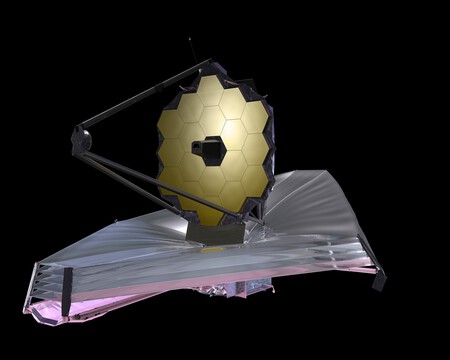
Thousands of slits. James Webb analyzed the objects in front of him by decaying the light they emitted. Its famous gold mirror is responsible for collecting the light, which bounces off other mirrors until it reaches its instruments. In this case, the research focused on one of them, called NIRSpec, which measures in the near infrared. This device has about 250,000 slits through which light passes, depending on its source. It then breaks up into its different wavelengths, just as sunlight forms a rainbow as it passes through water droplets.
Different chemical elements absorb or emit at different wavelengths, known as emission lines. Therefore, by analyzing the “rainbow” that passes through each slit, we can learn what the objects that sent light into it consist of.
Only familiar objects. Typically, you find an object you want to study, open the slits corresponding to it, and analyze the light. It is, logically, useful for the study of known objects, but not for the study of the invisible.
Seven signs. A team of scientists at the University of Minnesota wanted to use James Webb to see what Hubble missed. However, they couldn’t open the crack for something they didn’t know where it was. So, they had an idea. They opened all the cracks, which corresponded to the location of nearby objects that had already been cataloged. In this way, they will avoid interference from their light and only analyze light that comes from places where there is apparently nothing. But there was something.
They identified seven signals that corresponded to apparently invisible objects. Six were from known distant galaxies. However, the seventh was a mystery. We may think it was an error, but it was detected twice, 88 days apart (August and November 2023), and from different angles. It wasn’t an error, but it wasn’t a constant signal either, since it didn’t appear in the JADES catalog, taken by James Webb in 2022.
POT
guess. There are four hypotheses about the supposed origin of this mysterious signal. However, it doesn’t quite add up. On the one hand, it could be a galaxy from the early universe, but in that case it should have appeared in JADES. It could also fit a nearby galaxy, but we would face the same problem. Does not appear in JADES. A third hypothesis points to a supernova, but it should have produced other emission lines that were not detected. Finally, it could be a black hole tearing apart a star. However, evidence is still lacking.
For all of these, follow-up observations with deep spectroscopy will be required. Until this is possible and more answers are found, the signal found by James Webb will remain a mystery.
Picture | Hubble Ultradeep Field. Credit: NASA, ESA, H. Teplitz and M. Rafelski (IPAC/Caltech), A. Koekemoer (STScI), R. Windhorst (Arizona State University), and Z. Levay (STScI)
In Xataka | This curious photo shows us a rainbow that hides a problem: light pollution