There is no longer any doubt that AI is going to mark the fore and aft of the labor market at all levels. But in the absence of conclusive data on the impact of this technology on job destruction, there are voices that warn of the storm and others that sell umbrellas.
Dario Amodei, curiously, does both and it has always raised doubts. Anthropic’s CEO has been saying for over a year that AI will destroy entry-level jobs. ie recent graduates or those just starting their careers. As there is still no conclusive data on the impact of AI on what is considered to be the most vulnerable segment, economists have published a report on how Anthropic’s own workforce has changed since AI agents started working alongside it. What they say makes you think.
27% to 9% in a year and a half. According to demographic recruitment data, junior profiles accounted for 27% of technical profile recruitment by the start of 2025. However, by June 2026, that profile has come down to 9% of total recruitment Its weight among the total junior technical staff has also dropped from 21% to 14% in just a year and a half.

What is most interesting about this statistic is that the company is in full expansion, and its workforce has tripled in one year, but not all divisions have done so at the same rate.
However, recruitment of technical profiles in general also slowed, going from 61% of the total workforce to 56% in just one year. The sales, finance and staffing departments saw the fastest growth, while the teams that used Claude the most were the first to notice a phenomenon that other analysts had already anticipated: an increase in their productivity.
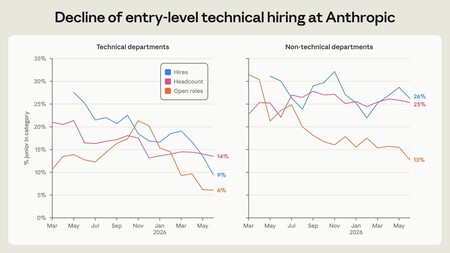
Recruiting junior staff with technical and non-technical profiles
Six agent hours per man hour. The report’s authors explained that those who used Claude more intensively realized that they could delegate routine tasks such as writing code and detecting errors to agents. “Nearly a third of machine learning managers and a fifth of software engineering managers report fewer hires due to AI.”
In August, worker AI agents worked six hours for every human hour, significantly increasing their productivity for each employee. Each engineer now uploads five times more code than they changed six months ago. Of course, Anthropic recognizes that more code doesn’t necessarily mean more business. An NBER study with GitHub developers also confirms this. If actual launches are measured, the jump in activity is at 30%.
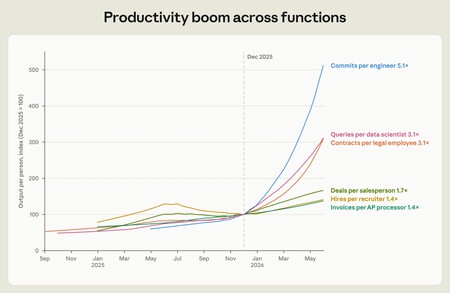
Productivity increases in departments with greater use of AI
Occupation: Claude’s Caretaker. Now the constraint is the attention that each employee must pay to the agents to whom they have delegated their work, not the work itself.
One engineer compared it to caring for children: “Every child brings their concerns to you with the same attention needs.” The same thing happens with Claude’s agents. 20% of respondents said they have moved from doing the work to managing the work of AI agents. And the average employee spent 20% more time in meetings than a year ago.
Criteria are sought. In interviews for technical positions, mentions of creative uses of AI will triple between 2024 and 2026. Comments on candidate autonomy and judgment have also increased, while technical skills are losing weight.
In an interview for Axios, Dario Amodei already warned that AI could end half of office jobs. “We, as producers of this technology, have a duty and obligation to be honest about what’s coming,” said Anthropic’s CEO. The report acknowledges that shifting workers, one of the company’s moves, doesn’t help those who never entered, confirming what some analysts already expected: that AI isn’t going to cause a net destruction of jobs, but rather a displacement of those jobs. In this case, transfer those employees to other departments and hire others without retrenchment.
Outside of Anthropic it looks the same. A Stanford study reached conclusions very close to Anthropic’s internal research. Workers aged 22 to 25 have lost 13% of their relative employment in businesses most exposed to AI. On the other hand, veterans of the same trade remained stable. In the U.S., entry-level hiring is down 35% from 2023, according to Revelio Labs.
In Spain, the head of DigitalES wrote in El Español that offers for junior programmers fell by 33% in a year. In Barcelona, the Mobile World Capital Foundation estimates that between 2023 and 2025 there will be 27% fewer junior offers in ICT companies. Of course, there is still no definitive proof that AI is the sole cause. And anyone who doesn’t train newcomers today will be left without people to oversee AI tomorrow.
In Xataka | Anthropic offers 172,000 euros a year to someone who wants to do exactly what an AI agent should do
Picture | Unsplash (Flipsnack)