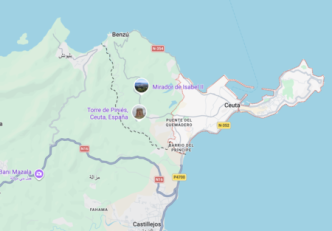
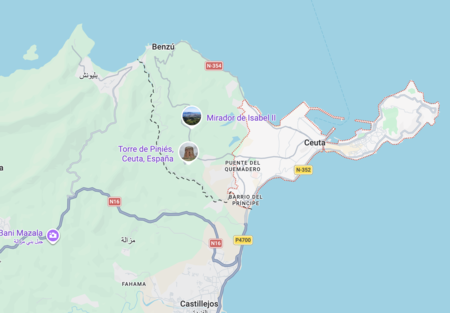
On a map, the type of line along which a boundary is drawn is a political question. For centuries they have been well defined on paper, and this was maintained with the advent of navigation apps. However, these borders are dynamic depending on what is happening now and Google made a curious decision: to draw Ceuta and Melilla as if it is not clear whether they belong to Spain or Morocco.
This isn’t new, but after what happened this summer, the issue has grown so much that the European Parliament’s Petitions Committee is investigating whether Google is violating the Digital Services Act.
line. On Google Maps, undisputed boundaries are shown with a solid gray line The problem is when we see a dash because it can mean different things. They mark a boundary determined by agreement, de facto, temporary and negotiated.
According to Google, in this case it is a case of presenting “controversial boundaries” and the problem is that it is not new. In fact, Maldita documented it in 2020 (and there were users who asked Google themselves) and Ceuta and Melilla Observatory more of the same in 2023. With the massive influx of people into Ceuta at the end of July this year, the problem came back to the fore
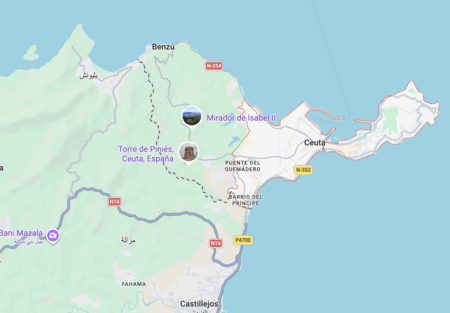
The petition states that this dotted line may misinform users about the limits of the European Union
request. As the situation heats up, the Observatory has condemned Google Maps for questioning the Spanish sovereignty of the two cities, and Geolandia, an association represented in the national court case for widespread access, has already expressed its concerns to Google’s general director in Spain about how Google Maps is representing the situation, claiming that Google specifies that technical line.
you go to europe. At the time, PP MEP Juan Ignacio Zoido had already commented that he was going to raise the matter with the European Commission. And Zoido… obeyed. According to the party’s own website, the politician registered his query with the commission, asking if it knew about the dashed line and whether it would use the DSA (Digital Services Act) to force Google to make corrections.
However, this is not only a case of multilateral reform, but also of putting pressure on Europe. The document uploaded by the PP states that this is a way for Ceuta and Melilla to “qualify fully for European instruments and programmes, including the Recovery and Resilience Mechanism, the Just Transition Fund, Horizon Europe, the Border Management Fund and the Asylum, Migration and Integration Fund.” Also for Frontex’s greater involvement in protecting the Union’s external borders.
What is DSA doing here? It is simple and based on the fact that the Commission designated Google Maps as a major platform in April 2023 which had to ensure good competition among other things. With more than 45 million monthly active users in the EU, this requires strict responsibility, but also direct supervision from Brussels.
The petition notes, as reported by El Español, that the map in its current state may give incorrect information about the Union’s external borders. This is also a test, as Brussels will have to identify which specific obligations Google has violated and, as noted in Moroccan media Le360, place it as an arbitrator in a territorial dispute.
There is still a way. Again, this is not new and we will have to see what Brussels decides about Google Maps, but it is clear that the events of this summer have ignited more than five years of open debate about the presentation of these two borders in the app.
But Google is really taking a “don’t bother me” stance here because Morocco has been requesting the registration of Ceuta and Melilla as its territory for decades, while Spain maintains that they are part of its national unity.
And it doesn’t look like they’re going to do anything on their own because, as they announced to Maldita this summer, “Google remains neutral in geopolitical debates,” saying they’re committed to only showing “areas in dispute objectively.” It seems that Brussels will have to appeal to DSA Gedel to be the judge of all this. As of the date of this article, if you go to the application, you will definitely see the dashed line.
In Xataka | Ceuta is leaving diesel generators behind: an underwater cable will connect it to the peninsula’s electricity grid for the first time