
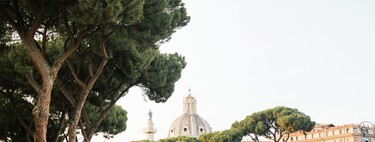
On Thursday, October 8, Zaragoza was declared European Green Capital 2028 after beating the historic northern Portuguese city of Guimarães, Porto, Aalborg, Kosice and Bielsko-Biała. The next morning, residents of the Plaza de San Miguel gathered to reject the renovations that had just been completed. One of them, María del Carmen Lapuente, from the platform for the afflicted, asked for a small fountain and found a pergola. His comment was: “They put that pergola in Huerva and we’ll all be happy.” Two pieces of news in 24 hours that explain why many Zaragoza residents are smiling.
What Europe has rewarded. The jury assessed governance strength, long-term commitment to sustainability and the combination of environmental action, social resilience and community engagement. And be careful because the prize was an unthinkable 600,000 euros, and the city plans to create around 150 jobs by 2028. Natalia Chueka assures that this title places Zaragoza “among the European elite of cities committed to sustainability.” The city council boasts 171,138 trees, over 11 million square meters of green area and 66% of the population has a park within 300 metres.
Before the decision, Tree Table sent the jury an 85-page “letter of amendment,” supported by thirty organizations. La Mesa is a group of neighbors, environmentalists and citizens born this summer. His conclusion was that Zaragoza does not yet meet the conditions for the title. He clarified that he did not want to give up the award, but rather deserved it: “A green city is not only built by more plants, it is built by taking better care of it.”
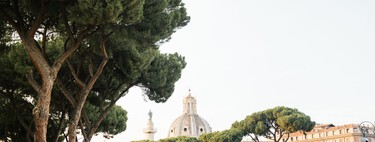
Ten thousand less trees. According to the Federation of Neighborhoods and the Table, Zaragoza has lost around 10,000 trees since 2022: around 4,000 in parks, 2,500 in green areas and around 2,000 on streets. Zaragoza en Común reached the same figure with city council data from November 2025. Elena Thomas, from the aforementioned formation, sums it up like this: “Maintenance is cut, trees are lost, control is reduced.”
And the city council denied it. He said the recalls were due to technical and safety criteria and “they were not removed intentionally.” Its environment minister, Tatiana Gaudes, blamed previous governments for the loss of trees over the past two decades and contradicted the “verified” data with the headlines. In July it announced 3,370 plantations for 2026-2027, which will cover almost all of the 2,557 vacant tree holes that can be planted.
66%. Let’s talk about hard numbers today. The report by Friends of the Earth and UPM applies the WHO 3-30-300 rule: three trees within sight, 30% coverage and one park within 300 meters. Under this rule, 63% of Zaragoza’s residents live more than 300 meters from a quality green area of at least one hectare. Low-income neighborhoods tend to have the least amount of greenery. La Mesa Delicias, referring to Oliver and Las Fuentes, has not a single tree.
Blessed Saint Michael. The square had 39 ancient trees, according to environmental groups. The city council itself admits it has retained 20 and added 18 new ones, compared to the 27 the project promised. To present them, their social media account invites them to “discover” them with the words of the video game and, according to Heraldo, “the young are planted so that they take root, they will grow with time.” Among the responses, many followers called for an end to tree felling across the city and doubted that large trees would survive with their roots covered in cement.

The square has reopened with 25 benches and over 120 square meters of garden. The Naturalist Association of Aragon (ANSAR) reported in August that more than half of the trees that should be preserved had been cut down. He described the result as a “cemented plaza where it would hardly be possible to stay”. The Platform for Affected People, taking up the plan, lost 12 trees.
The City Council maintained that it maintained the large ones, except for one very inclined and some smaller ones whose roots interfered with underground services. But the works correspond to temperatures above 46 degrees. Neighbors reported that the workers “practically worked twelve hours a day”, with noise beginning before seven in the morning. We have already said: “We never needed so many trees in the city.”
A lawn of Salamero, El Portillo and El Pilar. Salamero spent 5.2 million and rescued 3 of its 11 olive trees. The project has reserved 1,447 of its 8,158 square meters of flower beds with metal pergolas for climbing plants, less than 18% by our count. There is a real technical reason: the weight on the roof of the parking lot, whose platform failed in 2020. Nevertheless, the board included Salamero in the renovation with large areas without shade.
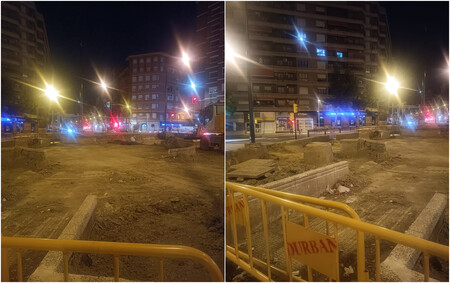
In El Portillo, of the 306 trees on Anselmo Clave Street, 209 have already been removed, as shown in the night photo above. In Pedro Cerbuna, mature trees along the entire road have been cut down. In El Pilar, the city council installed 2,100 square meters of artificial grass for a spring festival in April 2024, with material donated by an Aragonese company. In September 2026, it covered the square again for Street Sports Day. And artificial grass may be green, but it’s not alive.
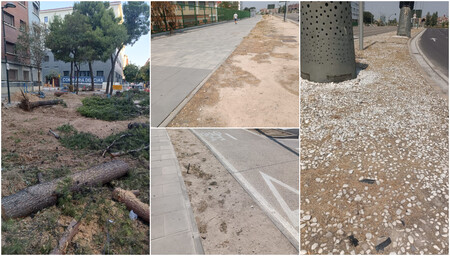
Plaza Aragon at the height of Ibarcaza? Dead. Plaza de Santa Engracia in front of the basilica, likewise? with tree holes. Dozens more have dropped in on Avenida Valencia’s work. And Delicious suffers from a pressing absence of green areas that provide minimal shade. In less than five years, historic irrigation ditches have been cut, some over a hundred years old, and in general, such scenes are easiest and most common to see in working-class neighborhoods:
Another front: noise. The European Commission has dedicated a report to how Zaragoza designs quiet neighbourhoods It contains a technical guideline, a “5 dB rule” for new developments and five special acoustic protection zones The rule applies to built-up neighbourhoods. Protected areas exist because the objectives have already been exceeded, and they include a large part of the city integrated within the Z-40, in addition to neighborhoods such as Casetas, Garapinillos or Juslibol.
The surrounding associations say about 250,000 sufferers, about a third of the population. They claim that they have not followed the rules for two decades. A neighborhood spokesperson summed it up in 2024 with a phrase: “We’ve been asking for compliance with the law for 22 years.” The previous map, with data from 2016, already put 26% of the population above the limit during the day and 17% at night. The 2025-2029 plan aims to reduce that population by 20%. The Commission itself recalls that noise is, according to the WHO, the second biggest environmental risk to health in Europe after air pollution.
who participated. The jury rewards community participation and provides board dates. According to his letter, the Environment Sector Council has not met since January 2025. The Biodiversity Commission has not met since July 2016, the Climate Change Commission since February 2015, the Water Commission since March 2018 and the Noise Commission since June 2017. The Board regrets that numerous unanswered requests for technical reports remain. Their request is an institutional table for trees with the city council, neighbors, environmentalists and the university.
Now Zaragoza faces the 2027 title and several open fronts. The Federation of Neighborhoods has 22 data center projects in the province. According to complaints from environmental and neighborhood groups, the Microsoft project next to Venice’s pine groves would involve cutting down about 1,000 pine trees and would have 1,846 megawatts of sanctioned power. The city council, for its part, promises more plantings and a management model that, it says, has already reversed the trend. It remains to be seen whether the trees planted today will provide shade in time and whether the protesting residents in San Miguel will feel heard (or displaced) before 2028.
Cover image Trees uprooted by wind on Paseo de la Constitución (February 14, 2026 – Aragón Digital)
In Xataka | Our cities never needed trees so much and we never had so many reasons to remove them