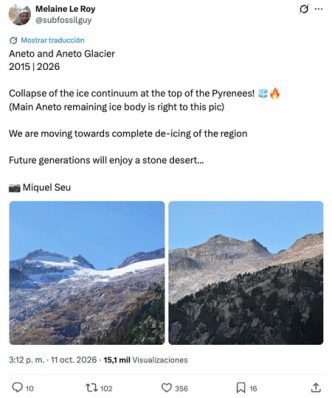
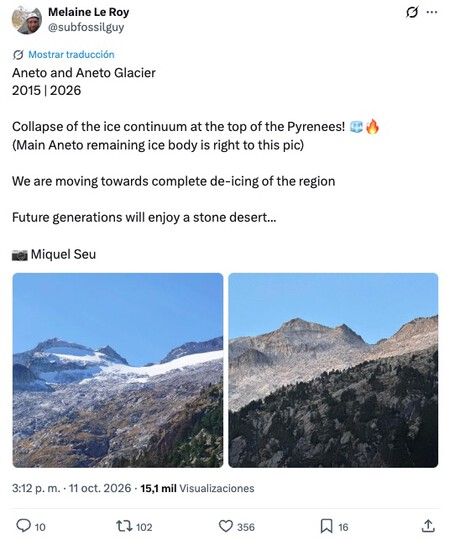
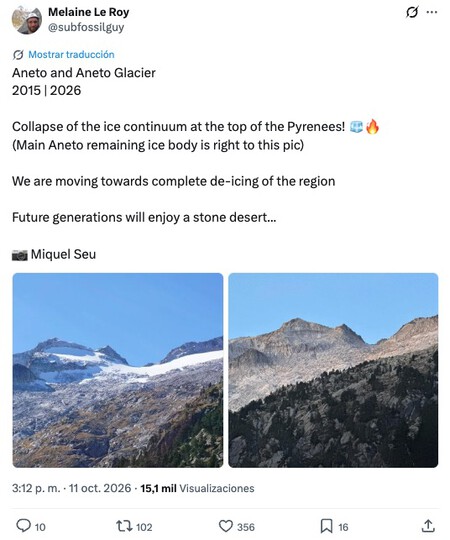
Climate change is exacerbating desertification in Spain and in the process brutally destabilizing river flows and making the Pyrenees more Mediterranean than ever. And that means saying goodbye to one of the Iberian Peninsula’s few glaciers: the Aneto. Since a picture is worth a thousand words, below this line you will find two pictures of Aneto from 2015 and 2026. The change is obvious: where there used to be white patches of snow and ice, now bare rock and dirty ice dominate.
Anato’s pain. The depressing picture shown in the two photographs should not surprise us. The CryoPyr group of the Pyrenean Institute of Ecology (IPE-CSIC) has been measuring its retreat with drones and lasers for years and, after the September 2025 campaign, detailed that the core fragmented under Pico del Medio and the mass under Collado de Corona was now considered a glacier. The result is three disconnected ice masses, a very different state from 2015.
Preliminary results from the expedition later this summer indicate a loss of more than two meters in average thickness, leaving the glacier with an average thickness of around 12 meters. Researcher IPE-CSIC Ignacio López-Moreno remembers that the loss was about one meter per year in the last two decades, although it exceeded three in 2022 and 2023.
Tap to go to post
Why is it important?. Because, although it is small (about 30 hectares, 0.3 square kilometers), Aneteau is the largest glacier in the Pyrenees and acts as a thermometer for the entire mountain range. The disappearance of Pyrenean glaciers is progressing: the Pyrenees went from more than 100 glaciers in 1850 to 18 in 2022, with a loss of 92% of its glacier surface since the end of the Little Ice Age, according to an IPE-CSIC study compiled by the EHU. In fact, there is already a scientific article with a title that sounds like an epitaph: No hope for Pyrenees glaciers, which estimates that the Pyrenees could run out of ice by 2034, or sooner if extreme summers like 2022 and 2023 repeat.
And its consequences go beyond the impact of changing the landscape: although small glaciers do not contribute much to sea level or the flow of major rivers, their disappearance alters erosion, nutrient transport and high mountain ecosystems. Furthermore, ice loss and frozen ground encourage rock falls, which, however, also make access to the peak difficult.
41 years of data and a diagnosis. Between 1981 and 2022, the glacier shrank by 64.7% and its average thickness decreased from 32.9 to 11.9 m to 30.5 m. This is the longest record of ice thickness reduction in the Pyrenees: 41 years of reconstruction since Anneteau. Globally, one study projects that glacier loss will peak between 2041 and 2055, with 4,000 glaciers per year, but we have already seen that the IPE-CSIC projections for the Pyrenees put the end of the ice earlier.
Chronicle of a death prophesied. Between 2011 and 2020, the Aneto lost 24.3% of its area and an average of 8.5 m in thickness, with reductions of up to 21 m in some areas. There’s also one particularly worrying indicator: the ice is barely moving, and a glacier that doesn’t flow is at its limit. Added to that it no longer has a storage space to replace what is lost.
The problem is accelerated by a familiar process: the seasonal snow that protects the ice melts earlier, exposing older, darker ice covered in dust and rocks that absorbs more radiation and melts faster.
In Xataka | We thought we knew them all, but no: we just “discovered” a new 3,000m peak in the Catalan Pyrenees.
In Xataka | Last year we killed all the fish from two Pyrenees lakes: after 10 months they were full of life again
cover France