To his many and very distinguished titles, an overwhelming list in which he was bachelor, knight captain, royal captain or perpetual alderman, Alonso Yánez Fajardo, alias “El Granadino”, added around 1490 what was perhaps his most lucrative term: the status of chief courtesan.
After the successful campaign of 1486 and as Reward for help which he lent at the taking of Loja, and would lend until 1492, to occupy the squares of Baja, Malaga, or Almeria, when the Catholic monarchs decided to grant the brave captain the income of Mencebius, of the kingdom of Granada.
It was not a bad facility. And the best proof is that even today, more than five centuries after his death, Fajardo is not so much known for his brothel business as an official of the Catholic Monarchs. He had such weight in the brothel that in time he was nicknamed “Lord of the Whores”, “Government Whore” or “Fajardo Putero”, as he was referred to among the soldiers.
By Trade: Senior Adulterer

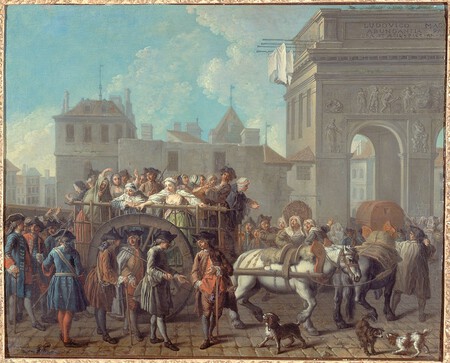
Etienne Giorat’s painting shows French prostitutes being taken to the police station.
But the most curious thing is that Alonso Yánez Fajardo, the bastard son of the Warden of Lorca, decided to exclude the state of Granada from the great business of brothels, an activity that he managed through administrators who favored all kinds of extravagance. If there is anything interesting about the case, it is the approval of the court. That and they were a drop in the bucket. Huge network of brothels which was conducted during the reigns of Isabel and Ferdinand.
As I remembered recently ABCAragon and Castile already had regulated youth centers, places where prostitution was tolerated, a “lesser evil” – in St. Augustine’s own words – with which they sought to avoid problems that were seen as bad by the authorities, such as adultery, kidnapping and rape. Their Catholic majesties were recognized in this formula as suitable to transfer to other troubled areas of their dominions. And they did not hesitate to apply it.
“The connection between noble gangs and ruffians created an atmosphere of general conflict that was very present in the pacifist policies of the kingdom in the 15th century. In this atmosphere of crisis in the late Middle Ages, we can understand the initiative by the Catholic monarchs to legalize prostitution, Promote yourself creating brothels so that the most loyal minor nobility could reward them exclusively”, historian Milagros León explained in a 2022 article dedicated to the 17th-century Castilian Mencebius.

The lords and municipal authorities began to regulate the brothels in detail, allowing the court to profit twice from the carnal trade, as Milgrass Lyon abounded: the Crown was able to make it profitable for him and transformed it into an “escape valve”, a way to calm disputes and maintain order. Or at least try to.
Courts have not even hesitated to use laws to encourage prostitution to concentrate on brothels. In the Cortes of Madrigal of 1476, the Catholic Monarchs stipulated that secret prostitutes should double salary Compared to the public: 24 Maravedi per annum compared to 12 for the latter.
Adultery legislation
In order to legislate brothels throughout Castile, the ordinances of Seville, the city that had the country’s busiest brothels, were taken as a model. The result was the Pragmatic of 1571, which had already been granted by Emperor Felipe II, and a regulation that regulated the state of health of prostitutes or required the payment of what was known as “partridge rights”, which workers had to pay to the bailiffs of the council in exchange for their protection.

“To avoid excess, civil and religious authorities decided to build municipal brothels,” explained historian Andres Moreno Mengiber in 2000. the country. Against this background, the Catholic monarchs requested cities such as Écija, Carmona or Cádiz to create Mensebia, and among other benefits in payment for their services, they granted Fajardo the monopoly of those located in Granada.
Brothels were gathering in the south A dense network During the 16th and 17th centuries. Moreno Mengiber estimates that there were about a hundred “apothecari” in Seville alone by the mid-16th century, the name given to houses where prostitutes lived in exchange for rent.
If there is one point on the map of the 16th century European carnal market that is Valencia. There was a huge brothel – if we are to believe the Flemish traveler Antony de Lalaing, who visited it in October 1501 – which housed “200 to 300” female workers. “It is as big as a small city,” the courtier of Flanders highlighted with wonder, detailing that macrobrothel It consisted of several hostels spread across several streets, all organized.
Neither Valencia, nor Granada, nor Seville were in any case isolated doubt.
It is said that during the reign of Philip III, 800 brothels spread in Madrid, houses open day and night where young women were allowed to perform such work, something for which certain specific requirements were established: being over 12 years old, being an orphan or of unknown parents, and not coming from a noble birth. Such an atmosphere of permissiveness did not last forever, of course: the panorama took a turn with Emperor Philip IV (1605–1665), who is said to have been scandalized after learning of the secluded life of the Ottoman ambassador in Madrid.
In 1623, one known as the “King Planet” identified such a network as immoral and began a long period of restriction. That is, the same Philip IV who was said to be sex addictA wild, promiscuous and tormented libertine who had enough children to form several soccer teams: some estimates suggest between 20 and 40; Others, more generous, reach a full 46 children.
But that is another chapter of national history.
Picture | Wikimedia 1 and 2
In Xataka | The first miracle diet in history was experienced by King Sancho I of Leon and it made him lose 120 kilos.
In Xataka | Historians have been grappling with a mystery for decades: What were the giant warrior snails of the Middle Ages?
*A previous version of this article was published in 2023