On a gravel plain north of the Western Sahara, about 600 meters high, is an oval stone mound from which two rows of slabs rise eastward, in a place so dry and inhospitable that shepherds only venture there when it rains heavily, says Archeology magazine. It is next to Wadi Lawash el Teli at the eastern limit of Sluguila Lawash, the site of the highest concentration of prehistoric rock art in the area, with 1,143 inscribed rocks.
When viewed from above, it appears to have antennae, which is why this funerary monument is known as the “mound with antennae”. It was suspected to be ancient, but now we know: a team of archaeological professionals has just dated it and put the date between 2467 and 2150 BC. c.
discovery. A team from the University of Girona and the Sahrawi Ministry of Culture dated the mound with the Saharan antenna, a structure that was excavated in April 2018, only partially and intentionally, since half of the mound was uncovered. Inside was a single man, aged between 25 and 35 years.
The body was lying face down on natural ground, unburied, with the head pointing south and the feet bent west. He wore an ornament of four beads made of ostrich eggshell. Initial dating analysis using collagen failed, so in 2025 they used another technique using biopatite (the mineral fraction of bone) in two samples, one from the humerus and the other from the femur. The result? It is between 4,100 and 4,400 years old.
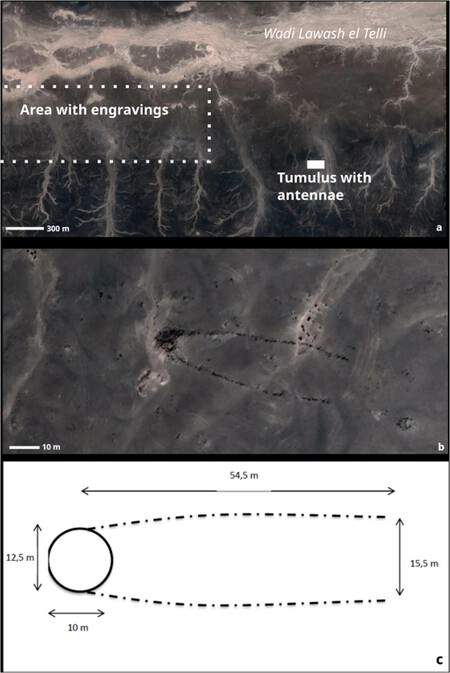
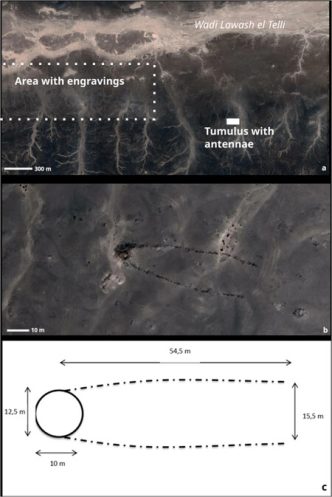
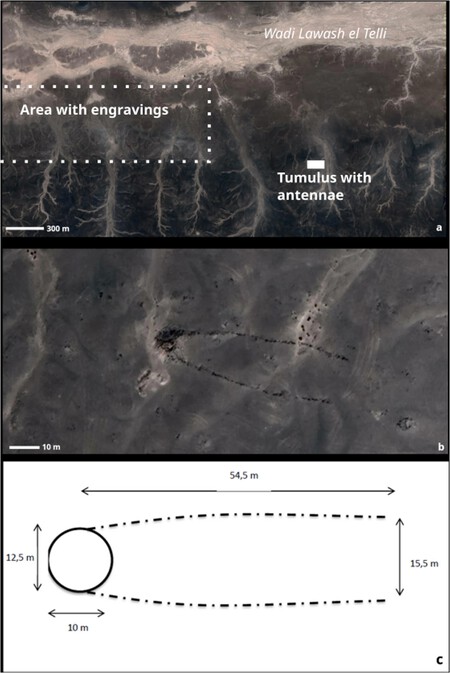
A. The location of the monument. B. Aerial view. C. Measurement
Why does it matter? Until now, it was assumed that these structures had a funerary function, but it was never proven or known how old they were. Indeed, the only other sample excavated in the region, at Wadi Tasua, has not yielded archaeological material.
Now we know that these are indeed tombs and that they can be placed in the order that Andoni Saenz de Buruga from the Basque-Sahrawi Association of Cultural Evolution has made based on radiocarbon dating in the south of the region. In particular, at the end of the first monumental phase, the final Neolithic.
Archeology comes in fits and starts. Western Sahara has many stone monuments, but they have been very difficult to study due to lack of material, poorly preserved bones, and war conflicts. The first stone funerary monument in the area was excavated in 1902, without finding remains, and later, between 1970 and 1974, the University of La Laguna studied 33 but did not date them. The 1975 war stopped almost everything, until a cease-fire from 1991 to 2020 allowed European parties to return. Since then, projects such as the University of East Anglia have excavated conical burial mounds with articulated skeletons and few objects.
A lot of unknowns. The monument is constructed of local limestone slabs stacked without using mortar. Except for the roof slab, the rest of the stones are moderately small (less than a meter), so the research team believes that a small team was able to move them in a short time and without special equipment.
The mound measures 12.5 by 10 meters and is no more than 3 meters in height, and the antennae begin to diverge slightly, but throughout its length they come close without touching each other. They are oriented at 102° north. Since only one grave and one skeleton are dated, no conclusions can be drawn. We don’t know which city built it or why the antennae point east, although there is another study that suggests the orientation may respond to astronomical considerations.
In Xataka | Western Sahara has a bleak future in relations with Morocco for one reason: phosphorus
In Xataka | Long before Manhattan, Africa 2,800 years ago built a structure that mathematics defines as a skyscraper.
cover Chronology and Funerary Practices Associated with Antenna Tumuli in the Western Sahara (Joaquin Soler et al.).