Elias is a lighthouse keeper who This appears very frequently when you have to ask an artificial intelligence model to write a story. His name and occupation regularly appear in results from different providers, as the Cornell Chronicle reported, based on research that shows other details of the story vary, but the same settings and occupations appear consistently.
Hamilton and Mimno’s study analyzed twenty thousand stories, and 88.3% of them contained at least one of eleven key words. 51.2% contain “Lighthouse” and 26.5% contain “Elias”. These percentages vary considerably, but the article clarifies that the research does not suggest that nine out of ten stories contain the word “lighthouse.”
“You feel like you’re getting a unique story.”He said Seal Hamilton, PhD student in Information Science. is your partner David Mimno, professor of the same university. The results were released on October 19, 2026, ahead of the EMNLP conference taking place between October 24 and 29 in Budapest.
Their stories were revisited Version Claude Haiku 4.5, Gemini 3.1 Flash-Lite, GPT-5.4-mini and OLMO 7b Thinking. They all responded a thousand times to each of the five requests in English, incl “Write a Story”and the study description on arXiv as of May 26, 2026, so the percentages refer to those terms, and not to interactions with other instructions or later editions.
The characters have traditional jobs and are in familiar places. “Atmospheres are always vague before modern times”Hamilton said. The researchers suspect that tuning may favor this repetitionAlthough they did not prove causation.
The research does not claim that language models are incapable of writing interesting and diverse stories. Hamilton notes that the creative side of writing receives little attention in the development of language models.
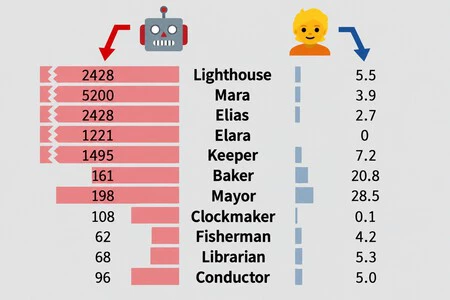
Hamilton and Mimno’s study
What WildChat brings to research
Hamilton and Mimno analyzed a data set called WildChat, which was created in 2024 as a collection of one million ChatGPT conversations. They observed this and discovered pieces about the lighthouse keeper Elias, and they believe that this finding allows us to track how these patterns pass between training sets. however, Why they appear so frequently is a subject of research.
WildChat contains real conversations between users and ChatGPT. It was created with the consent of those who accessed ChatGPT for free, and its authors suggest its utility to help people who want to fine-tune these models to follow the instructions.
That data has the potential to investigate how one language model’s responses can be incorporated into the training of other language models, and this will help people better understand how to fine-tune language models based on data, but The mere existence of this circulation of information does not prove what accounts for the significant prominence of these stories in responses..
According to OLMO’s analysis, of its 78,958 subsequent tuning stories, 3,053 contained at least one of the eleven words, which the authors kept at 3.8%. This value does not explain why words have so much weight in generated responsesAnd the words were much more rare than the stories generated in both the English novels and the analyzed OLMO 3 pre-training data. Furthermore, the test was conducted with instructions and answers in English.
The author has made the story identifier public so that others can identify records in the public OLMo 3 post-tuning data repository, along with instructions for downloading them. The scope of that investigation may also be confused with access to competitors’ post-tuning data, as it documents OLMO’s situation, but does not provide data for other brands.
Creativity and diversity in stories
In another experiment, similarity between stories did not prevent respondents from evaluating them positively. According to an experiment conducted by Doshi and House, writers were tasked with writing stories, some with the help of artificial intelligence concepts and some without. Next, 600 judges evaluated these texts for creativity, without knowing which authors received ideas from AI and which did not. Aided texts received higher creativity ratings, but showed greater similarity to each other.
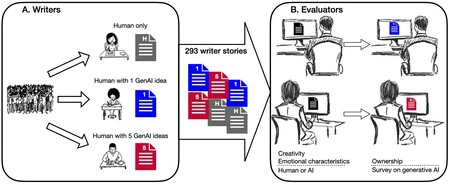
Doshi and Hauser Study (2024)
The interpretation of the results, according to the UCL publication on the study, is that improvement Creativity scores were higher for writers with low basic creativity. It is important to note that this distinction may apply to the use of artificial intelligence to explore ideas. The rating of an individual story and the diversity of the whole can evaluate different aspects, and a tool can help to write a pleasant story, while it is easy to reach similar stories to different people. We already write creativity tests with memes.
A different query is to determine whether the same task exists Best results when done with or without artificial intelligence. The study collected by Genbeta provides results on different ways of generating memes and does not allow all tools to be classified according to a single dimension in ascending or descending order. Therefore, when writing a story for a particular event, it can be useful to test the recommended tool not only in the initial request, but also in subsequent requests for options.

This is the NoveltyBench goal, a 2025 investigation Yiming Zhang and his authorwhich evaluated twenty language models on their ability to produce multiple, qualitative responses. The authors reported that diversity was lower than in human-written responses, and that within a family, larger models often produced less diversity. Requesting new answers based on previous ones can improve diversity, although this can still be a problem.
Therefore, there may be an opportunity to compare the situations and conflicts raised by different stories before deciding to act on one of them. Since changing some names is not enough to conclude that the contents are different, this appears as a tentative recommendation for the application of these language models for that purpose, along with a warning that Elias’ research did not prove a solution to avoid repeating the story of the lighthouse keeper.
Picture | GPT Image, Doshi and Hauser Study and Hamilton and Mimno Study