It was June 1982, towards the end of the Falklands War, when the United Kingdom was still preparing for an operation straight out of a military espionage movie. Today and through declassified documents, we know that the objective was to enter Argentine territory and destroy five warplanes that turned out to be a nightmare for the Royal Navy. The plan included a night air raid with elite commandos, submarines, elimination of enemy pilots.
It almost happened.
Five warriors that terrorized the entire fleet. During the 1982 war, Argentina had five French-made Dassault Super Etennard and five AM39 Exocet anti-ship missiles before the French embargo. The planes operated from the Rio Grande base at Tierra del Fuego and posed a disproportionate threat to British naval forces sent to retake the islands.
What’s more, the combination had already demonstrated its destructive power: on 4 May, an Exocet destroyer hit HMS Sheffield, and on 25 May another attack damaged the transport ship Atlantic Conveyor. London realized that a few planes could compromise a large-scale military operation.
The first plan was practically suicidal. The British designed a series of special operations aimed at identifying the Super Atendards, destroying the aircraft and their missiles, and killing all their pilots. The most ambitious, called MIKADO, contemplated landing two Hercules transport planes at night at a base in Rio Grande Argentina and landing 70 members of the British Army’s special forces SAS.
Commandos would attack parked aircraft and then attempt to escape by land to Chile. Commanders estimated the potential loss of both transports, while pilots warned of the great risk of landing on potentially protected military runways due to insufficient information and adverse weather conditions. The Ministry of Defense canceled MIKADO on 4 June.

Super Etenard 3-A-204 of the Argentine Navy with her equipment
Failure that led to a last operation. Prior to MIKADO, Operation PLUM DUFF attempted to launch a recovery team near the Rio Grande using a Sea King helicopter during the night of 17–18 May. The mission fails, and the crew ends up in Chile, where they deliberately destroy the helicopter to hide evidence of their presence.
Kettledrum was another naval incursion project directed against Puerto De Cedo in Santa Cruz Province, Argentina. After canceling MIKADO, London ordered the development of an alternative called IMPI in reference to a Zulu fighter formation. Its purpose was to nullify the combat capabilities of the Super Eténard by infiltrating special forces into Argentine territory.
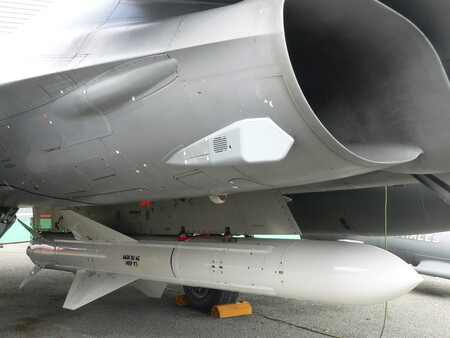
Exocet AM.39 A French Rafale variant
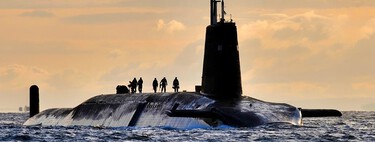
A nuclear submarine, ten commandos and an attack from the sea. We now know that the new operation progressed far beyond a simple proposition. On 9 June, the nuclear submarine HMS Conqueror, deployed off the Patagonian coast, received preparatory instructions to act as a radio beacon and facilitate the navigation of a possible Hercules that would fly at low altitude at night.
The maritime incursion will be accompanied by HMS Onyx, the only British conventional submarine deployed in the conflict. On 14 June, at 08:15 GMT, ten men from the SAS and SBS, the British Naval Special Forces, embarked. The plan: About two nautical miles off shore, land in Gemini inflatable boats and destroy objectives using anti-tank weapons and explosive charges.
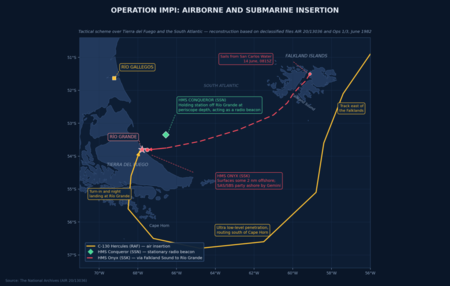
A schematic map of planned operations IMPI
That Hercules had to enter Argentina through the back door. The most spectacular part and movie maker IMPI envisioned that a Hercules would take off from Ascension Island, refuel in flight, and circle the southern tip of South America to approach Argentina from an unexpected direction. The aircraft would fly at low altitudes to avoid radar and land at night at facilities codenamed San Jose and Arco Iris (probably Rio Grande and Rio Gallegos).
However, this part of the operation remains controversial. Its main documentary support is a historical account written many years later by the RAF, which, according to researcher Mariano Schiaroni, contains verifiable errors. In fact, the crew members of the unit that was to carry out the mission claim that they did not know about the plan, so it is not proven that the air element was prepared to carry it out.
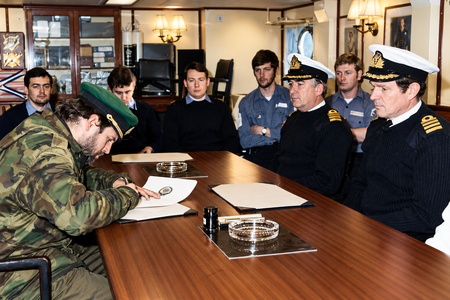
Lieutenant Alfredo Astiz of HMS Plymouth signs the Act of Surrender on behalf of his Argentine forces at Leith, South Georgia Island
As the commandos prepare, the war ends. On June 12, two days before the Argentine surrender of the islands, a message from General Jeremy Moore described IMPI as an operation with already allocated resources and operational capabilities. On 14 June, while the defeat of Argentine forces in the Falklands was being celebrated, ten commandos embarked on Onyx and continued preparations to attack targets on the continent.
Even on June 15, with the surrender already completed, they still carried out landing exercises with Gemini boats. Finally, the cessation of air operations in Argentina led to the mission being aborted before the British could land on enemy shores.
A secret that is still being kept 44 years later. The research, published hours ago in The War Zone, reconstructs IMPI from military communications, submarine records, testimonies and documents preserved in the British National Archives. However, the entire file, identified as DEFE 71/980, remains closed and without an announced opening date, which prevents us from knowing with certainty all the details of the operation and the planned role for Hercules.
Available documentation confirms that the United Kingdom mobilized resources for the last campaign against Argentine aircraft when the war was virtually decided. Five French fighters, their missiles and the crews that could use them maintained the British strategy until the last hours of the conflict.
Photo | General Archives of the Argentine Nation, Crown, Martin Otero, David Monniax
In Xataka | The Falkland Islands depend on 500 million barrels of oil. Now the UK wants to approve its withdrawal
In Xataka | British Navy buys 20 drone boats They found cameras in China to automatically send signals to an IP