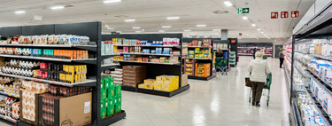
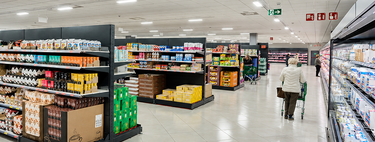
Spanish supermarkets no longer compete only through their white label shelves, prices and catalogues. Now they do it in the payment method, the options that the customers have while paying the ticket. Bizum is gradually adding common payment methods (cash and card) and digital platforms such as Google Pay or Apple Pay. The most recent example has just been left by Grupo Iroski on its premises and in Caprabo.
By incorporating Bizum into their payment system, they join a growing list of big fashion and restaurant companies already using it (to a greater or lesser extent) or testing it, such as Mercadona or Lidl.
What happened? Bizum, which has become a way to transfer money between individuals (the usage that popularized it) and a payment method for businesses, is making its way to battle titans like American Visa, MasterCard and American Express.
Last week Grupo Eroski announced that it has included “Bizum in person” as a new payment method in its stores. And on Monday Catalan chain Caprabo (from the same parent company) confirmed a similar move, extending Bizum to both its physical supermarkets and digital channels.
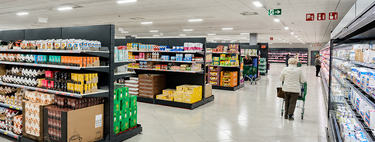
How will they implement it? Grupo Eroski explains that payment with Bizum is now available in Caprabo. In the rest of its commercial network, the service will be rolled out gradually. Furthermore, at least in the first phase, food businesses will be limited, not including Forum Sport or gas stations.
“Its expansion to the rest of the peninsula and the Balearic Islands will be done in a phased manner depending on the availability of individual Bizum among various banking entities,” the company clarified. “It is integrated into the normal payment process without changing the operations of the cashier staff, so that customers can choose their preferred digital payment method themselves. To use it, the customer’s bank needs to enable this service.”
Is it the first chain to do so? not at all Lidl began testing payments with Bizum in 2023, and since then, various supermarket, fashion or restaurant chains have done something similar.
A few days ago expansion revealed that Inditex, Ikea, Carrefour, Eroski, Alcampo and Burger King have opened the doors to Bizum Pay, an extensive list that could grow in no time. The economic newspaper assures that, after a pilot plan in Soria a few months ago, Mercadona is preparing for its full deployment. Another large chain preparing to incorporate it is El Corte Inglés.
Why is it important? for various reasons. The first is that ads like Grupo Eroski and Caprabo showcase Bizum’s expansion into the commercial fabric, where it wants to serve as another payment tool. In fact, this summer the platform introduced Bizum Pay, a digital wallet that allows you to pay in stores by bringing your mobile phone close to the POS, a gesture we make when using cards or Google and Apple Pay services.
The platform recently boasted that “Personal Payments with Bizum” is now available to 60% of its users, which equates to around 20 million people. According to their calculations, 1.6 million institutions have already adopted it, “which represents about 75% of banking terminals.”
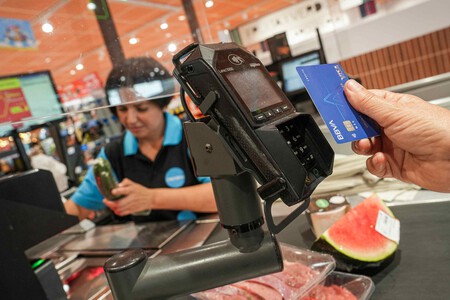
Is it so different? Although at first glance it may seem that there is no big difference between Bizum Pay and other tools widely used in Spain, such as Google Pay or Apple Pay, the new application has an important feature. Bizum Pay does not necessarily need to be linked to a physical card
Bank accounts can be used, from where instant transfers between accounts are made. Payments, the company clarifies, can be made “directly from the account or with a card.” That is, the user activates the app on the mobile phone, brings it closer to the dataphone and pays. No card. There is no telephone number, as is the case with money transfers between individuals.
Is it important? yes Among other things because this makes Bizum a potential competitor to large American multinationals such as Visa, MasterCard and American Express. All in all, and despite movements like Eroski, Caprabo or Mercadona, Bizum Pay will not have an easy time expanding.
Although the company assures that its deployment is progressing in both chains and small and medium-sized businesses, visits to shops and restaurants show that it is still far from popular options such as payment by credit card, cash or other methods based on mobile phones.
What data do we handle? yes Bank of Spain reports also show that Bizum Pay needs to enter a business niche with a very established practice. By the end of 2025, the regulator estimates that cash continues to be the main means of payment in institutions for 57% of the population, compared to 27% who use cards and 15% who use mobile phones.
Bijum also appears in statistics, but as a form of payment between individuals. In fact, it’s the favorite among under-45s and second overall to cash. Time will tell if decisions like Iroski and Caprabo allow that dominance to shift to supermarkets.
Picture | Eroski and Caprabo
In Xataka | The data suggests what seemed impossible until very recently in the supermarket business: Mercadona has reached its ceiling