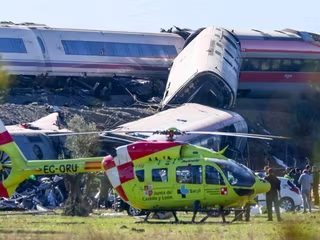
The Toledo train crash is gone At least 68 people died And More than 179 people were injured because Accident between a Renfe AVE train carrying 397 passengers and a Hitachi Erio train carrying 147 passengers. The accident happened Wednesday, October 28 at 8:54 am Between the cities of Los Yebanes and Urda in the province of Toledo.
The shock was so strong that three train cars Erio Apart from the first cars of the AVE they are completely derailed; Immediately after impact, Adif High-speed traffic between Madrid and Andalusia was suspended, and all emergency protocols were initiated.
The first estimates from the government are a “human error” That would have happened Control and Control Center (CRC) Directed by Adif. According to the information, the computer system failed and an Adif operator made a mistake when ordering the AVE to move when it was in front of a stalled Erio.
First guess
This human error would be the last stone in a series of computer errors that occurred throughout the morning.
The first would be LZB System (Linienzugbeeinflussung, “Linear Influence”)German origin. It is a system specially designed for high-speed lines Speed between 250 and 300 km/hThe braking distance of a train is so long that it is inadequate and unsafe to rely on visual observation of traditionally used fixed side signalling.
The LZB system is based on ground control facilities, a transmission cable and connection to train cabin equipment, which processes the received data and shows the driver the current speed, the permitted target speed and the distance to the next limiting speed point or stop.
If the LZB fails (something which the Minister for Transport and Sustainable Mobility, Oscar Puenteadmitted that this sometimes happens) trains are ordered to stop automatically; In case of Urda accident, up to 8 trains stopped For this reason at 8:30 am.
Then Adif Regulation and Control Center (CRC) comes into force, and the decision to resume the march is its decision which depends on the situation. According to Puente, the CRC operators decided to decelerate the trains while solving the LZB problem.

However, this in itself is not dangerous or attractive. Apart from LZB, trains are limited to what is known as ‘March in sight‘, in other words, the driver himself has to go around looking at the tracks and signs, to brake if he finds another train; Because of this, the speed in this mode is severely limited, up to 40 km/hr.
The CRC signaled the restart of the stopped trains at 8:36, but that’s when the trouble started. The situation was unusual, one of the drivers of the stopped train The operator has to be corrected that he indicated that he could start the march normally, indicating that it was only ‘in theory’ possible without the LZB; It is not clear whether the rest understood the same thing or whether they naturally obeyed the order of preaching.
Also, one train, the Erio, never really moved. For some reason unknown at the time of writing these words, Erio had not received orders to resume his march, behind which, AVE had already begun; Between 8:36 and 8:53, the AVE traveled 25 kilometers Without LZB’s help, though, it could have reached speed 200 km/hMuch more than what is allowed with ‘March in sight’.
Without LZB, train drivers mainly rely on CRC operators and constant communication via telephone, as the only method left ASFA systemWhere the safety distance between trains is defined by fixed beacons along the track that allow side traffic lights to be switched on, which can be ignored if the operator allows it, which would have happened according to the first analysis.
“The most advanced system”
Adif identified this center as the Spanish High Speed Central CRC. From its facilities, the circulation of the Madrid-Seville line, inaugurated in 1992, is managed and the necessary systems for traffic control are integrated. is in spain 20 Railway Control Centresof which Four are dedicated to high speed.
From there, technicians check on the screen what section each train is on and where it’s going, but not its exact location. With systems like LZB, all information collected from the road reaches this centre.
The basic tool is Da VinciRailway management platform for all processes, systems and users; It has an open architecture and allows its expansion and adaptation to the needs of the Spanish railway network. CRCs use DaVinci to control train traffic, from signaling to passenger information.
The DaVinci platform, introduced in 2010, represents an evolution of the multi-disciplinary integration of the railway environment towards comprehensive management of processes, systems and users by grouping all previously independent subsystems into a single system. either, “One of the most advanced rail traffic management systems in the world”, Adif explains on his website.
DaVinci is an integrative rail traffic management platform designed for New high speed lineAlthough it is also able to adapt to other types of rail traffic on conventional broad and narrow gauge lines, subways, trams etc.
Thus CRC operators have Transition priority reconfiguration is fully functional and change the time grid in case of delays and incidents, change the itinerary remotely, Passing red mark approval and establishing temporary speed limits.
Although the Spanish railway system is based on decades-old technology, it has so far run safely and accidents have occurred for other reasons, such as infrastructure failures as in the case of Adamuz or human error, as first analysis indicates may have occurred in the case of Urda.
Despite this, Óscar Puente confirmed that a replacement process for the LZB system has already begun, but not because it has become obsolete in terms of functionality, but At a technical and regulatory level; This is an old system, from 1992, associated with proprietary technology that is no longer produced.
Therefore, the ERTMS System (European Rail Traffic Management System) His successor will be. As its name suggests, it is a system that allows European interoperability, so that the same train can run on lines in different Community countries without the need to change equipment.
In addition, ERTMS is better prepared for the high-speed future, by having two layers, which allow Top speed is 300 km/hand others that allow Up to 350 km/h Without traffic lights.
However, there is currently nothing to indicate that the earlier adoption of ERTMS was sufficient to prevent Urda accidents, in particular If it is confirmed that it was caused by human error.