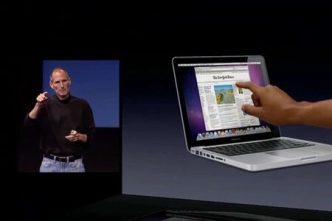
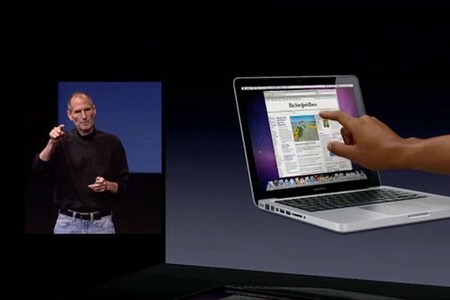
In October 2010, Steve Jobs projected an image of a hand touching a laptop screen and dismissed it. “Touch surfaces don’t want to be vertical,” he said: “After a while your arm gets tired and eventually you want to drop it.” They did a lot of testing with users and it didn’t work. In that context, three decades of MacBooks without touch screens followed.
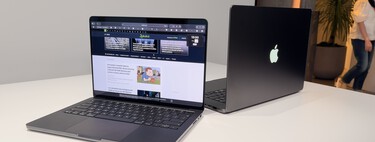
This Wednesday, John Turnus introduced a MacBook Pro with a touch screen.
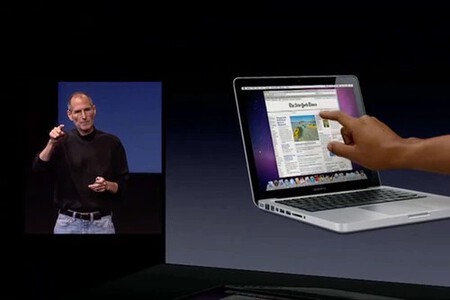
Jobs, in 2010, graphically explained why he didn’t want to see a touchpad on a Mac. Photo: Apple.
The simple thing is to read it as an amendment to Job, as a tabula rasa About the very long shadow of the founder. but What’s interesting is how Turnus justifies the change, because there’s a standard with which he’s going to run the company.probably
The principle is the same. Conclusion, the opposite. What has changed is self-explanatory: they have to reach a point where touch does not degrade the product in any way, neither in weight nor in thickness. This is only possible with OLEDs with integrated sensors. And he ends with a phrase that sums up the entire presentation: “All this and, oh, yes, it’s touching, too.” well played
Jobs framed his decisions as judgments. “It doesn’t work.” If you see one penThey are bad. Tim Cook maintained that tone in 2012, when he said that a toaster can be combined with a refrigerator, but the result will not please anyone: putting two things together forces you to compromise both.
It’s not that Turnus contradicts that idea, he just adds a proviso: If combining them doesn’t make you pay more, they come together. Touch comes to the Mac not because Apple changed its mind about ergonomics, but because it stopped “costing.” The new 14-inch MacBook Pro, in fact, weighs 220 grams less than its predecessor. A 16, about 300.
The pattern repeats itself on the iPhone Duo. Turnus said Time Since that seems to be cheaper and sloppier than the competition Tom’s Guide The decisive moment came when looking at a prototype with nanotextured glass that hid the crease. Apple wasn’t the first to create a foldable, but it waited to find a way to eliminate the flaws that raised doubts about the format.
In the same interview he was asked about the Apple Pencil on an iPhone, which apparently contradicts another of Jobs’s famous phrases (actually not because it’s different pen to control the interface rather than an optional stylus for drawing and writing). He responded that he did not see this as a rule.
And therein lies the difference. For Jobs, a “no” was a stance, a moral compass. For Turnus, a “no” is only temporary: something that cannot be done without paying a price yet. I don’t want to force a read because both products were built using Turnus hardware and two launches don’t define a phase. Jobs didn’t just make decisions by intuition, as he also mentioned some experiments with users. But the way decisions are interpreted says a lot about who makes them.
Apple of Turnus is rarely going to say that something can’t be done. All you do is wait, sometimes longer than necessary, until it “costs nothing” to do so. It’s a less epic approach and more difficult to turn into a legend, but messianism at Apple ended long ago. So the question for this stage is no longer what Apple refuses to do, but how long it is willing to wait.
Featured Image | Xataka with the Magnificent
In Xataka | The price of the new MacBook Pro with touch screen in Spain from 3,349 euros: 1,000 euros more than its “non-touch” brother