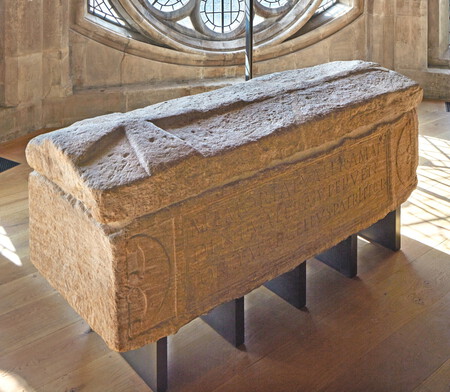
More than 3,000 people are buried in London’s famous Westminster Abbey, including kings, prominent writers such as Charles Dickens or Rudyard Kipling, and scientists such as Isaac Newton or Charles Darwin. Among these thousands of tombs is one that has puzzled experts for more than a century: a 4th-century Roman sarcophagus that for centuries contained a skeleton that did not belong to the Romans for whom it was made. Finally the mystery is solved.
discovery. British archaeologist and abbey adviser Warwick Rodwell has done extensive research and almost certainly knows who he is: an Anglo-Saxon abbot, probably Ælfwig. Indeed, Rodwell’s research narrows the possibilities down to two usurpers: Ælfwig and his successor Wulfnoth, both Abbots of Westminster.
The key to everything is radiocarbon dating: a bone sample places the person’s death between 987 and 1052 AD. C., about 700 years after its original use, confirms that the sarcophagus was reused in the late Anglo-Saxon period. As a curiosity, the piece with its Roman Latin inscription is on display in the Abbey’s Queen’s Diamond Jubilee Gallery for viewing.
Why is it important?. Because reusing a Roman sarcophagus is a very unusual practice for a medieval monastery. So much so that Rodwell notes that nothing like it has ever been found. Furthermore, this case combines two worlds into a single object: Roman London and Anglo-Saxon England, just before the Norman Conquest.
Nothing fits in this tomb. Warwick Rodwell
Nothing fits in this tomb. In 1820, some workmen accidentally found it north of the abbey and deliberately broke the lid into several pieces, as detailed in their records. However, it was officially “discovered” in 1869 during renovation work on the North Green, Northern Gardens.
Historic England collects Roman inscriptions containing: ‘In memory of Valerius Amandinus, made for Valerius Superventor and Valerius Marcellus their father’, dedicated by his children to a certain Valerius Amandinus. Something didn’t fit: the inscription refers to the time of the Roman occupation, but as the Smithsonian Magazine details, the cover had a large cross that was more in line with the early Middle Ages.
Occupying Candidates. Rodwell narrows down the candidates from the dates of the Abbots of Westminster: Wulfsige (988–993), Ælfwig (993–1020) and Wulfnoth (1020–1049). The first he rejected because he had left Westminster to become a bishop elsewhere and was probably not buried there. Ælfwig received the most votes: he was already a monk at Westminster before becoming abbot and held the post for about 27 years. Of course, the birth dates of either of the two Abbots are not known, and their inclination is based on their extensive connections with Westminster throughout their lives, not because direct evidence is lacking.
Regarding the burial, Rodwell interprets certain signs as evidence that the body was covered with lime and placed in a wooden coffin inside the sarcophagus. The sarcophagus was probably removed by Henry III in the 1240s and repositioned in the courtyard of the new sacristy around 1258. However, one question remains unanswered: Why did an 11th-century monk end up in a reused Roman sarcophagus? Rodwell suggests that there may have been a villa and its associated cemetery near the monastery which has not yet been discovered.
In Xataka | History’s first “diaspora” lived next to the Vatican: Rome had an English quarter in 950
In Xataka | We have been telling ourselves for thousands of years that “all roads lead to Rome.” The reality is that they led to Constantinople
cover The Roman Sarcophagus of Westminster Abbey and its Afterlife (Warwick Rodwell) Version with Gemini